
When I first encountered Dusk’s Segregated Byzantine Agreement (SBA) consensus, I’ll admit I didn’t give it the attention it deserved. I was too focused on the confidentiality layer, the Phoenix model, and institutional-grade privacy. But the deeper I traveled into Dusk’s documentation, the more I began to realize that none of those upper-layer guarantees would matter without a consensus model specifically engineered for predictable, deterministic, regulator-friendly settlement. That’s when SBA stopped feeling like an internal technical choice and started feeling like the hidden backbone of the entire regulated-finance vision Dusk is building. In a world where milliseconds of uncertainty can cost millions, SBA is not an optimization—it is the execution anchor.
What struck me immediately was SBA’s segregation. Unlike classical BFT systems where every node performs every task—leading to bloat, inefficiency, and performance ceilings—Dusk divides the consensus pipeline into distinct roles: provisioners, block generators, and verifiers. This division isn’t decorative. It isolates responsibilities the same way regulated workflows isolate trading desks, settlement operations, and compliance oversight. And the more I thought about it, the more I understood that Dusk’s consensus isn’t structured like a blockchain—it’s structured like a financial market infrastructure system masquerading as a blockchain.
The first turning point for me was understanding how SBA selects block generators. In most networks, leader election is noisy, unpredictable, or overly reliant on large stakes or high-performance machines. SBA instead uses Verifiable Random Functions (VRFs) combined with eligibility proofs that cannot be forged. When I internalized this, something clicked: Dusk isn’t pushing for decentralization as chaos—it’s pushing for decentralization as predictable fairness. Every participant has mathematically guaranteed chances of being selected, and no one can pre-emulate or manipulate the leader. In regulated environments, this level of determinism is priceless.
But what really impressed me was how SBA mitigates the common bottleneck of BFT protocols: communication overhead. Traditional BFT requires nodes to exchange endless messages just to confirm agreement, especially when the network grows. SBA solves this through layered committees: small, purpose-specific groups handle critical functions, while the rest of the network operates as supporting infrastructure. This ensures that block production doesn’t degrade as the ecosystem becomes more institutional. As someone who has studied settlement systems, this kind of scalability-through-role-specialization feels like the way finance has always been engineered—only now, executed cryptographically.
One of the most powerful insights came when I realized how SBA enforces secure, deterministic finality. In most chains, finality is probabilistic. You “wait six confirmations.” You “trust the chain won’t reorganize.” For crypto-native users, that might be acceptable. For institutions, it is unacceptable. SBA, combined with Dusk’s zero-knowledge transaction model, gives you deterministic finality: once the block generator commits and the committee verifies, the state is final. No rollbacks. No reorganizations. No “soft finality” illusions. For markets that settle millions in high-pressure environments, this is the difference between compliance-grade infrastructure and hobbyist experimentation.
As I studied this more, I started thinking about something that bothered me for years in blockchains: front-running, order manipulation, and mempool espionage. What shocked me was how SBA, without even branding itself as an anti-MEV solution, inherently eliminates entire categories of extractive behavior. There is no public mempool, leader selection is unpredictable, and confidential transactions hide all actionable data. Suddenly, I understood why Dusk felt “quiet” compared to other chains—it doesn’t market anti-MEV features because the consensus architecture silently removes the attack surfaces.
Another aspect that caught my attention was how SBA integrates with Dusk’s broader privacy story. It’s easy to assume privacy happens only at the transaction level. But privacy must also exist at the consensus level. If block producers could see and analyze transactions before finality, confidential execution would become meaningless. SBA, by controlling visibility and isolating roles, ensures that no single participant sees enough information to violate confidentiality. Consensus itself becomes privacy-preserving. And this was the moment I realized how deeply intentional Dusk’s architecture really is.
I kept returning to the question of regulatory alignment. Why would regulators trust a blockchain that behaves like a chaotic, probabilistic system? They wouldn’t. And that’s why SBA’s deterministic finality matters so much. It mirrors traditional settlement cycles where finality is absolute, not probabilistic. It mirrors the architecture of clearinghouses rather than casinos. It mirrors the institutional need for predictable outcomes, not unpredictable markets. For the first time, I saw a blockchain not trying to imitate traditional finance while breaking its rules, but actually respecting the structural constraints of traditional finance while upgrading them with cryptography.
Another detail I appreciated is how SBA reduces the operational burden on validators. Most consensus mechanisms require participants to be “always on,” consuming resources, handling every step of the pipeline, and processing information they do not need. SBA liberates them from this inefficiency. Nodes perform the tasks they are best suited for, which leads to more sustainable operations. And in a network aspiring to attract regulated institutions as participants, cost-efficient node operations are not just technical—they’re strategic.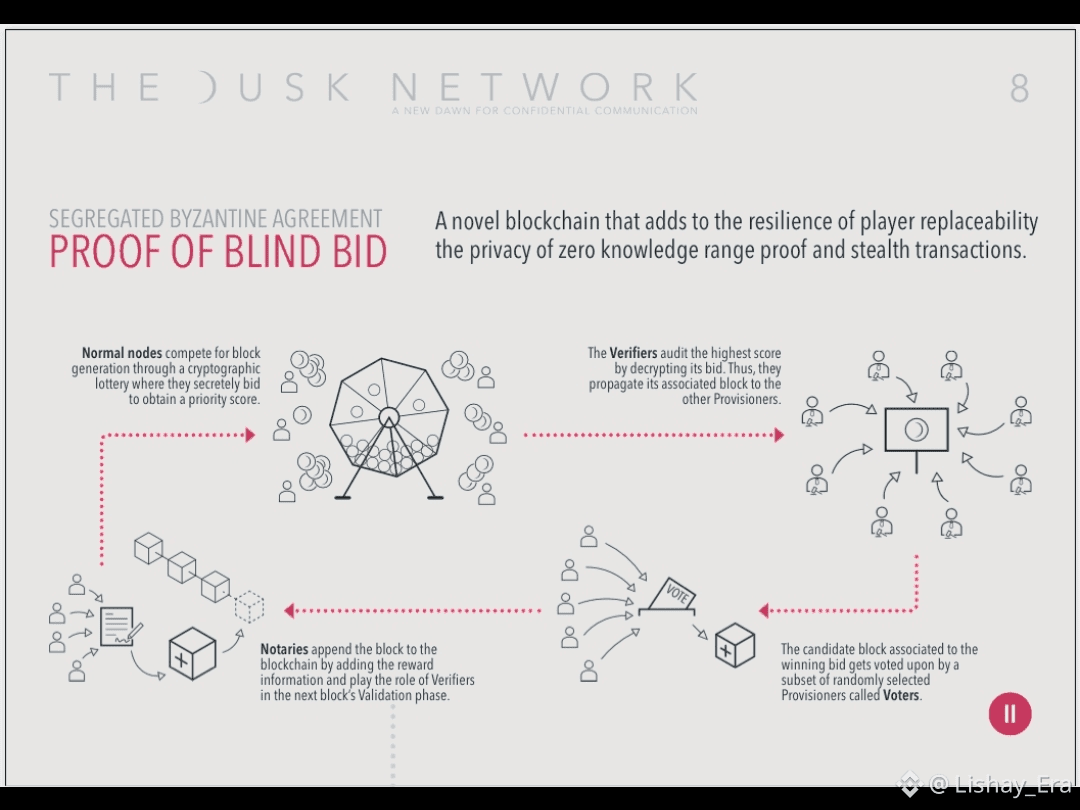
One of the most personal realizations I had came when thinking about failure modes. In almost every blockchain, high-stress environments—network congestion, sudden spikes, contentious blocks—produce chaos. In SBA, the segregated roles absorb shock. Even if one group encounters temporary difficulty, others can maintain forward progress. This resilience reminded me of redundancy in financial infrastructure: multiple clearing rails, settlement fallback procedures, and disaster recovery layers. Dusk’s consensus is built with that same mindset—not for hype cycles, but for durability.
But what stays with me most is how SBA changes the way I think about trust minimization. In many blockchains, “trustless” means exposing everything to everyone. In Dusk, trustlessness means making sure no single actor can compromise confidentiality, execution ordering, or settlement correctness. SBA ensures that no participant sees more than they are supposed to, and yet the system still produces verifiable proofs of correctness. Suddenly, trust minimization becomes compatible with secrecy—a paradox that Dusk resolves with elegance.
The more I reflect on SBA, the more I see it as Dusk’s quiet superpower. Phoenix gets the headlines. Citadel gets the regulatory attention. EVM compatibility gets the developer interest. But SBA is the reason all of those layers can function in a regulated, confidential, fair, and deterministic environment. Without SBA, Dusk would be a privacy chain pretending to be institutional. With SBA, it becomes a settlement-grade infrastructure that institutions can genuinely adopt.
What makes SBA feel so special to me is that it doesn’t scream for attention. It doesn’t market itself aggressively. It simply exists as the silent architecture enabling everything else. And the more I studied it, the more I respected the engineering discipline behind it. This is consensus built not for speculation but for longevity. Not for hype but for compliance-aligned execution. Not for retail frenzy but for institutional trust.
So when I say SBA made me rethink finality, I mean it genuinely changed the way I view the foundations of regulated DeFi. It made me realize that finality is not a confirmation. It is a guarantee. It is not a social assumption. It is a cryptographic truth. And Dusk, through SBA, delivers that truth with a level of precision that I have rarely seen in blockchain architecture. For me, that’s the moment Dusk stopped being “another privacy chain” and became the first chain whose consensus feels engineered for regulated markets from the ground up.
