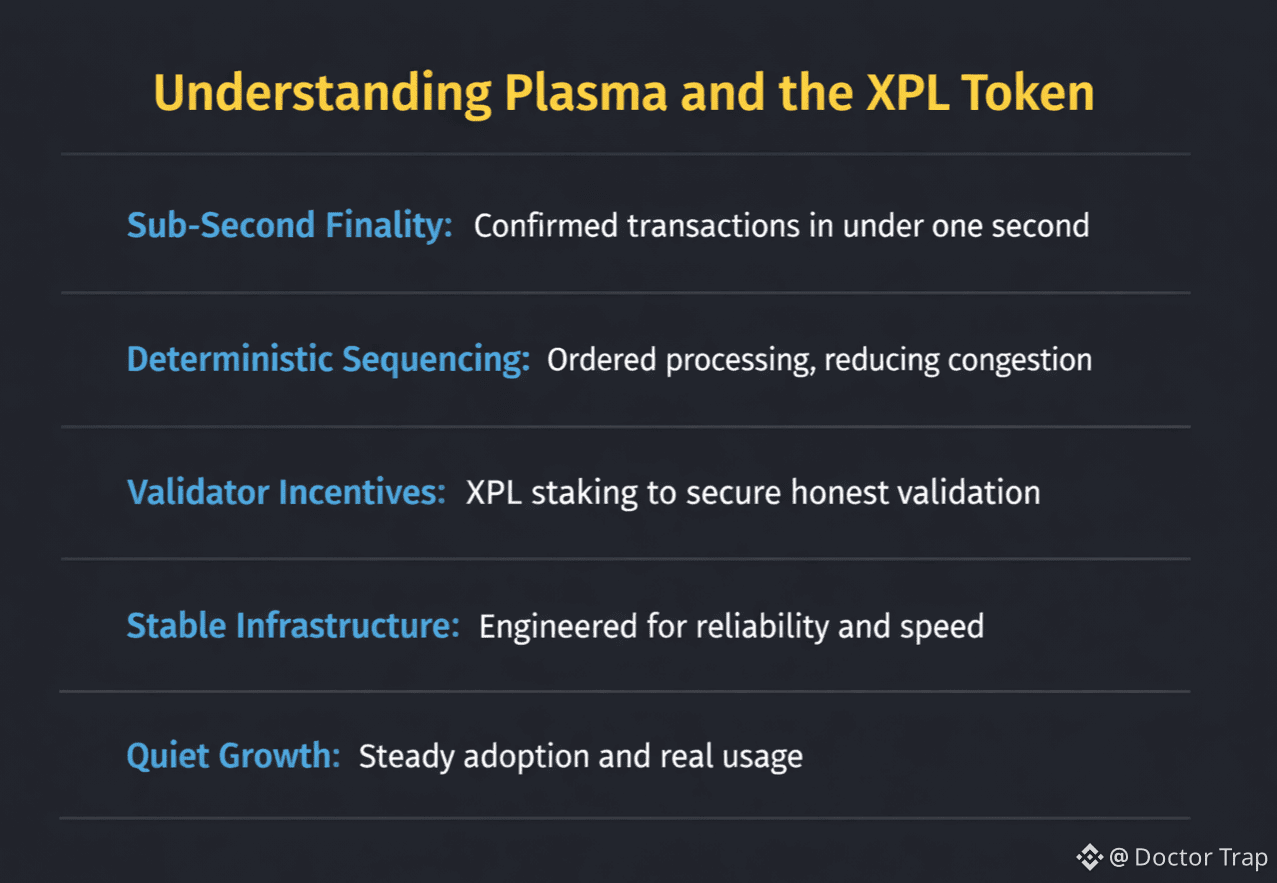
The first time I stopped chasing throughput charts and started reading commit logs again. That shift usually happens after a few cycles of wins and losses, when the excitement fades and only engineering remains. When I dig into Plasma and the XPL token, that same old feeling comes back. It is not loud. It is not trying to impress anyone. It feels like something quietly built under the surface, with patience instead of urgency.
Sub second finality is often marketed like magic, but when I trace it back line by line, it usually comes down to discipline. Plasma caught my attention because it did not talk first. It built first. From my vantage point, Plasma’s approach to finality is rooted in reducing uncertainty rather than accelerating everything blindly. The XPL token lives inside this logic, not as a distraction, but as a coordination layer that aligns validators, sequencers, and users. I remember thinking, this feels familiar, like systems I worked on long before anyone cared about block times.
Finality is not about speed alone. It is about confidence. When I dig into Plasma’s consensus flow, I see a design that minimizes rollback risk by structuring confirmations in tight, predictable windows. Transactions settle fast because the network does less guessing. To me, sub second finality here feels earned, not forced.
XPL plays a quiet role in this, incentivizing honest behavior at the validator level. I’ve watched networks fail by overpromising finality, Plasma seems to prefer depth over breadth.
I keep coming back to the sequencing layer because that is where Plasma quietly builds its edge. Instead of broadcasting chaos, Plasma sequences transactions deterministically, reducing contention before it even reaches consensus. When I noticed how this sequencing ties back to XPL staking and participation, it clicked. The token is not decorative. It is infrastructure first. Validators who commit XPL are economically tied to the quality of ordering, which keeps latency low without cutting corners.
This is the kind of design that only shows up when builders have been burned before.
Earlier chains chase raw throughput, only to collapse under their own complexity. Plasma feels like it learned from that era. Sub second finality here is a side effect of simplicity, not excess.
XPL acts as a pressure valve, aligning incentives so that the network does not need constant governance drama. I’ve noticed how upgrades roll out quietly, with minimal disruption. That tells me the team values stability more than headlines.
While digging through on-chain data, I noticed Plasma’s total value locked moving steadily, not explosively, just consistent growth. That usually means real usage. Transaction confirmation times stay tight even during activity spikes, which tells me the finality model is holding. XPL participation metrics show long term holders rather than fast churn. I’ve seen enough chains to know that this pattern matters more than any announcement. Quiet adoption is often the most honest signal.
Sub second finality is about human behavior. When confirmation feels instant, developers design differently. Users trust differently.
Plasma enables this without asking the network to take reckless risks. XPL underpins this trust loop by rewarding patience and long term alignment. I remember building systems where milliseconds changed user psychology. Plasma seems to understand that subtlety. It is not loud about it, but the design reflects it.
I’ve noticed Plasma avoids grand narratives. That restraint shows in the way finality is engineered.
The network does not rely on complex fallback mechanisms that only work on paper. Instead, it leans on predictable validator behavior, backed by XPL economics. In my experience, this is how infrastructure survives bear markets. Quietly building, under the surface, with no rush to explain itself to everyone.
When I step back, XPL feels less like a speculative asset and more like a system component. It secures sequencing, finality, and governance without demanding attention. I’ve watched tokens fail when they tried to do too much. Plasma keeps XPL focused. That focus supports sub second finality by keeping incentives clean. No excess, no noise.
Many networks promise speed, and I’ve seen most of them slow down when reality arrived. Plasma gives me a different impression. It feels like something designed by people who expect stress and plan for it. XPL exists to support that expectation, not to distract from it. I rarely talk about price, and even here I hesitate. Markets will do what they do. What stays is infrastructure, and Plasma seems intent on quietly becoming part of that foundation.