
Walrus didn’t make a loud promise when I first came across it. If anything, I expected another smart idea weighed down by assumptions that have slowed decentralized storage for years. Web3 has never lacked ambition, but it has often lacked durability. Systems look impressive in demos but falter when faced with real usage. Storage, in particular, is where this gap becomes painfully clear. Privacy breaks down under traffic. Costs balloon unpredictably. Centralized shortcuts creep back in quietly.
What changed my skepticism about Walrus wasn’t a bold claim or an eye-catching roadmap. It was the quiet confidence in its design. Walrus doesn’t chase an idealized future. It starts from the present, accepting the realities of technology and human behavior, and builds around them. That grounded approach is rare, and it immediately feels different.

At its core, Walrus acknowledges a truth many in Web3 still resist: blockchains are incredible coordination engines, but they are not efficient places to store massive amounts of data. Instead of trying to force a square peg into a round hole, Walrus builds a storage layer that works alongside the blockchain. Large files are broken into pieces using erasure coding and spread across a decentralized network so that no single node holds everything. Only some fragments are needed to reconstruct the data, keeping redundancy manageable while ensuring availability and censorship resistance. It’s not flashy it’s practical, and it behaves predictably once actually used.
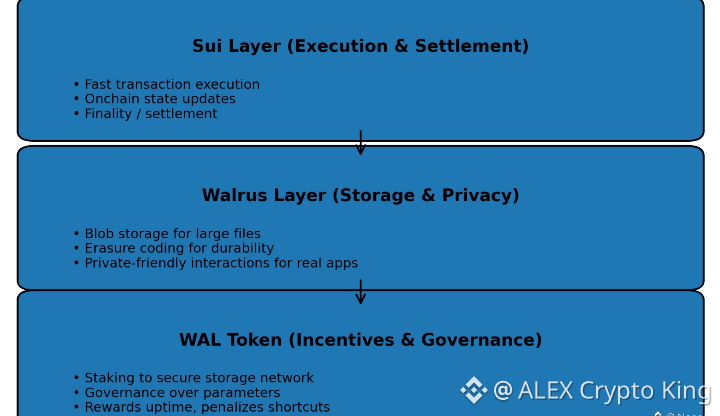
What sets Walrus apart is the clarity of its goals. It isn’t trying to be every cloud provider or a universal data layer. Its mission is precise: provide decentralized, privacy-preserving storage and predictable network behavior under real-world conditions. WAL, the native token, is a tool, not a product. It secures the network, aligns participation over time, and supports private interactions, decentralized apps, governance, and staking but nothing is inflated beyond its purpose. Privacy isn’t marketed as a feature; it emerges naturally from design. Efficiency isn’t measured by peak numbers in a lab, but by how calmly the system handles growing demand.
Using Walrus feels like stepping into a system built for people who have already been burned by Web3. Storage costs are treated as constraints, not footnotes. Failures are expected and planned for. By building on the Sui blockchain, Walrus benefits from an execution environment designed for high throughput and object-based data handling, which complements its blob storage perfectly. Everything about the system feels legible. When developers and organizations can understand how it works, they’re far more likely to trust it.
Walrus is informed by the failures of its predecessors. Decentralized storage projects often stumbled not because the ideas were weak, but because they assumed too much patience. Incentives worked until markets shifted. Complexity piled up until only a few operators could keep the network alive, quietly recreating centralization. Governance promised flexibility but delivered stagnation. Walrus doesn’t chase maximal decentralization if it compromises reliability. It doesn’t assume participants will act perfectly forever. Instead, it aims for balance enough decentralization to matter, enough efficiency to remain usable, and enough simplicity to evolve without constant redesign. That balance is difficult, and rarely celebrated, but it is where lasting infrastructure lands.
Looking forward, the questions around Walrus are refreshingly realistic. Can the network sustain healthy decentralized participation as storage demand grows steadily, rather than explosively? Will governance through WAL stay thoughtful as stakeholders’ incentives diverge? How will the system behave after years of quiet, unremarkable use, when the novelty has faded and only reliability matters? These are the questions that determine whether infrastructure becomes foundational or forgotten. Walrus doesn’t pretend to have all the answers, but its architecture feels flexible enough to adapt without abandoning its core principles.
The timing of this approach feels perfect. Web3 is moving past its most maximalist phase. The belief that everything must be on-chain is fading. Modular architectures are becoming normal. Builders and enterprises are increasingly prioritizing predictable costs, privacy, and operational clarity over ideology. Early signs around Walrus careful experimentation, integrations driven by necessity, a focus on reducing risk show that this grounded positioning resonates. Adoption is quiet but deliberate, and deliberate adoption is usually what lasts.
In the end, Walrus may never dominate headlines or fuel speculative hype around WAL. And that may be its greatest strength. Infrastructure doesn’t earn its place by being flashy. It earns it by continuing to work long after the excitement fades. If Walrus can maintain its focus on constraints, simplicity, and practical design, it could quietly become a backbone of Web3. Not celebrated. Not hyped. Just relied upon. In an ecosystem still learning to build things that endure, that quiet dependability might be the most important progress of all.


