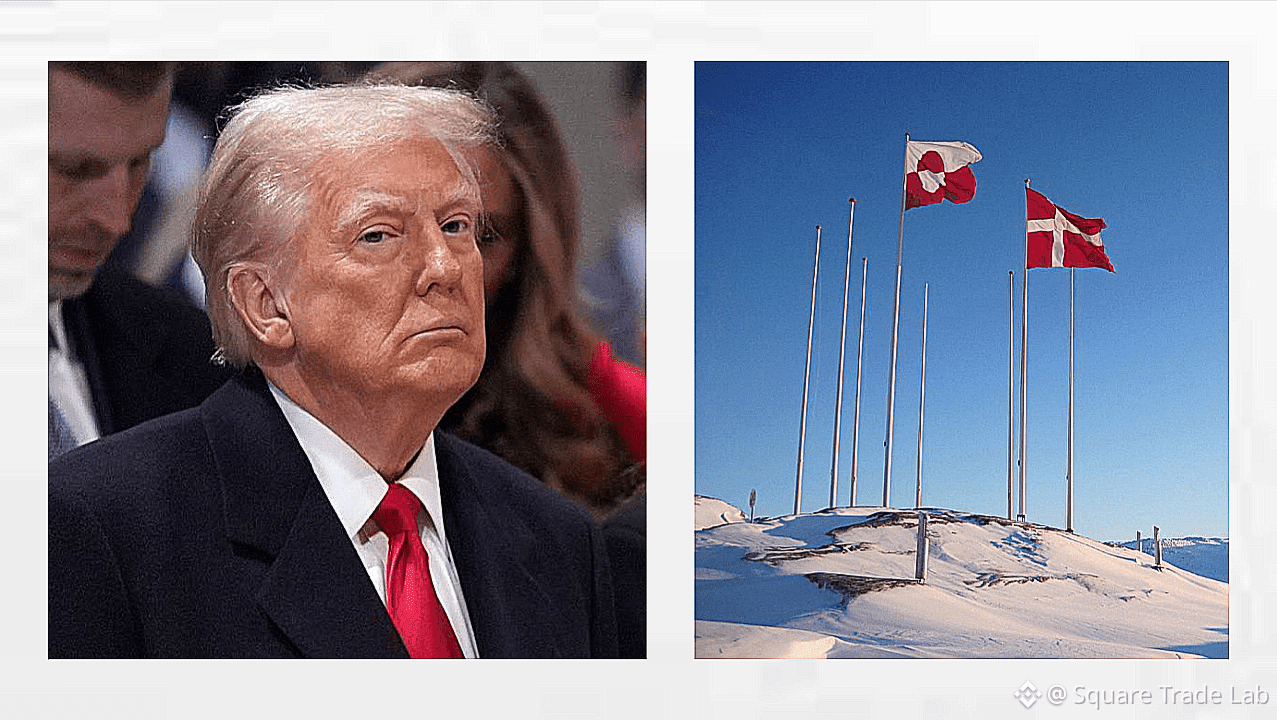
💥 BREAKING: White House Says Denmark Cannot Defend or Control Greenland
The White House has delivered a shockwave across global geopolitics by stating that Denmark lacks the capacity to defend or effectively control Greenland.
This is not a casual diplomatic comment — it is a strategic declaration that repositions Greenland as a critical security asset rather than a passive autonomous territory.
This single statement changes the rules of the game in the Arctic.
🌍 Greenland Has Entered the Global Power Chessboard
Greenland is no longer viewed as a distant icy landmass. It is now one of the most strategically valuable regions on Earth due to four irreversible trends:
Arctic militarization is accelerating
Global powers are racing for rare earth dominance
Climate change is unlocking new shipping routes
Missile defense and space surveillance depend on Arctic positioning
Greenland sits at the intersection of all four.
🇺🇸 Why the United States Is Speaking So Directly
The U.S. is signaling urgency because time is no longer neutral.
Russia has expanded Arctic bases, radar systems, and hypersonic coverage
China is embedding itself economically as a “near-Arctic stakeholder”
NATO defenses in the far north remain fragmented
Denmark lacks the force projection needed for 21st-century Arctic threats
By publicly stating Denmark cannot defend Greenland, the U.S. is reframing responsibility.
This is a warning — and an invitation.
🇩🇰 Denmark’s Control Is Legal, Not Strategic
On paper, Greenland is part of the Kingdom of Denmark.
In reality:
Denmark does not possess sufficient Arctic naval power
Air response times are slow and infrastructure is limited
Surveillance depends heavily on U.S. systems
Greenland’s local government increasingly favors autonomy
The White House is effectively acknowledging that real control equals security capability, not legal ownership.
❄️ Greenland Is the Backbone of Western Defense
Greenland hosts:
Early-warning missile detection systems
Critical space and satellite monitoring infrastructure
Strategic airfields connecting North America and Europe
If Greenland were compromised, NATO’s northern defense shield would fracture.
That risk is no longer hypothetical.
🧨 What This Means for Global Markets
Geopolitical shifts at this scale ripple directly into financial systems:
Defense spending accelerates
Commodity and rare earth prices rise
Energy routes are repriced
Sovereign risk models change
Hard assets outperform fiat-dependent instruments
Historically, moments like this drive capital toward scarce, neutral, borderless assets.
📈 Why Crypto Benefits From This Shift
When geopolitical uncertainty rises:
Trust in centralized systems weakens
Governments expand strategic reserves
Neutral settlement layers gain relevance
Investors hedge against currency and policy risk
Bitcoin and major crypto assets thrive in environments where power blocs compete and monetary neutrality matters.
Greenland’s situation reinforces the broader macro thesis:
The world is fragmenting — and digital scarcity becomes more valuable.
🔥 Big Picture Takeaway
This is not about Denmark alone.
This is about:
Arctic dominance
Global security realignment
Strategic resources
Monetary hedging
The future balance of power
The White House just pulled Greenland into the center of global strategy.
Markets are watching. Governments are recalculating.
And capital is already positioning.
Coin