


hello my dear cryptopm binance square family, today in this article we will talk about Dusk Network
In real finance, privacy is not a preference. It is a boundary.
When brokers protect client positions or institutions conceal deal terms, they are not being secretive for fun. They are preventing front-running, coercion, reputational damage, and the slow erosion of trust that happens when too many strangers are allowed to stare at sensitive information. This is the reality Dusk Network operates in. Not the ideological version of privacy. The practical one.
Dusk is built on a simple but uncomfortable idea for crypto: markets can be verifiable without being naked, and accountability does not require humiliation.

Regulated Is a Constraint, Not a Target Audience
Most projects treat “regulated” as a future marketing segment. Dusk treats it as a design constraint.
You see this immediately in how it handled mainnet. There was no theatrical switch-flip moment. No surprise launch followed by damage control. The rollout was staged, explicit, and operational: stake onboarding, genesis preparation, controlled migration, and finally the production of the first immutable block. That sequence reads like a system designed to be audited by time itself, not applauded by a timeline.
This matters because the audience Dusk is aiming for does not tolerate improvisation. Institutions do not trust vibes. They trust processes that behave predictably when nobody is watching.
What People Actually Fear About Transparency
Most people don’t fear transparency as an idea. They fear what transparency does to them when conditions turn hostile.
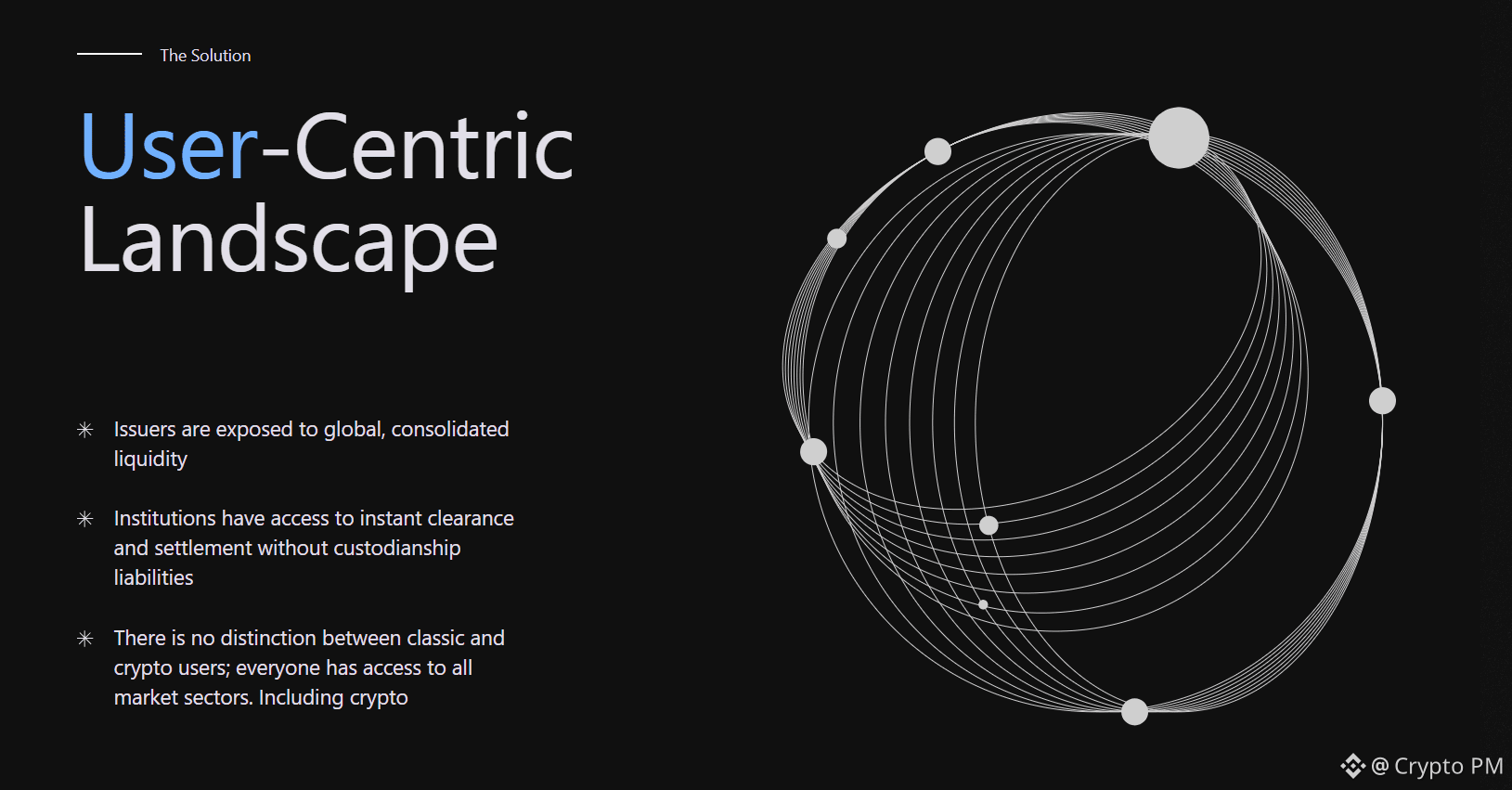
A fully public ledger turns normal business behavior into strategic vulnerability. Inventory becomes visible. Intent becomes inferable. Counterparties become targets. Dusk’s bet is that you can prove a market followed the rules without forcing every participant to expose their identity, balances, strategies, or weaknesses.
This is where zero-knowledge proofs stop being a cryptography flex and become social infrastructure. They allow a system to say “this is legitimate” without turning legitimacy into exposure.
Privacy Only Works If the Engineering Is Real
None of this works if privacy is expensive, slow, or brittle.
Dusk has kept its proving system public, Rust-native, and focused on efficiency for a reason. In real markets, the cost of proving is the cost of dignity. If proofs are too slow, users abandon privacy. If they’re too expensive, only large players can afford it. If they break under edge cases, compliance teams lose trust instantly.
Privacy that fails under pressure is worse than no privacy at all.
Incentives Decide Whether Systems Survive Fear
Finance is not ideology. It is incentives disguised as routine.
That’s why the DUSK token matters beyond price action. The supply model is explicit and long-horizon: 500 million initial supply, another 500 million emitted gradually over decades, capped at one billion. This isn’t designed for explosive short-term speculation. It’s designed to reward participation, validation, and security over time.
The staking threshold reinforces the same message: participation should be reachable, but not weightless. Systems that are too easy to abuse usually are.
Accepting That Adoption Is Messy
Dusk does not pretend everyone will live inside its walls forever.
The two-way bridge work wasn’t about “expanding reach.” It was an admission that liquidity has habits, and adoption is never clean. Letting value move out and back while preserving a single source of truth is not flashy, but it’s essential. Trust quietly dies at handoffs, and Dusk is clearly trying to reduce those fracture points.
This realism shows up again in how Dusk approaches execution-layer privacy: encrypted computation combined with zero-knowledge proofs, allowing balances and activity to remain hidden while correctness stays provable and auditable when required. Not invisibility. Controlled visibility.
That distinction is everything in regulated finance.
Regulated Counterparties Force Systems to Grow Up
You cannot claim to be built for regulated markets and avoid regulated partners.
Dusk’s collaboration with 21X under the EU DLT Pilot Regime matters because it exists inside real oversight, not theoretical compliance. When a licensed venue integrates with you, your privacy model has to survive governance, supervision, disputes, and delayed scrutiny. There is no “just trust us” escape hatch.
The same logic applies to work with NPEX and the use of Chainlink standards. Disputes in finance usually start as disagreements about data: which price was official, what was known, and when. Standardized data and settlement rails reduce the places where ambiguity can later turn into blame.
The Token as a Social Signal
When DUSK became available on Binance US, it wasn’t proof of technology. It was proof of accessibility.
Listings change the emotional temperature of a market. Liquidity deepens. Participation broadens. Volatility moves from a private room into a public square. For a project aiming at institutional relevance, that shift matters more than short-term price candles.
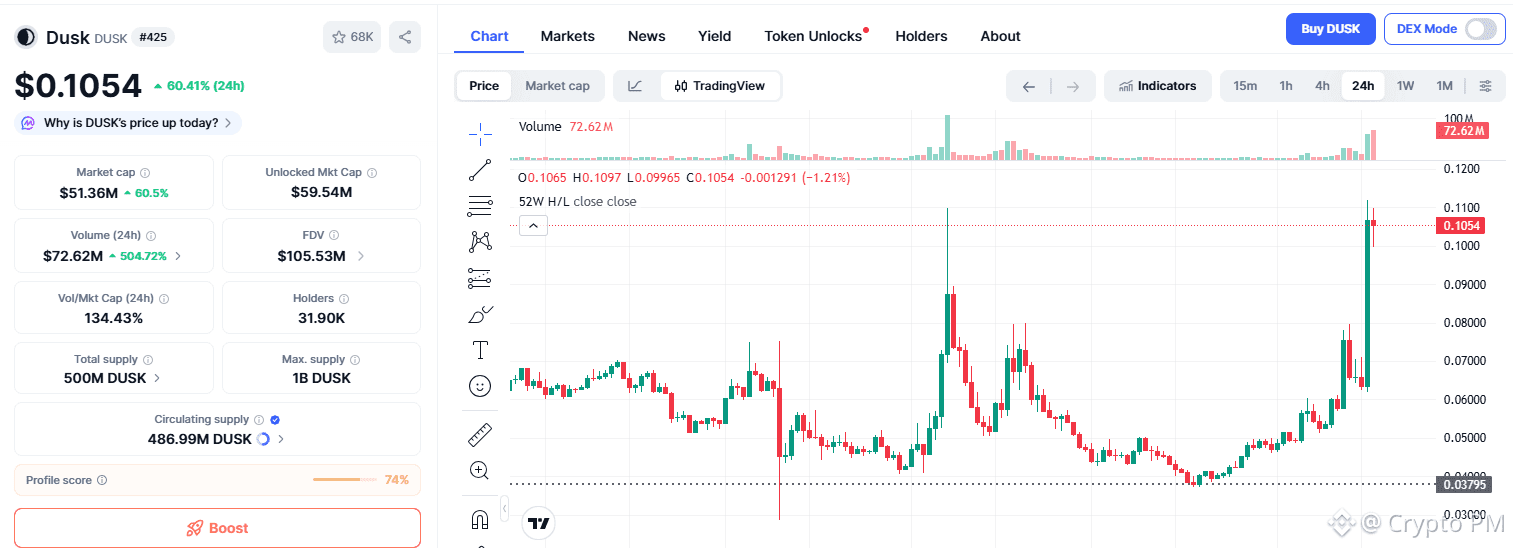
As of January 16, 2026, roughly 487 million DUSK are circulating against a one billion maximum supply. That gap is not just tokenomics. It’s an incentive horizon. A statement that this system is meant to exist long enough for patience to matter.
Designing for the Moment Trust Is Tested
The hardest part of building privacy for regulated finance is accepting that failure is not an edge case. It’s a season.
People make mistakes. Markets panic. Regulators arrive late with hard questions. Auditors demand proofs that don’t rely on goodwill. Dusk’s recent trajectory—architectural refinement, bridging, regulated partnerships, execution-layer privacy—looks like a project designing for those moments, not just for calm conditions.
MY Thought
Dusk’s most interesting claim is also its quietest.
That the future of on-chain finance will not be won by attention, but by restraint. By systems that can carry sensitive value without turning participants into targets. By infrastructure that proves correctness without demanding confession. By incentives that reward honesty over time, not excitement in the moment.
Quiet responsibility is not cinematic.
But it is what real markets run on.