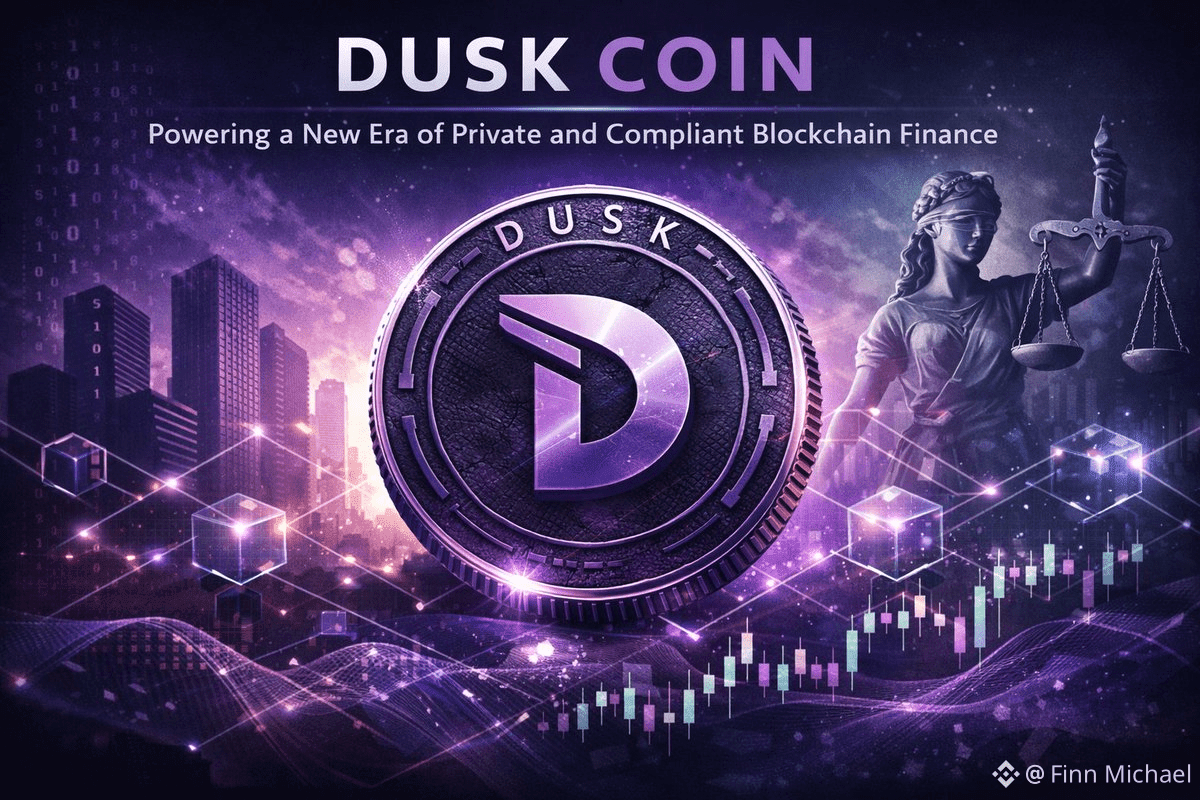
In 2018, while much of the blockchain world was busy chasing speed, hype, and speculation, a quieter question lingered beneath the noise. A question most people avoided because it was uncomfortable, complex, and deeply human.
What happens when blockchain grows up?
What happens when real money, real institutions, real people, and real laws enter the picture?
Finance is not a game. It carries pensions, livelihoods, futures, and dreams. It carries responsibility. And yet, most blockchains were built as if none of that mattered. Radical transparency exposed everything. Regulation was dismissed as an obstacle. Privacy was treated as optional.
Dusk was born from the realization that this path could never lead to mass adoption. That if blockchain truly wanted to change the world, it had to stop pretending the real world did not exist.
From its earliest days, Dusk set out to solve a problem that sat at the heart of modern finance. How do you build a system that is open and decentralized, yet private and compliant? How do you protect individuals without hiding wrongdoing? How do you give institutions the tools to innovate without forcing them to break the law?
These questions are not technical curiosities. They are emotional questions. They touch trust. Fear. Responsibility. And hope.
Privacy, in traditional finance, is not about secrecy. It is about dignity. Your salary is not public. Your investments are not broadcast to strangers. Your financial life is yours. Yet most blockchains stripped that dignity away in the name of transparency.
Dusk chose a different path.
Instead of exposing everything by default, Dusk was built with privacy woven into its foundation. Using advanced cryptography, the network can prove that transactions are valid without revealing sensitive information. Ownership can be verified without identity being exposed. Rules can be enforced without private data being laid bare.
This is not about hiding. It is about protecting what deserves protection.
At the same time, Dusk does not turn its back on oversight. Compliance is not an afterthought bolted onto the system later. It is built directly into the protocol. Regulatory requirements are treated not as enemies of innovation, but as constraints that force better design.
This matters because real finance does not operate in a vacuum. It exists within legal frameworks designed to protect investors, prevent abuse, and maintain stability. For institutions, ignoring these frameworks is not rebellion. It is negligence.
Dusk understands that trust is earned not just through code, but through accountability.
This balance becomes especially powerful when applied to real-world assets. Stocks, bonds, financial instruments, and regulated securities are not abstract concepts. They represent businesses, governments, and people. Tokenizing them without privacy or compliance would be reckless.
On Dusk, these assets can exist on chain without losing their legal meaning. They can be transferred, settled, and managed efficiently, while still respecting the rules that govern them in the physical world. For institutions, this opens the door to blockchain without forcing a leap into the unknown. For individuals, it opens access to financial systems that were once closed, slow, or unreachable.
Under the surface, Dusk’s architecture reflects this same philosophy of maturity. The network is modular, flexible, and designed to evolve without breaking its core principles. It does not chase trends. It prepares for longevity. It assumes that finance will continue to change, and builds accordingly.
What makes this story powerful is not just the technology. It is the restraint behind it.
Dusk did not promise instant revolutions. It did not market shortcuts. It chose the harder road. The road that requires patience, dialogue with regulators, collaboration with institutions, and a deep respect for how finance actually works.
That kind of discipline is rare. And it is deeply human.
Because at its core, Dusk is not about machines trusting machines. It is about people trusting systems again. About knowing that your data is safe. That your assets are protected. That innovation does not come at the cost of responsibility.
In a world where technology often moves faster than our ability to control it, Dusk stands as a reminder that progress does not have to be reckless. That decentralization does not have to be chaotic. That privacy and transparency can exist together, if we are willing to design for both.
The future of finance will not belong to systems that shout the loudest. It will belong to systems that quietly work, reliably, ethically, and at scale.
Dusk is not trying to tear finance down.
It is trying to rebuild it, carefully, thoughtfully, and with the understanding that behind every transaction is a human life.
And that may be its most powerful feature of all.