

Plasma is no longer just a scaling concept—it has matured into a living, breathing Layer 2 engine that reshapes how Ethereum handles speed, cost, and trust. Built as an extension rather than an escape from Ethereum, Plasma moves the bulk of activity off-chain while anchoring truth back to the mainnet. The result is a system that feels instantaneous to users yet remains uncompromising in security. By early 2026, Plasma has evolved into critical infrastructure for decentralized finance, on-chain gaming, and high-velocity applications that demand performance without surrendering decentralization.
At its core, Plasma answers a question Ethereum has wrestled with for years: how to scale without fragility. Instead of bloating the base layer, Plasma distributes computation across specialized child chains, each optimized for distinct economic behavior. Ethereum becomes the court of final appeal, not the execution bottleneck. This architectural humility—doing less on Layer 1 but doing it perfectly—has become Plasma’s defining strength.
Architecture Designed for Scale, Not Compromise
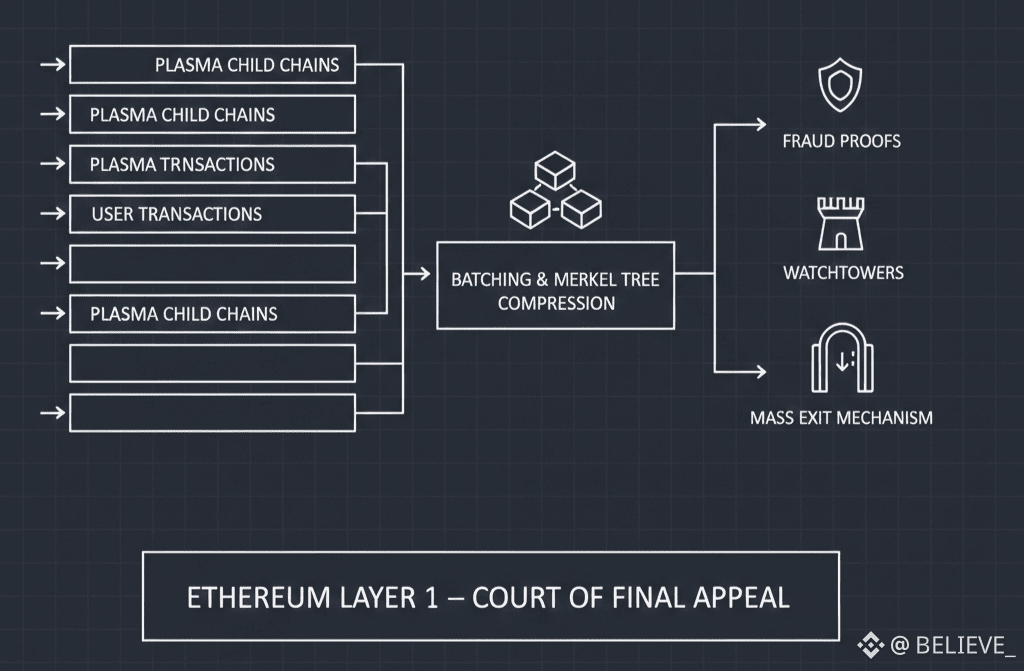
Plasma’s structure resembles a constellation rather than a monolith. Independent child chains operate in parallel, processing transactions with their own logic and cadence. Once batched, these transactions are distilled into cryptographic commitments and submitted to Ethereum, where finality and security are enforced with precision.
The system is guarded by fraud proofs, which act as economic tripwires. If a chain operator attempts misconduct, users or decentralized watchtowers can challenge the claim, forcing transparency or triggering penalties. This threat alone keeps behavior honest, while mass-exit mechanisms ensure users can always reclaim funds—even under hostile conditions.
Exit periods remain deliberately conservative, favoring security over haste, but real-world usage has prompted adaptive optimizations. In calm network conditions, exits accelerate. In turbulent moments, the protocol slows down, prioritizing safety. This elasticity reflects Plasma’s maturity: it no longer assumes perfect conditions—it plans for chaos.
For developers, compatibility matters. Plasma preserves EVM alignment, allowing existing Solidity applications to migrate with minimal friction. This has unlocked a wave of experimentation, where teams deploy high-throughput applications without rewriting their entire codebase or exposing users to experimental security models.
Nexus: The Upgrade That Changed the Trajectory
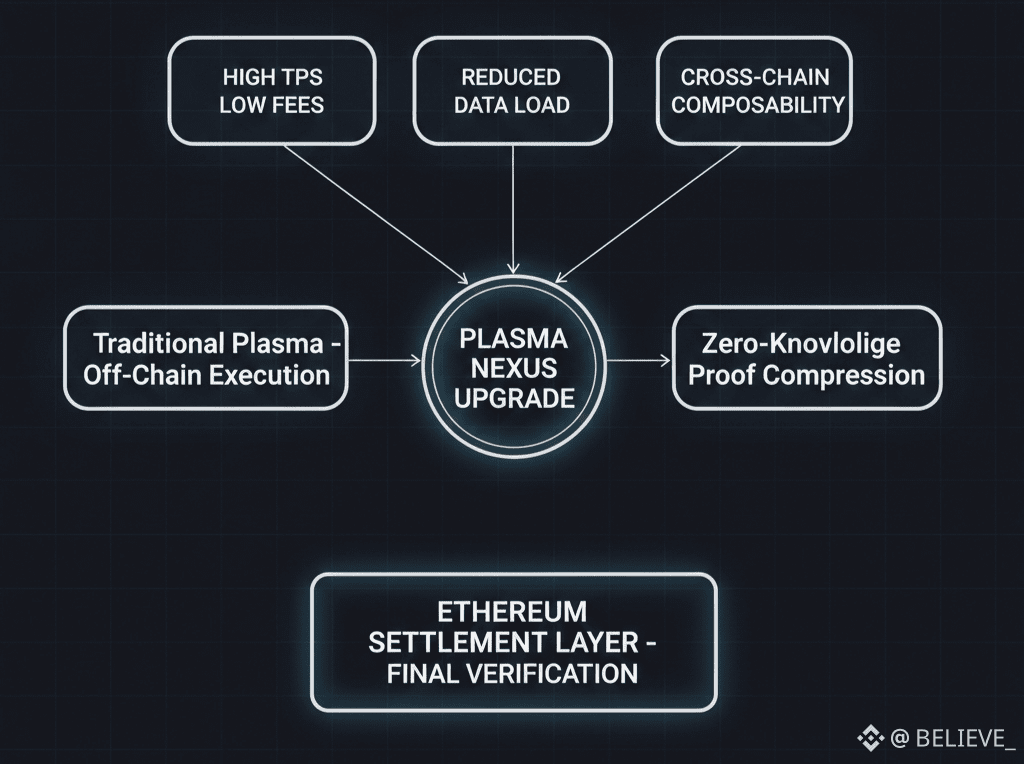
Late 2025 marked a turning point with the introduction of Plasma Nexus. This upgrade fused traditional Plasma mechanics with zero-knowledge proofs, combining parallel execution with cryptographic compression. The impact was immediate. Throughput surged into six-figure transactions per second in controlled environments, while verification costs plummeted.
Zero-knowledge proofs reduced the data footprint dramatically, easing Ethereum’s load and slashing fees across the ecosystem. More importantly, Nexus unified two previously divergent scaling philosophies—Plasma’s off-chain execution and rollups’ succinct verification—into a single, coherent system.
This hybrid approach attracted developers who wanted flexibility without fragmentation. Cross-chain composability improved, bridges became faster and safer, and liquidity began to move freely between Plasma and adjacent ecosystems. The result was a noticeable rise in total value locked, driven not by speculation, but by genuine utility.
Governance evolved alongside technology. Token staking secured the network while distributing rewards, and quadratic voting diluted the influence of large holders, giving smaller participants real voice. Protocol fees began feeding scheduled token burns, introducing deflationary pressure that aligned long-term incentives with network health.
Performance Proven in the Wild
Plasma’s claims are no longer theoretical. In live environments, transaction costs routinely fall to fractions of a cent—even during demand spikes. This economic efficiency enables use cases that were once impractical: high-frequency trading strategies, social micro-transactions, real-time gaming economies, and continuous settlement systems.
Scalability is additive rather than congestive. New child chains absorb sector-specific surges without degrading the rest of the network. Gaming chains handle NFT mint storms. DeFi chains endure arbitrage bots and liquidation cascades. Each operates independently, yet all settle back to Ethereum’s security umbrella.
Governance parameters adapt dynamically. Challenge windows, fee structures, and validator incentives adjust based on on-chain telemetry. Diagnostic tools monitor transaction patterns much like spectral analysis, detecting anomalies before they escalate. This proactive resilience has become a quiet but powerful differentiator.
Energy efficiency further strengthens Plasma’s appeal. By minimizing redundant computation and optimizing consensus roles, the network consumes significantly less energy than monolithic alternatives—an increasingly important factor for enterprise adoption.
Engineering Beneath the Surface
Underneath the user-facing simplicity lies precise engineering. Merkle trees compress vast state transitions into elegant proofs. Decentralized watchtower networks eliminate single points of failure. Operator stakes scale with the value they secure, aligning incentives through economic gravity rather than trust.
Recent innovations have focused on usability. Complex exit procedures are now abstracted behind automated flows, protecting users who may never want to understand the underlying mechanics. Interoperability has improved through atomic swap frameworks, reducing reliance on trusted bridges and lowering systemic risk.
Treasury governance channels protocol revenue into ecosystem development, funding public infrastructure and tooling through transparent voting. Data availability responsibilities rotate among validators, strengthening censorship resistance and reducing reliance on centralized sequencers.
The Road Ahead
Looking toward mid-2026, Plasma’s ambitions extend beyond crypto-native applications. Cross-border payments are emerging as a major frontier, where speed and cost efficiency directly challenge legacy financial rails. Gaming ecosystems are scaling into persistent worlds with real asset ownership and instant settlement. Developer SDKs with no-code primitives are lowering barriers, inviting builders who previously lacked blockchain expertise.
Regulatory integration is also advancing. Compliance-aware bridges aim to welcome institutional capital without compromising decentralization. Incentive programs and token economics continue to evolve, reinforcing long-term sustainability rather than short-lived hype.
Plasma is no longer just a scaling solution—it is becoming the connective tissue of a scalable Web3. By blending speed, security, and adaptability, it offers a vision where blockchains feel invisible to users yet uncompromising in integrity. In that sense, Plasma doesn’t merely extend Ethereum’s reach. It redefines what decentralized infrastructure can realistically achieve.


