
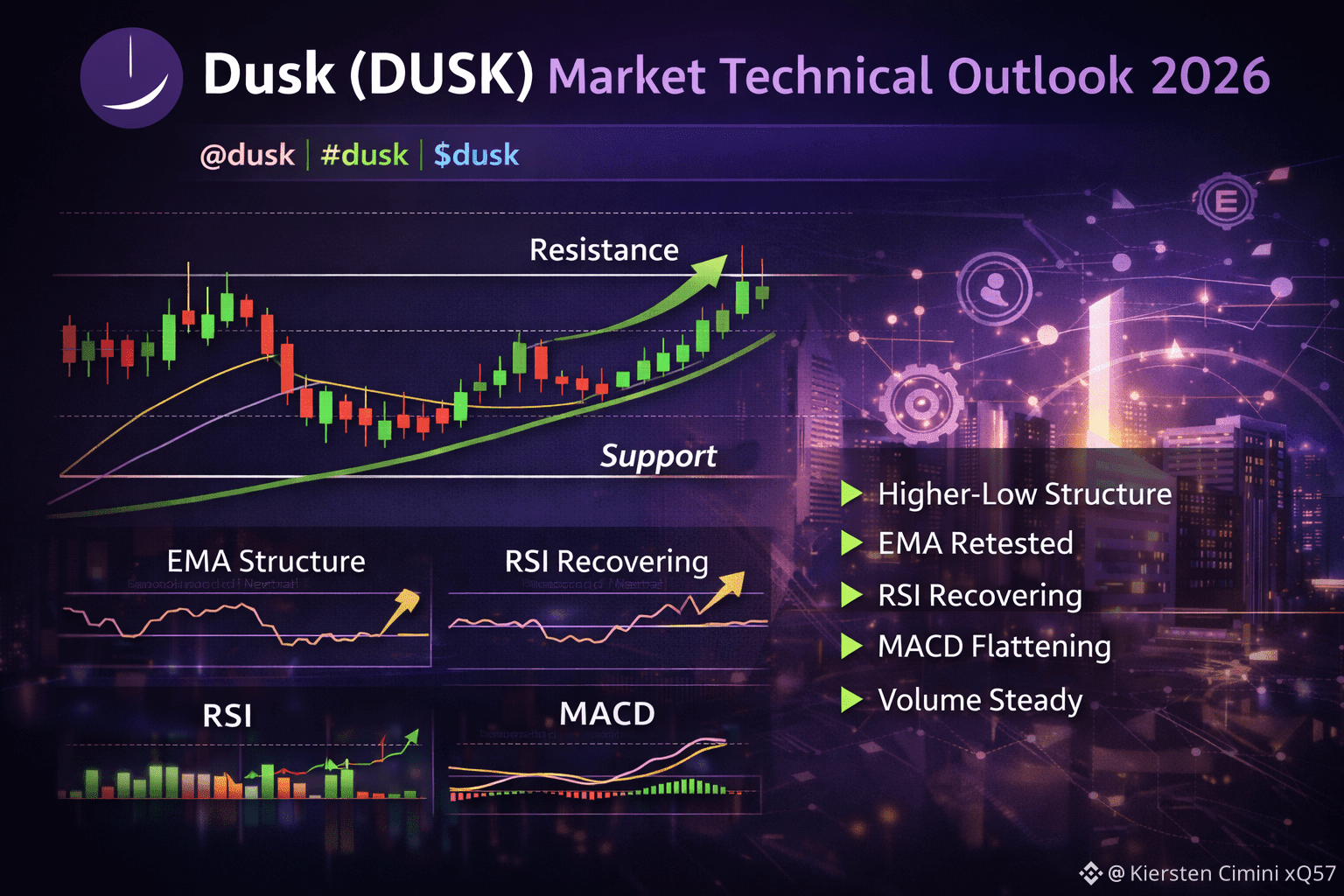
 Swing traders looking at @Dusk are finding an interesting opportunity as $DUSK consolidates after recent volatility. Dusk Network is a privacy-focused blockchain for regulated finance and real-world assets, which gives #dusk utility beyond speculation. For swing trading, technical structure, support/resistance levels, and indicator confirmations are key to planning entries, targets, and risk management.
Price Structure and Support
Currently, $DUSK has formed a higher-low pattern over the past several sessions. For swing traders, this structure is important because it reflects that selling pressure is diminishing and buyers are gradually entering the market. The key support zone near the previous consolidation low has held multiple times, reinforcing confidence in the setup.
Swing traders typically look for price stability at support zones before entering, as this increases the probability of a favorable risk-to-reward setup. In DUSK’s case, maintaining above this support is crucial for any bullish swing.
Resistance and Potential Targets
Immediate resistance for #dusk is at the short-term highs formed during consolidation. A successful breakout above these levels could trigger momentum toward the next range, offering swing traders potential targets in the $0.10–$0.12 zone (adjust based on live market data). Monitoring volume during breakout attempts is critical — stronger volume indicates commitment from buyers, while low volume may signal a false move.
Swing trading is about catching these medium-term moves without overreacting to short-term noise, so patience and proper stop placement below support are essential.
EMA Trend Analysis
$DUSK is currently testing short-term Exponential Moving Averages (EMA) as dynamic support. For swing traders, EMA support often provides a good entry area during pullbacks. If price maintains above the EMA structure, it strengthens the case for a swing trade. Conversely, failure to hold EMAs could signal trend weakening and an increased chance of a pullback.
Monitoring multiple EMA timeframes (e.g., 20 EMA, 50 EMA) helps assess whether the swing is aligned with the broader trend or just a short-term bounce.
RSI and MACD Indicators
From a swing perspective, #dusk’s Relative Strength Index (RSI) has started to recover from oversold levels and is trending toward neutral. This indicates that selling pressure is easing — a positive sign for swing traders entering on support.
Meanwhile, the MACD is flattening and hints at a potential bullish crossover. Swing traders often use MACD crossovers on daily or 4-hour charts as an additional signal confirming momentum alignment with higher lows and EMA support.
Volume Behavior
Volume is key for swing setups. In $dusk, volume has remained steady rather than spiking on down days, suggesting accumulation rather than distribution. A breakout accompanied by increasing volume provides the confirmation swing traders need to enter with higher probability.
Risk Management
Even in promising swing setups, risk control is essential. Stop-loss placement below key support or EMA levels ensures that adverse moves are limited. Swing traders also monitor broader market sentiment and Bitcoin correlation, as macro moves can impact altcoin swings.
Conclusion
For swing traders, @undefined offers a structured setup: higher lows, EMA support, RSI recovery, flattening MACD, and steady volume. A confirmed breakout above resistance with volume could create a medium-term swing opportunity toward higher targets, while support zones provide clear risk levels.
Overall, dusk is a project to watch for swing opportunities, combining technical structure with unique blockchain utility.
#MarketRebound #WriteToEarnUpgrade #USJobsData #StrategyBTCPurchase
