

The Dusk Foundation sees blockchain tech as a way to support real financial markets, not just a tech experiment. A key thing they're doing is building decentralized market infrastructure (DeMI). They think blockchain can replace or improve how normal financial markets work if it's set up right from the get-go. Instead of just making apps, they're working on the basic platform for regulated markets to run without hiccups.
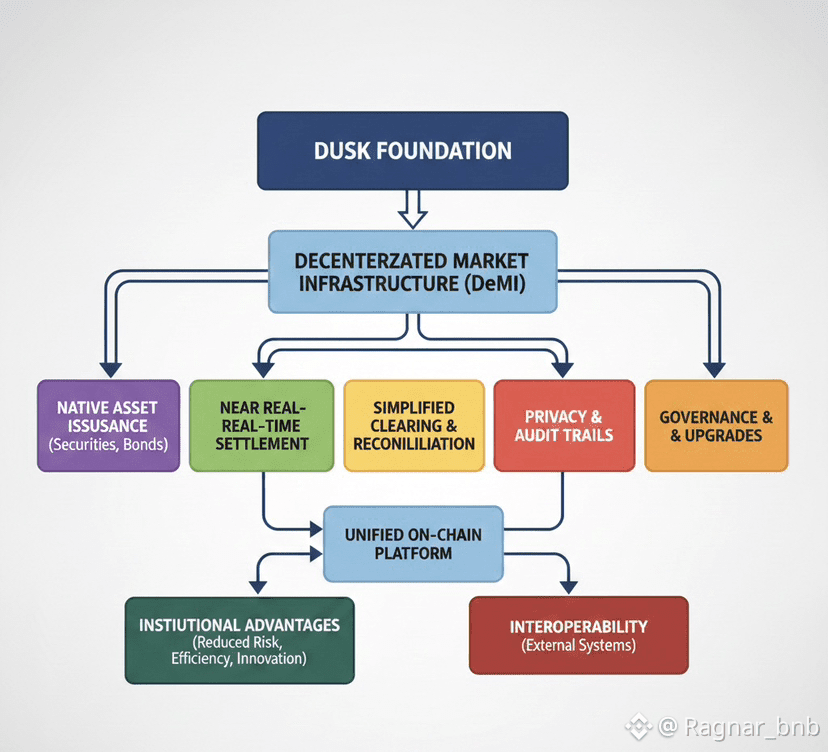
Normally, market infrastructure includes things like exchanges and clearing houses. These are usually run by different groups and connected through complicated processes. The Dusk Foundation knows this setup makes things expensive, risky, and slow. Their idea for DeMI is to put all these functions on one blockchain platform while keeping the legal and operational safety nets that regulated markets need.
The Foundation knows that markets need trust, finality, and predictability. People need to know trades will go through correctly, records will be accurate, and rules will be followed. Dusk's system makes sure of this with its design focusing on guaranteed settlement, crypto verification, and built-in market rules. This way, the infrastructure gives the assurances that centralized institutions usually do.
A big part of Dusk's DeMI is how assets are created. Many blockchains create assets with standard tokens that don't consider market rules. The Dusk Foundation backs asset models made for things like securities and bonds. These assets can have built-in logic for following rules and transfer limits. This lets markets run right on the blockchain without needing outside agreements or manual checks.
Settlement is another key piece that the Foundation is tackling. Normal settlement can take days and involve lots of middlemen. Dusk's system lets things settle almost in real time with crypto verification. The network checks and finalizes transactions based on the rules, which lowers risk and simplifies operations. This is super important for big players who need certainty and speed.
Clearing and reconciliation are also easier with Dusk. Since all transactions are on a shared, verifiable ledger, there's less need for separate reconciliation. The Foundation sees this as a big win for DeMI. With one source of truth that's both private and auditable, institutions can cut costs and mistakes from keeping multiple ledgers.
Privacy is key to making DeMI work. Market players can't operate well if everyone can see their moves. The Dusk Foundation puts privacy into the basic infrastructure, keeping sensitive data safe while letting regulators check for compliance. This balance is needed for any market infrastructure that wants to support real financial activity.
The Foundation also sees governance as part of market infrastructure. Rules about who can participate, when it can be upgraded, and how disagreements are solved need to be clear and predictable. Dusk's governance is made to let the protocol change while staying stable, so markets on Dusk can adapt without losing trust or legal certainty.
Being able to work with other systems is also vital for DeMI. Financial markets don't operate alone. Institutions need to connect to outside systems, other blockchains, and old infrastructure. The Dusk Foundation allows this in a controlled way, moving assets and data between systems without showing sensitive info. This makes Dusk a useful piece of bigger financial systems.
The Foundation's focus on DeMI also affects how applications are made. Instead of each application remaking market functions, developers can count on the shared infrastructure. This cuts down on duplication and keeps things consistent. Marketplaces, issuance platforms, and settlement systems can all run on the same layer, sharing security and compliance features.
For institutions, DeMI has good sides. It lowers their need for centralized middlemen while keeping the safeguards those middlemen provide. It boosts transparency where needed and keeps things private where necessary. It also allows new financial products to be made and handled programmatically. The Dusk Foundation sees this infrastructure as a way to update markets without losing the things that keep them stable.
The Foundation hopes DeMI can support a range of regulated activities, like issuance, trading, clearing, and reporting. By providing one platform for these functions, Dusk wants to lower friction and unlock new efficiency. This idea is bigger than individual cases and focuses on improving how markets work overall.
Another key thing about this infrastructure is its resilience. Decentralized systems can keep running even if some participants fail or disconnect. The Dusk Foundation sees this resilience as vital for financial infrastructure. By spreading out validation and enforcement across the network, it reduces single points of failure and makes things stronger.
In short, the Dusk Foundation's idea of decentralized market infrastructure is a change in how financial markets can be built and run. By combining crypto security, privacy, compliance, and programmability, the Foundation makes an environment where regulated markets can run right on the blockchain. This isn't just an idea, but a system made to replace or add to traditional market pieces. With this, the Dusk Foundation wants to deliver a type of financial infrastructure that's efficient, trustworthy, and in line with the realities of regulated finance.
