
In today’s fast-paced digital economy, the movement of money is no longer a simple transaction—it is a critical function that underpins global commerce, enterprise operations, and financial innovation. Traditional banking systems, with their sequential processing, legacy architectures, and centralized bottlenecks, struggle to meet the demands of high-frequency, cross-border, and large-scale stablecoin payments. A delay of even seconds can translate into operational risk, missed opportunities, or reputational harm for businesses operating at scale. The modern financial world requires an infrastructure that is not only fast but deterministic, secure, and scalable, capable of supporting millions of transactions with the reliability expected by institutions and enterprises.
This is where Plasma positions itself—not as just another blockchain experiment, but as a financial-grade backbone for high-volume stablecoin payments. Plasma reimagines the digital rails along which money flows, combining modular design, advanced consensus mechanisms, optimized execution, and secure bridging. It is designed for organizations that demand both speed and certainty, enabling payments to move with precision and compliance. Think of Plasma as a network of highways built exclusively for digital money, where every lane, interchange, and checkpoint is optimized to prevent congestion, ensure reliability, and scale seamlessly as demand grows.
The Modular Architecture of Plasma: Layered for Efficiency and Scalability
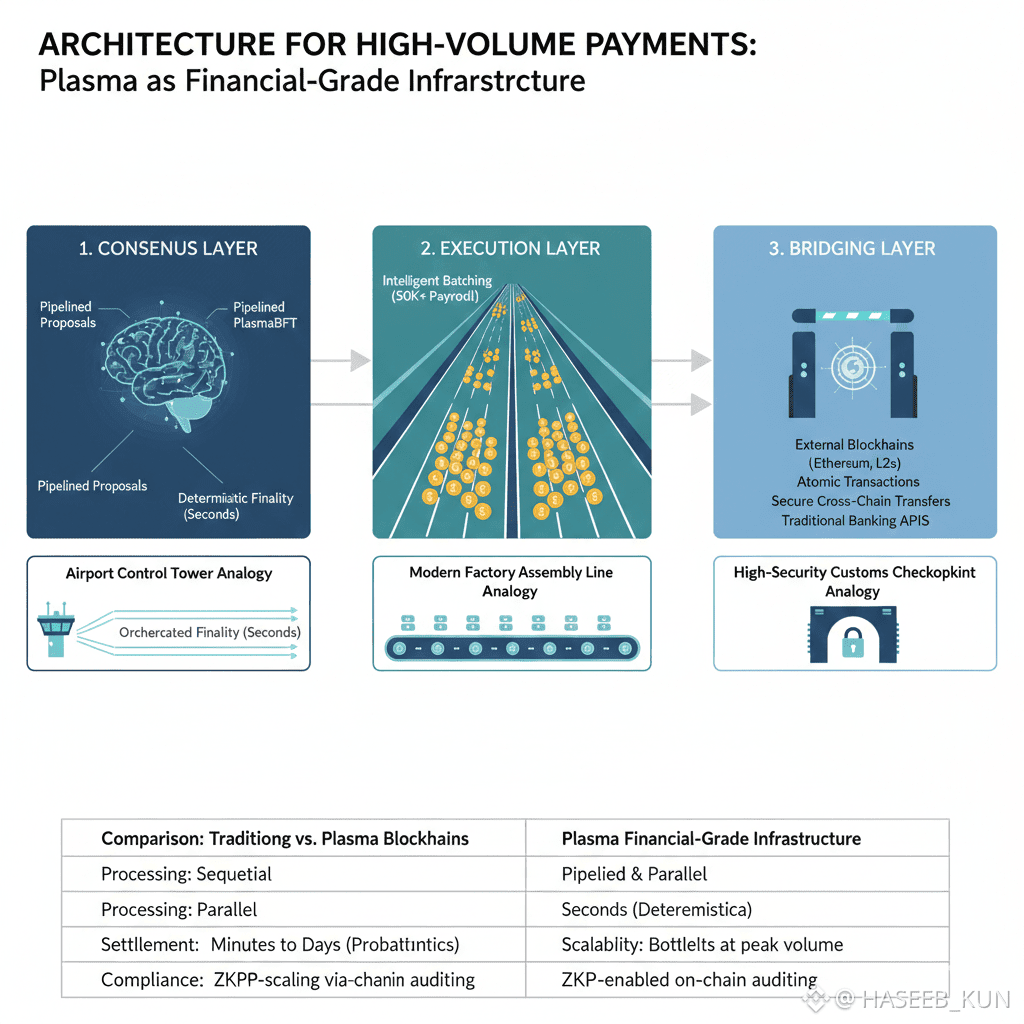
Plasma’s design is inherently modular, dividing the network into three interconnected layers: consensus, execution, and bridging. Each layer performs a distinct function, yet all operate in harmony to support enterprise-grade high-volume transactions.
The consensus layer functions as the brain of the system, ensuring every transaction is verified and finalized with deterministic certainty. Plasma implements PlasmaBFT, a pipelined adaptation of the Fast HotStuff consensus protocol. Unlike traditional sequential consensus designs that process proposals, votes, and commitments step by step, PlasmaBFT executes these stages in overlapping pipelines. This parallelization allows transactions to flow continuously through the network, significantly increasing throughput while maintaining reliability. Deterministic finality, a core feature, ensures that once a transaction is confirmed, it is irreversible and guaranteed, eliminating settlement risk for institutions.
To visualize this, imagine a busy airport: the consensus layer acts like air traffic control, orchestrating takeoffs and landings efficiently. Traditional systems resemble controllers who clear one plane at a time, causing delays as traffic increases. PlasmaBFT, by contrast, coordinates multiple aircraft in overlapping sequences, ensuring the skies remain safe while operations scale smoothly.
The execution layer is the muscles of the system. Once consensus is reached, transactions must be executed accurately and efficiently, especially when dealing with high-volume stablecoin flows. Plasma leverages parallelized processing, intelligent batching, and resource-aware execution to achieve this. Consider a global corporation paying salaries to tens of thousands of employees across multiple time zones. Plasma can process these transactions in batches, parallelizing execution to maintain speed and accuracy. It is similar to a modern factory assembly line where multiple products move simultaneously along different tracks, increasing throughput and reducing errors. The design ensures enterprises can meet operational deadlines without compromising transactional integrity.
Finally, the bridging layer acts as the network’s nervous system, connecting Plasma to external chains and financial systems. In real-world enterprise scenarios, funds often need to move across blockchain networks or integrate with off-chain infrastructure. Plasma’s bridges are atomic and secure, ensuring transactions either succeed completely or fail entirely, with no partial settlements. The bridging layer can be likened to a high-security customs checkpoint, where every shipment of digital assets is verified and routed safely to its destination, maintaining both security and compliance.
Consensus Engineering: Reliability at Scale
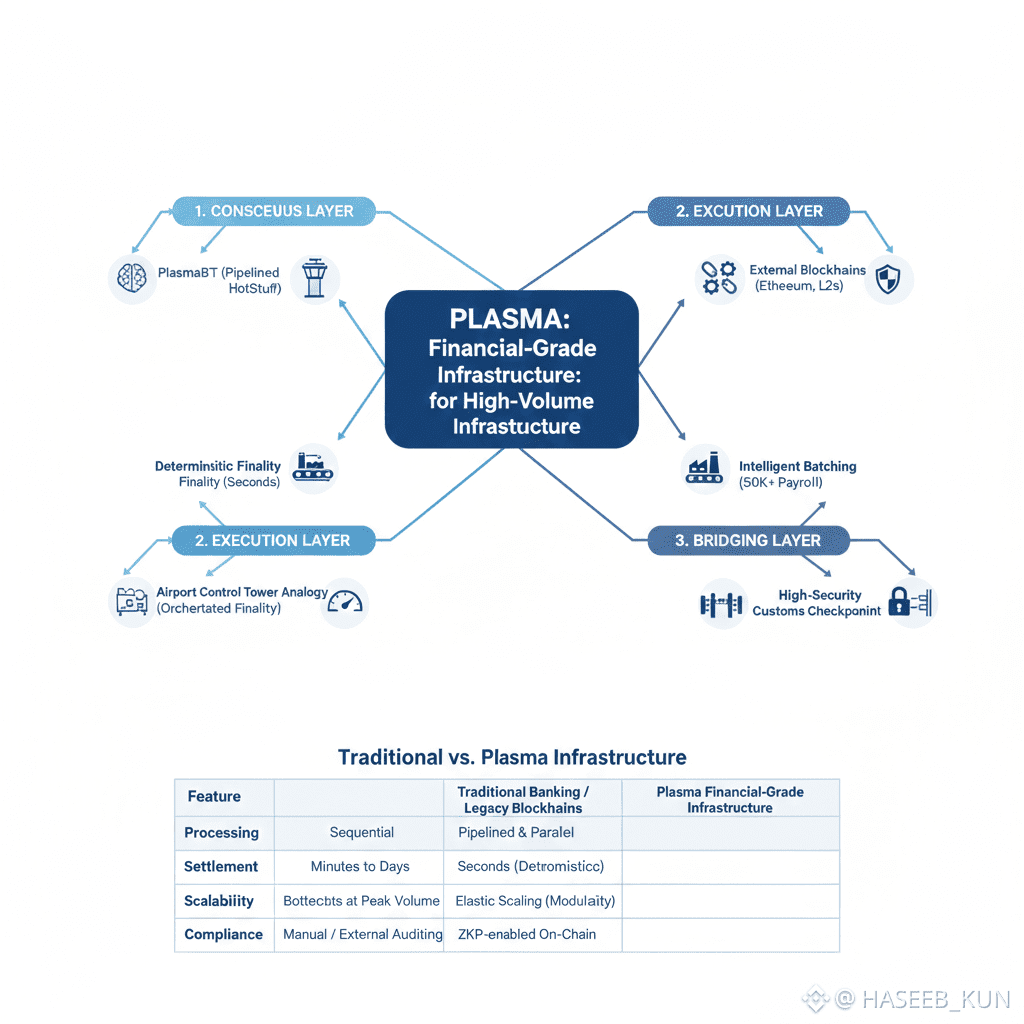
The reliability of high-volume payments depends on the underlying consensus engine. PlasmaBFT ensures deterministic finality, where transactions reach irreversible confirmation in seconds, regardless of network load. This is crucial for institutional finance, where each transaction represents real-world obligations, and any uncertainty introduces operational risk.
Unlike traditional proof-of-work or sequential consensus mechanisms, PlasmaBFT pipelines multiple stages of transaction validation. By overlapping proposal, vote, and commit stages, the network avoids the bottlenecks that plague sequential designs. The result is high-throughput processing with predictable outcomes, even under peak load.
Consider a cross-border payroll scenario: A company distributing stablecoins to 50,000 employees worldwide cannot tolerate delays or reversals. Plasma’s consensus ensures every transfer is finalized almost instantly, maintaining trust and operational integrity. To analogize, it is like a conductor leading an orchestra where multiple sections perform in overlapping sequences; the symphony remains harmonious even as complexity increases.
The consensus layer also integrates advanced fault tolerance, allowing nodes to recover from outages without affecting the overall network. This reliability is critical for enterprises that cannot risk downtime, whether during a peak sales season or a critical treasury operation.
Execution Layer: Parallelized Performance for Enterprise Use
Consensus alone does not guarantee speed; execution must be equally optimized. Plasma’s execution layer supports high-volume transaction throughput, parallelizing operations across nodes while intelligently batching similar transactions. This reduces computational overhead and ensures every transaction is processed efficiently.
Imagine a multinational bank clearing millions of stablecoin transactions daily for corporate clients. Plasma can process these simultaneously, maintaining accuracy and compliance with internal rules and regulatory requirements. This is akin to a factory floor with multiple parallel assembly lines, each optimized for efficiency, yet coordinated to prevent collisions or errors.
Additionally, Plasma incorporates resource-aware execution and gas management to prevent network congestion. By optimizing the computational cost of each transaction and dynamically batching operations, the network maintains consistent performance under heavy load. Enterprises can therefore rely on Plasma for mission-critical payments without fear of bottlenecks or slowdowns.

Bridging and Interoperability: Connecting the Financial World
High-volume enterprise payments often span multiple networks, requiring secure cross-chain interoperability. Plasma’s bridging layer ensures transactions maintain atomicity, security, and integrity across networks. Atomicity guarantees that transactions either succeed fully or fail entirely, preventing inconsistencies that could compromise trust or financial balance.
Security is reinforced with cryptographic proofs, ensuring that assets moving across chains cannot be altered or double-spent. Interoperability is flexible, supporting various stablecoins and blockchain protocols, allowing enterprises to integrate Plasma with existing financial infrastructure seamlessly.
Picture a secure global shipping system: each shipment of goods passes through customs and verification checkpoints, ensuring safe delivery. Plasma’s bridges function similarly for stablecoin payments, connecting disparate networks without exposing sensitive data or sacrificing reliability. This level of integration allows corporate treasuries, multinational payroll systems, and high-frequency stablecoin transactions to operate smoothly across multiple blockchains.
Performance, Scalability, and Future-Proofing
Plasma’s architecture is built for scale. Pipelines in consensus, parallel execution, and robust bridging allow the system to handle thousands to millions of transactions per second, meeting enterprise-level demands. Load balancing ensures that high transaction volumes do not overwhelm individual nodes, while fault-tolerant design guarantees continuity even in adverse conditions.
Consider a global e-commerce platform processing holiday-season transactions in stablecoins. Peak demand can surge exponentially, and traditional infrastructure may fail to cope. Plasma, however, dynamically scales, distributing workload and maintaining seamless operations. This is like a smart electrical grid automatically redirecting power to meet spikes in consumption—operations remain uninterrupted regardless of volume.
Plasma’s modular design also ensures future-proofing. Enterprises can integrate new consensus mechanisms, add tokenized asset types, or support emerging stablecoins without disrupting existing operations. Think of a highway engineered for cars today but capable of supporting autonomous vehicles, high-speed trains, and drone deliveries tomorrow. Plasma provides the same flexibility for digital finance: an infrastructure ready to evolve with market demands, DeFi growth, and stablecoin adoption.
Security and Compliance for Institutional Confidence
Security and regulatory compliance are foundational to enterprise adoption. Plasma uses zero-knowledge proofs to maintain transaction confidentiality while providing verifiable proof of correctness. Every transaction is auditable, satisfying internal controls, regulators, and financial auditors. Compliance protocols embedded in Plasma support AML/KYC requirements and data privacy regulations, ensuring that enterprises can operate confidently in regulated markets.
For example, a multinational treasury managing large stablecoin reserves can conduct encrypted transfers while simultaneously producing verifiable proofs of regulatory compliance. This reduces operational risk, protects sensitive financial data, and ensures full transparency when required. Enterprises can therefore embrace high-volume blockchain transactions without sacrificing security or regulatory integrity.
Real-World Applications: High-Volume Stablecoin Payments
Plasma’s capabilities shine in practical scenarios. Large corporations can execute cross-border payroll instantly, paying tens of thousands of employees in multiple currencies and time zones. Corporate treasuries can move millions of stablecoins between accounts, partners, and external financial networks seamlessly, maintaining both speed and compliance. Financial institutions can manage stablecoin-backed lending, repayments, and liquidity provisioning at scale, relying on Plasma for throughput, security, and deterministic finality.
Each of these scenarios underscores the same principle: Plasma combines performance, reliability, modularity, and compliance into a unified infrastructure capable of meeting the demands of modern enterprise finance.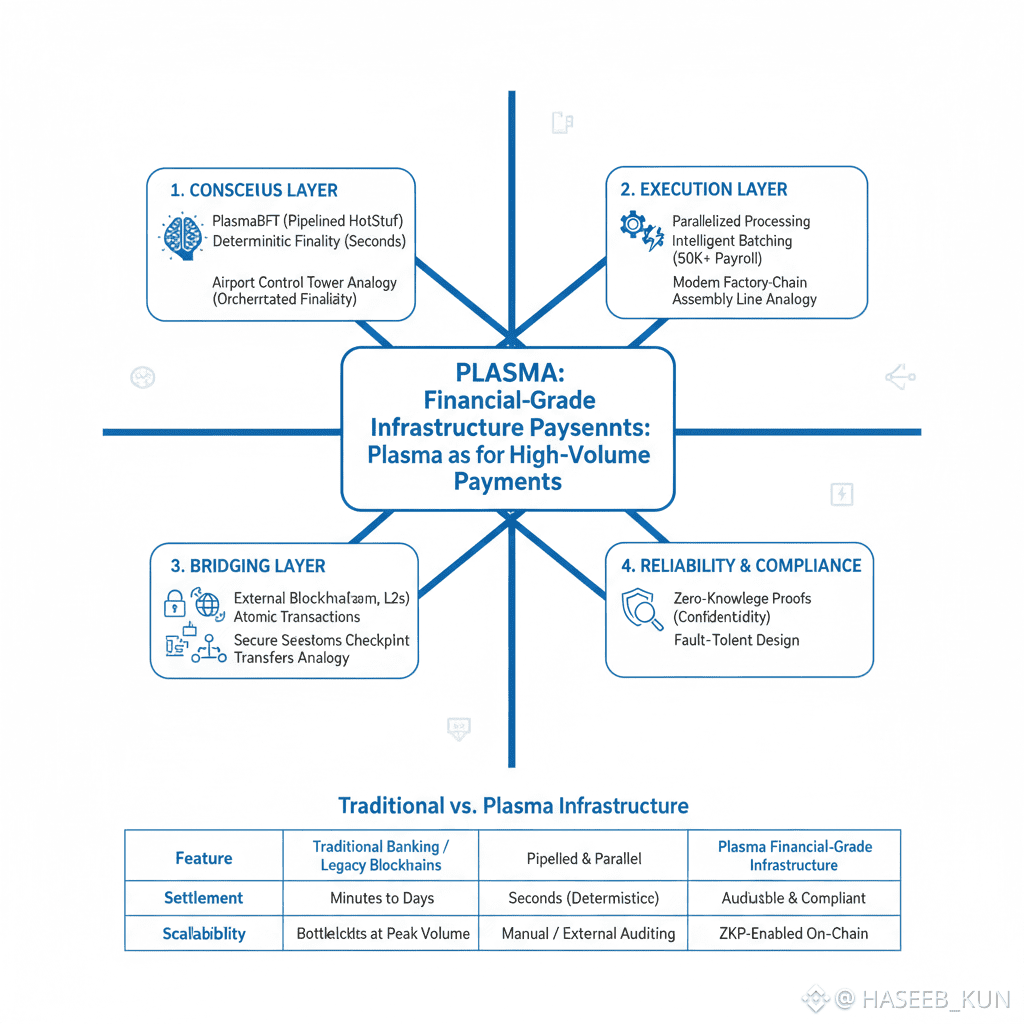
Conclusion: Plasma as the Backbone of Digital Finance
As digital finance continues to expand, the need for high-volume, reliable, and secure payment infrastructure becomes paramount. Plasma offers a financial-grade solution, combining pipelined consensus, parallelized execution, and secure bridging to support high-volume stablecoin transactions. Its modular design ensures scalability, flexibility, and adaptability for future financial innovations. For enterprises, institutions, and high-frequency stablecoin users, Plasma is not just a blockchain—it is a trusted backbone for the movement of digital money, enabling secure, fast, and compliant payments at scale.
By aligning speed, reliability, and compliance with enterprise needs, Plasma is positioned to redefine how institutions manage stablecoin payments, treasury operations, and cross-chain financial activity. It is a platform built for the realities of today and the demands of tomorrow—a future-proof, high-performance infrastructure for the digital economy.

