
In financial markets, speed isn’t just an advantage—it’s everything. Every second can mean a lost trade, a missed settlement, or a costly error. Traditional systems have intermediaries, auditors, and clearinghouses to ensure transactions are correct, but they’re slow, opaque, and centralized. Blockchain promised transparency, decentralization, and trustless operations, but many networks still struggle with delays, uncertainty, and reorganization risks. For real-world finance, that’s a problem.
This is where Dusk steps in with its Succinct Attestation Consensus (SAC) Protocol. SAC isn’t just another consensus mechanism—it’s a new way of thinking about how blocks are verified, confirmed, and finalized. Imagine a courtroom where every case—every block of transactions—is reviewed not by a slow jury but by a small panel of expert judges who make the decision instantly. Their verdict is final, secure, and unambiguous. That’s SAC in action: fast, deterministic, and designed for financial-grade reliability.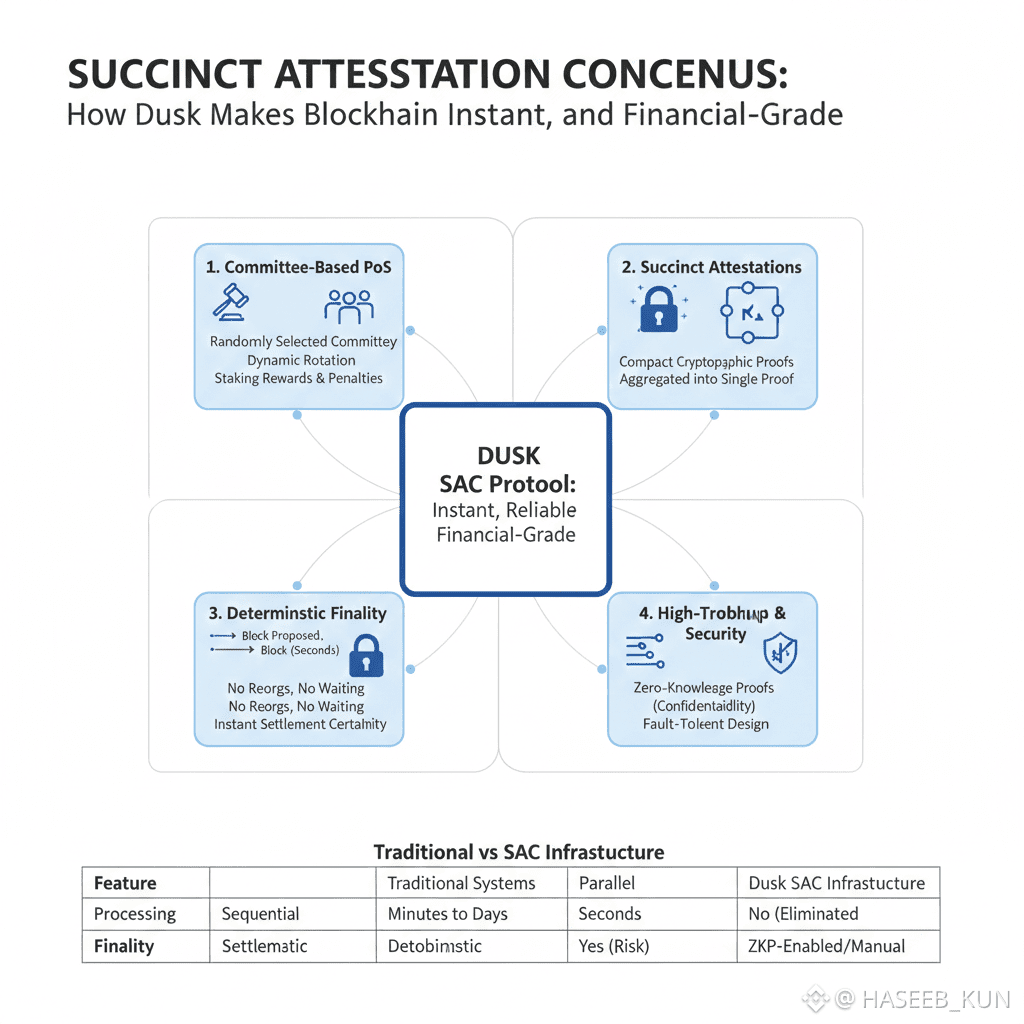
At its core, SAC combines Proof-of-Stake (PoS) with a dynamic, committee-based model. Traditional PoS networks rely on all validators participating in block verification, which is secure but slow. SAC takes a smarter approach. A small, randomly selected committee of validators attests to each block. They act like specialized auditors, confirming validity quickly, while the broader network oversees and ensures fairness. Validators are motivated by staking rewards—and penalized for misbehavior—so honesty isn’t optional; it’s economically aligned. The result is speed without compromising security or decentralization.
The process is deceptively simple yet powerful. When a block is proposed, the committee generates succinct attestations—compact cryptographic proofs that confirm the block’s validity. These attestations are aggregated into a single proof, which instantly finalizes the block across the network. This is deterministic finality: once a block is attested, it cannot be reversed. There’s no guessing, no waiting for confirmations, no chance of a reorganization undoing transactions. Even in high-volume scenarios like stablecoin transfers or decentralized exchange trades, SAC handles thousands of transactions per second while keeping the system secure and reliable.
Reorganizations, or “reorgs,” are a nightmare for financial operations. They occur when blocks are replaced, undoing transactions and potentially causing double-spend risks. SAC practically eliminates this problem. Its committee-based attestations ensure that once a block is confirmed, it’s final. In real terms, it works like modern banking: when your account is credited, you can trust it immediately. That certainty—instant, auditable, irreversible—is exactly what financial markets demand.
Through its high-throughput design, SAC is built to scale. Proposal, attestation, and commitment phases run in parallel, while only the committee’s attestations propagate widely, reducing network congestion. Confirmation times are predictable and consistent—a crucial factor for high-frequency trading, global payments, and tokenized asset settlements. Dusk’s approach ensures that speed and reliability coexist, rather than trade-offs in one for the other.
Security is layered into every step. Randomized committees prevent collusion and attacks, staking penalties discourage misbehavior, and cryptographic proofs ensure attestations are authentic and verifiable. Even if a few validators act maliciously, the network relies on the honest majority to maintain integrity. SAC isn’t just fast; it’s resilient.
The real-world implications are profound. Stablecoins settle instantly without the fear of reversal. Decentralized exchanges can operate at full speed, executing trades and arbitrage opportunities in real time. Tokenized assets can move seamlessly across the network. And regulated markets can integrate compliance checks directly into the attestation process. SAC turns blockchain from a promising ledger into a financial-grade infrastructure you can trust.
Compared to traditional blockchain models, SAC offers clear advantages. Proof-of-Work networks are slow, energy-intensive, and probabilistic. Standard PoS systems reduce energy costs but can still suffer latency and reorg risks. SAC delivers deterministic finality in seconds, handles high transaction volumes, and preserves decentralization—all without compromising security. For financial markets, this isn’t incremental improvement; it’s a paradigm shift.
SAC can be thought of as a trustworthy jury system. Each block is a case, the committee is the panel of judges, and attestations are the verdict. Committees rotate, ensuring fairness, while the wider network can rely on each verdict as final and auditable. This analogy captures SAC’s human-centered logic: fast, predictable trust wrapped in a secure, technical framework.
Looking ahead, SAC sets the stage for the next generation of financial systems. As decentralized finance grows, tokenized securities become common, and digital assets proliferate, SAC provides the backbone to handle massive transaction volumes reliably. Global payment networks could settle funds as instantly as sending an email. Decentralized exchanges could operate at unprecedented speed. Compliance could be enforced directly on-chain, without slowing the system. SAC doesn’t just keep up with the financial world—it shapes it.
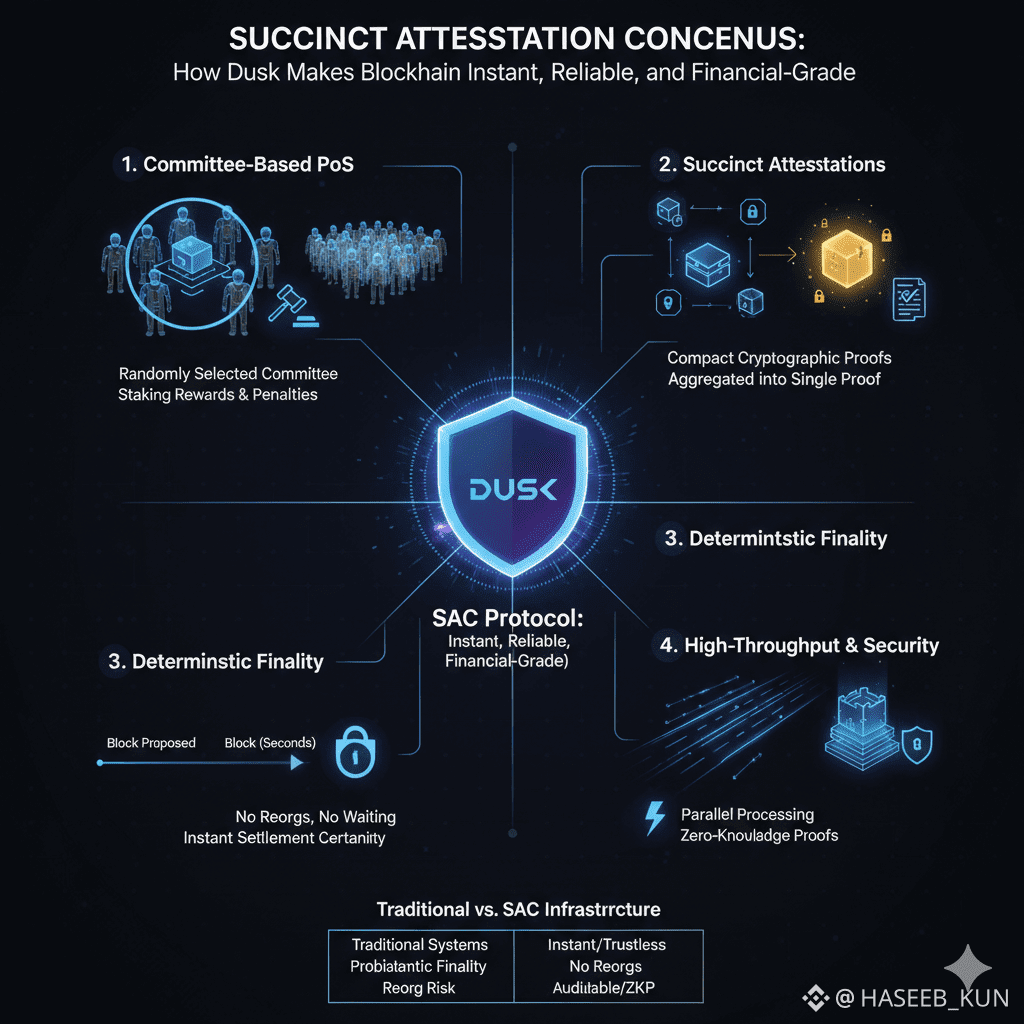
In conclusion, Dusk’s Succinct Attestation Consensus Protocol is more than a technical innovation—it’s a blueprint for fast, secure, and auditable financial-grade blockchain. By combining committee-based PoS, succinct attestations, and deterministic finality, SAC delivers instant settlement, minimizes reorgs, and supports high-throughput operations. It turns blockchain from a speculative technology into a reliable, predictable infrastructure that behaves like modern banking: fast, secure, and trustworthy. For anyone building, trading, or transacting in digital finance, Dusk’s SAC protocol is setting the standard for how blockchain should operate in the real world.
