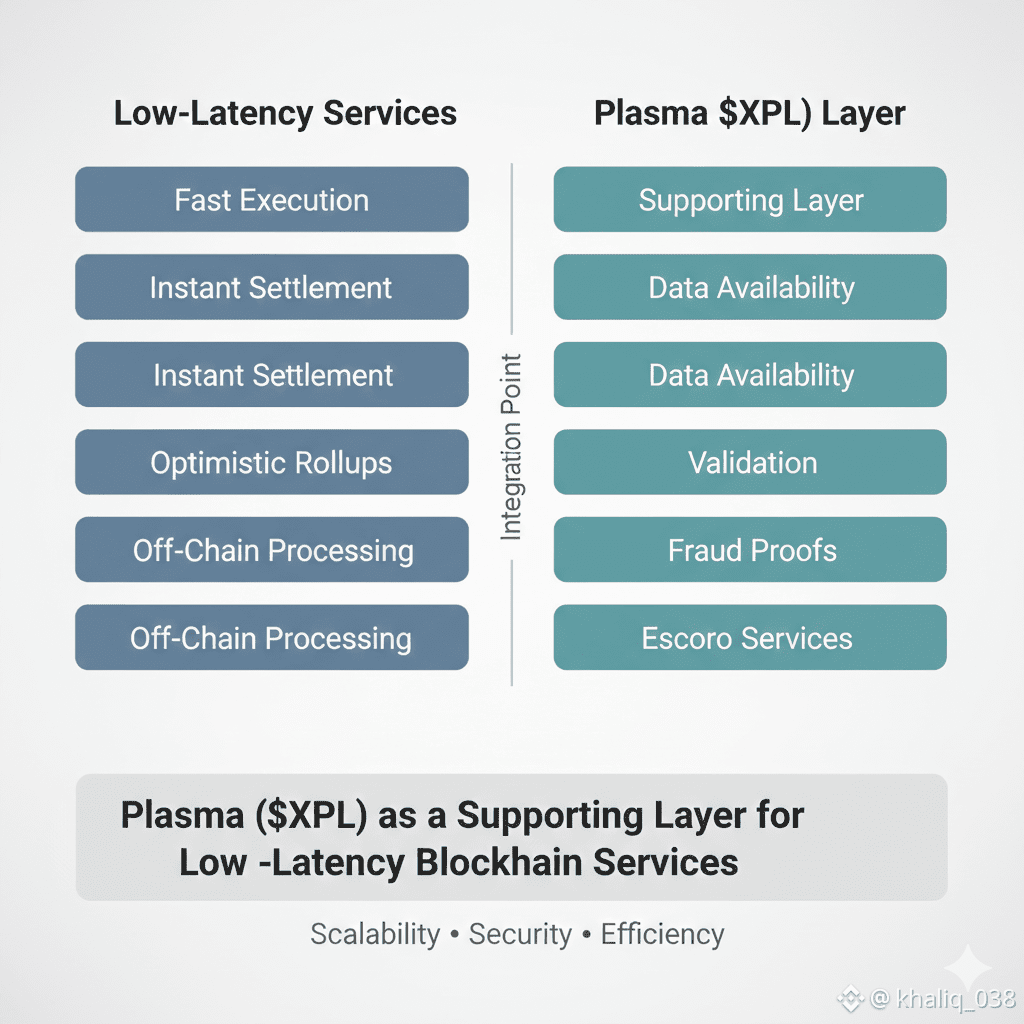
People rarely say it out loud, but speed shapes trust. I’ve felt this myself while using blockchain services late at night, waiting for something simple to confirm. You start calm, then curious, then slightly uneasy. That gap between action and response is where confidence fades. Plasma ($XPL) matters because it tries to shrink that gap, not with big promises, but by quietly supporting low-latency services underneath everything else.
Low latency isn’t about chasing instant results. It’s about removing doubt. When systems respond quickly, users don’t second-guess them. When they don’t, every delay feels personal. I’ve seen decentralized apps lose good users not because the idea was flawed, but because interactions felt heavy and slow. Plasma sits in the background, helping blockchain services move data and finalize actions with less waiting, so the experience feels steadier and less fragile.
What stands out to me is that Plasma doesn’t compete for attention. It doesn’t try to be the face of an application. It works as a support layer, letting other services do their job without tripping over timing issues. For tools that rely on live updates, automated decisions, or frequent interactions, this matters more than people realize. If responses lag, the whole system feels uncertain, even if it’s technically correct.
This is why the topic is gaining attention now. Blockchain users have changed. They’re no longer impressed by complexity. They want things to work. Builders are feeling that pressure too. I’ve noticed more conversations shifting away from “what’s possible” toward “what’s usable.” Plasma appears in those conversations because it focuses on making systems feel responsive under real conditions, not just on paper.
There’s also a quiet sense of progress here. Not flashy updates, not dramatic announcements, but steady improvement. Systems that stay calm during traffic spikes. Services that don’t freeze when activity increases. That kind of progress doesn’t trend loudly, but it lasts. From experience, infrastructure that behaves well when no one is watching usually holds up when everyone is.
Personally, I trust tools more when I forget they’re there. When I don’t have to refresh. When I don’t wonder if something failed. Plasma’s role fits that mindset. Its value shows up emotionally before it shows up technically. Less tension. Less hesitation. Fewer moments of doubt.
Plasma ($XPL) as a supporting layer for low-latency blockchain services feels relevant because the space is growing more honest with itself. Speed is no longer optional. Reliability is no longer impressive, it’s expected. What’s trending now isn’t noise, it’s usefulness. Plasma fits into that shift by doing something simple and necessary: helping decentralized services respond when users expect them to. And sometimes, that’s all real progress needs to be.
And that’s where Plasma’s relevance becomes clearer the longer you sit with it. It doesn’t change how people think about decentralization in theory, but it changes how they feel when they use it. That feeling matters more than whitepapers ever did. When a service responds quickly, users relax. They stop checking blocks. They stop questioning every step. The system fades into the background, which is exactly where good infrastructure belongs.
I’ve learned over time that most users don’t want to understand layers, throughput, or internal mechanics. They want certainty. They want to know that when something is submitted, it’s handled without drama. Plasma supports that expectation by helping blockchain services stay responsive even when activity increases. Not perfect, not instant, but stable enough to trust. That stability is rare, and it’s why people are paying attention now.
What feels different about this moment is that speed is no longer framed as innovation. It’s framed as responsibility. Builders are realizing that slow systems push risk onto users. Every delay asks people to be patient, to believe, to wait. Plasma’s approach reduces how often users are asked to do that. From a human point of view, that’s a meaningful shift.
I don’t see Plasma as a trend that burns bright and fades. It feels more like an adjustment, a correction toward how decentralized systems need to behave if they’re going to stay relevant. Quiet layers that keep things moving, without demanding praise, often shape the future more than loud ideas.
In the end, Plasma ($XPL) isn’t interesting because it promises change. It’s interesting because it supports continuity. It helps blockchain services feel less fragile, less stressful, and more dependable. And for users who just want things to work when they press a button, that kind of progress doesn’t need hype. It just needs to last.