

Most blockchain discussions focus on execution speed and low fees, but real applications break down for a different reason: data. Scalable apps need to store and access large volumes of information such as media files, user activity, game states, AI inputs, and historical records. Token transfers alone do not solve this. When data lives on centralized servers, applications inherit censorship risk, outages, and opaque control.
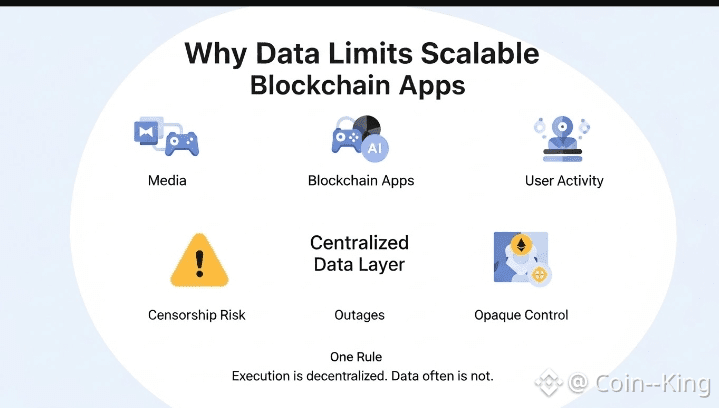
Pure on-chain storage is not a practical alternative. It is costly, inefficient, and unsuited for unstructured or large datasets. Many Web3 projects compromise by decentralizing value while quietly centralizing data, which limits long-term trust and resilience.
Walrus is built to handle this overlooked layer. Its architecture is designed around data availability for real applications. Using blob-based storage, Walrus allows large data objects to be stored efficiently without overloading the base chain. Through erasure coding, each dataset is split and distributed across multiple nodes, ensuring that data remains accessible even when parts of the network fail. This shifts the focus from theoretical decentralization to operational reliability.
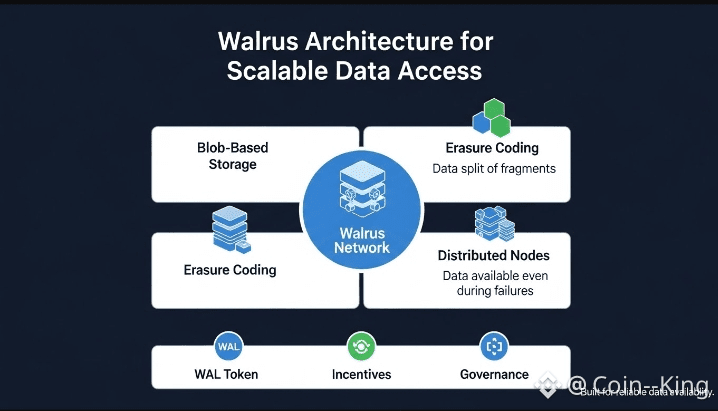
The WAL token supports this infrastructure by securing the network through staking, coordinating incentives for storage providers, and enabling governance-driven upgrades. Its role is functional and structural, aligning participants around network health rather than short-term usage.
As blockchain applications grow in complexity, scalable data access becomes foundational infrastructure. Walrus operates quietly beneath the surface, but it addresses one of the most critical constraints holding Web3 applications back: dependable, decentralized data at scale.

