Stablecoins have quietly become the most widely used application of blockchain technology. From cross-border remittances and merchant payments to on-chain treasury management, billions of dollars move daily through assets like USDT and USDC. Yet most blockchains were not designed with stablecoins as their primary use case. Plasma aims to change that by introducing a Layer 1 blockchain built specifically for stablecoin settlement.
Unlike general-purpose Layer 1 networks that optimize for a wide range of applications such as NFTs, gaming, or speculative DeFi, Plasma focuses on one clear mission: making stablecoin transfers fast, predictable, and usable at global scale.
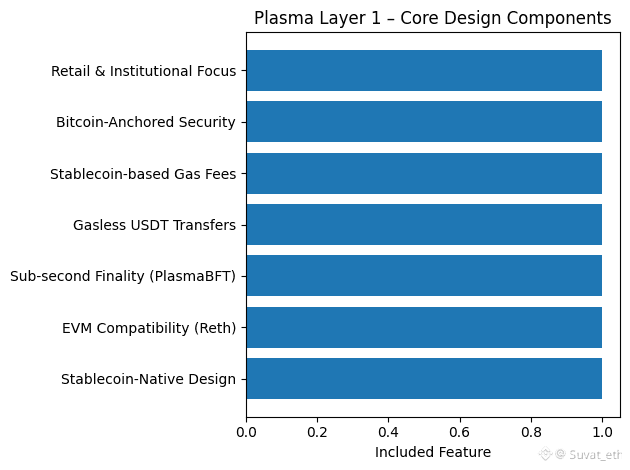
At the foundation of Plasma’s architecture is full Ethereum Virtual Machine (EVM) compatibility, implemented through Reth, a modern and high-performance Ethereum execution client. This ensures developers can deploy existing Ethereum smart contracts with minimal changes, while users retain access to familiar wallets, tooling, and infrastructure. By staying EVM-aligned, Plasma avoids the fragmentation that often slows developer adoption on alternative chains.
Performance is a central pillar of the network. Plasma introduces PlasmaBFT, a consensus mechanism designed to achieve sub-second finality. In traditional payment systems, instant settlement is essential — consumers and businesses expect transactions to confirm immediately. Probabilistic finality models common in many blockchains introduce delays and uncertainty, which are unacceptable for payments. Plasma’s fast and deterministic finality makes it suitable for retail transactions, merchant checkout, remittances, and institutional settlement flows.
What truly differentiates Plasma is its stablecoin-first economic design. On most blockchains, users must hold a volatile native token to pay for gas, creating friction and exposing them to price fluctuations. Plasma removes this barrier by enabling gasless USDT transfers and allowing stablecoins to be used directly for transaction fees. This design dramatically improves user experience, simplifies accounting, and reduces operational risk for businesses and financial institutions.
From a security and neutrality perspective, Plasma introduces a distinctive approach through Bitcoin-anchored security. By anchoring key security elements to Bitcoin, Plasma seeks to benefit from Bitcoin’s unmatched track record of censorship resistance and decentralization. For a settlement layer that aspires to support global payments and regulated financial activity, long-term neutrality and resistance to governance capture are critical. Bitcoin anchoring helps strengthen trust in the network’s credibility over time.
Plasma’s target audience reflects where stablecoins are already most impactful. In many high-adoption regions, stablecoins function as everyday money, used for savings, transfers, and commerce. Plasma aims to serve retail users in these markets by offering near-instant transactions with minimal fees and no technical complexity. At the same time, the network is designed to meet the needs of institutions, fintech companies, and payment processors that require predictable costs, compliance-friendly infrastructure, and reliable settlement.
For developers, Plasma opens the door to building a new generation of payment-focused applications. These include on-chain payment rails, programmable stablecoin wallets, treasury management systems, merchant solutions, and cross-border settlement tools. By optimizing the base layer for stablecoins, Plasma provides a foundation where such applications can operate efficiently without workarounds.
In an ecosystem crowded with Layer 1 blockchains competing for attention, Plasma’s strategy is deliberately narrow and pragmatic. Instead of chasing every trend, it aligns itself with crypto’s most proven real-world use case. Stablecoins are already reshaping global finance — the missing piece has been infrastructure designed specifically for them.
Plasma is positioning itself as that infrastructure: a stablecoin-native Layer 1 that combines EVM compatibility, sub-second finality, user-friendly economics, and Bitcoin-anchored security. If stablecoins are becoming the backbone of digital money, Plasma is building the rails to move them reliably, efficiently, and at scale.