

I’ve spent enough time around blockchain projects to recognize a familiar pattern. Most networks start by promising freedom, speed, and disruption, and only later try to figure out how any of that fits into the real financial world. Regulation is treated like an obstacle course to run after the product ships, not a design constraint to build around. Over time, that gap shows. Systems that work well for speculation struggle the moment institutions, compliance teams, or real assets enter the picture.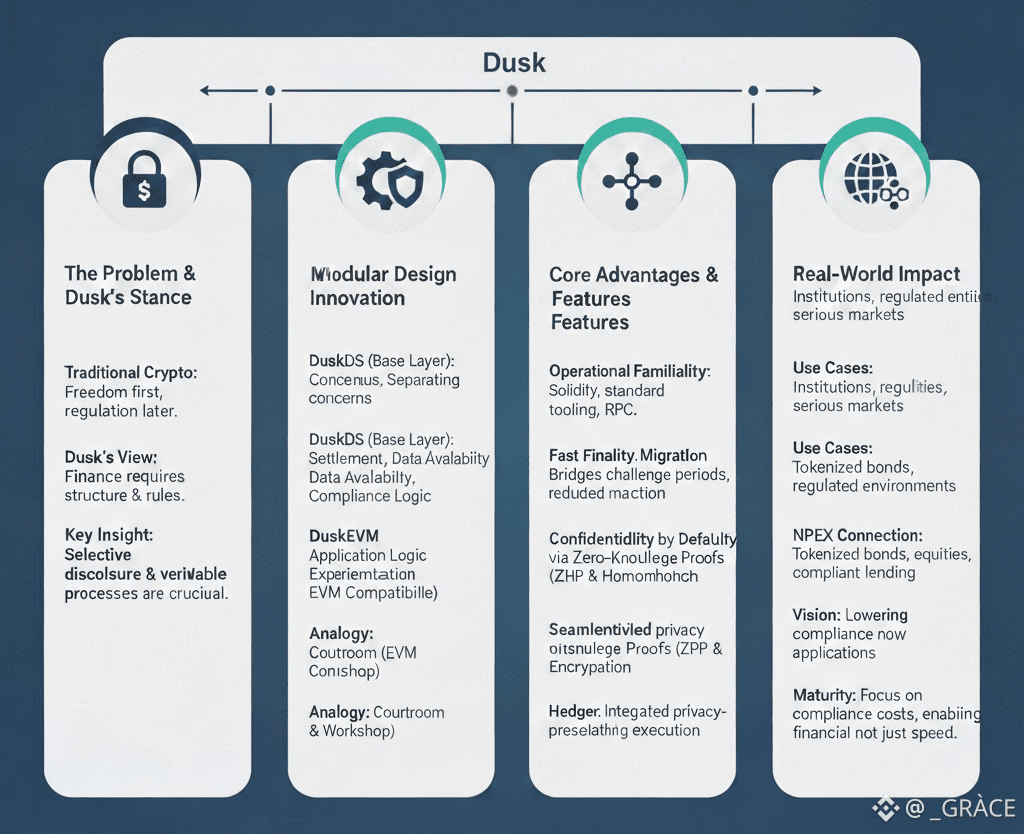
Dusk feels different because it never pretended that finance could exist without structure. From the beginning, the project took a position that many crypto teams avoided: if you want to support capital markets, you don’t get to ignore the rules. You also don’t get to expose everything just because transparency is philosophically appealing. Finance runs on selective disclosure, controlled access, and verifiable processes. That reality doesn’t disappear just because execution happens on-chain.
What’s interesting about Dusk’s current trajectory is not that it’s adding an EVM, or that it’s talking about modularity. Plenty of projects do that. What’s interesting is why those choices are being made and where the complexity is being placed. Instead of pushing regulatory burden onto developers or institutions, Dusk is trying to absorb that burden at the protocol level. The goal isn’t to make developers learn a new mental model for compliance. The goal is to make compliance fade into the background while still being enforceable.
That distinction matters more than most people realize.
In traditional finance, infrastructure succeeds when it’s boring. No trader wants to think about the internals of clearing and settlement. No asset issuer wants to redesign their legal processes just to use a new platform. Systems gain adoption when they slot into existing workflows with minimal friction. Crypto often gets this backwards, expecting the world to adapt to it instead.
Dusk’s approach suggests an understanding that the fastest path to institutional adoption isn’t ideological purity, but operational familiarity.
The introduction of DuskEVM sits squarely in that context. It’s not an attempt to chase Ethereum’s ecosystem for the sake of relevance. It’s a deliberate move to lower the surface area of change for developers and integrators. Solidity contracts, familiar tooling, standard RPC behavior these aren’t conveniences, they’re accelerants. Every unfamiliar tool or custom execution environment adds weeks or months to integration timelines. I’ve seen promising pilots stall simply because teams couldn’t justify retraining engineers or re-auditing unfamiliar stacks.
By anchoring execution in an EVM-compatible environment while keeping settlement, finality, and compliance-oriented logic at the base layer, Dusk flips a common crypto assumption on its head. Instead of asking developers to think about regulation, it asks the protocol to do that thinking for them.
This is where the modular architecture becomes more than a buzzword.
Dusk’s base layer, DuskDS, is positioned as the place where the “serious” responsibilities live. Consensus, settlement, data availability, and bridging aren’t treated as interchangeable components but as foundations that need to satisfy auditability and reliability requirements. The execution layer, DuskEVM, is where experimentation and application logic can move faster without compromising the guarantees below.
I like to think of it as separating the courtroom from the workshop. You don’t redesign the legal system every time someone wants to build a new financial product. You build on top of it.
One subtle but important aspect of this design is how it reframes finality. Many rollup-based systems rely on long challenge periods and delayed certainty. That might be acceptable for consumer applications or speculative trading, but it’s a hard sell for regulated environments where settlement finality has legal and accounting implications. By pushing verification responsibilities down to the base layer and avoiding extended fault windows, Dusk is signaling that it understands how institutions measure risk.
This isn’t about theoretical security. It’s about operational confidence.
Migration is another area where Dusk’s thinking stands out. Most platforms talk about composability and interoperability, but fewer acknowledge how painful real migrations are. Legacy systems don’t move quickly, and neither do regulated institutions. Any infrastructure that demands a clean break from existing tooling is unlikely to see meaningful adoption.
By aligning with Ethereum standards while maintaining its own ledger and compliance model, Dusk creates a kind of shortcut. Developers don’t have to abandon what they know, and institutions don’t have to accept exposure models they’re uncomfortable with. The weirdness stays under the hood.
The public DuskEVM testnet reinforces this philosophy. Testnets are often treated as playgrounds for developers, but here they feel more like dress rehearsals. Bridging behavior, token transfers, deployment workflows these are not just technical features, they’re operational patterns. Exchanges, custodians, and service providers care deeply about how systems behave under normal conditions, not just edge cases.
What stood out to me is how early the conversation shifts from “can this work?” to “how does this behave?” That’s a very TradFi question, and it’s refreshing to see it taken seriously in a crypto context.
When people talk about “compliance-first EVM,” it can sound abstract, so it’s worth grounding it in practical terms. Imagine building a lending protocol where the collateral isn’t volatile crypto assets but tokenized bonds or equities. Participation needs to be restricted. Certain disclosures must be provable. Regulators may require access to specific information without making everything public.
On most EVM chains, you end up choosing between privacy and auditability. You either expose too much or hide too much. Neither option is acceptable for real financial products.
Dusk’s architecture suggests a third path: confidentiality by default, with controlled visibility for authorized parties. This isn’t about secrecy for its own sake. It’s about aligning on-chain behavior with off-chain legal expectations.
This is where Hedger becomes particularly interesting. Rather than treating privacy as an external layer or a separate ecosystem, Dusk integrates it directly into the execution environment. Techniques like zero-knowledge proofs and homomorphic encryption aren’t presented as exotic cryptography experiments, but as tools to enforce rules without overexposure.
That framing matters. Privacy in finance isn’t about anonymity; it’s about discretion. Market participants need assurance that their strategies, positions, and relationships aren’t being broadcast, while regulators need assurance that rules are being followed. These goals aren’t contradictory they’re complementary.
The idea of privacy-preserving order books or selective disclosure transfers might not excite retail traders chasing yield, but they resonate strongly with institutions that operate under fiduciary duties. Those are the kinds of mechanics that enable serious markets, not just liquid tokens.
Dusk’s connection to regulated venues like NPEX reinforces this direction. Instead of theorizing about institutional adoption, the project anchors itself in environments where licensing, reporting, and oversight already exist. That context shapes design decisions in subtle but important ways. You build differently when you know your system will be scrutinized by regulators rather than just users on social media.
The anticipated DuskEVM mainnet launch has attracted attention, but I think the real shift is conceptual. It’s not about unlocking a new feature; it’s about unlocking a new category of applications. When the cost of compliance drops, experimentation increases. Developers can explore ideas that were previously impractical, not because of technical limitations, but because of regulatory friction.
One thing I appreciate is that Dusk doesn’t oversell this as a revolution. There’s no promise that institutions will flood in overnight. Instead, there’s a steady focus on building infrastructure that doesn’t break when real constraints are applied. That’s not glamorous, but it’s how systems last.
From my perspective, this is what maturity in crypto looks like. Less obsession with narratives, more attention to process. Less emphasis on speed for its own sake, more emphasis on correctness. The industry doesn’t need more chains it needs better ones.
What Dusk is attempting won’t appeal to everyone. Developers who enjoy pushing boundaries without constraints may find the compliance focus limiting. But for builders interested in real-world finance, those constraints are the point. They define the problem space.
Personally, I find this direction compelling because it aligns with how finance actually works. Markets thrive on trust, predictability, and enforceable rules. Technology doesn’t replace those principles; it implements them more efficiently. Dusk seems to understand that distinction.
The modular strategy also creates room for evolution. By decoupling execution from settlement, Dusk can adapt to changes in developer preferences or regulatory standards without rewriting its core. That flexibility is underrated in a space where yesterday’s innovation quickly becomes technical debt.
If there’s a risk here, it’s patience. Building for regulated finance is slow. Adoption cycles are long, and feedback loops are measured in quarters, not weeks. But the payoff, if it comes, is durability. Infrastructure that survives regulatory scrutiny tends to become sticky.
In the end, I don’t see Dusk as trying to compete with every Layer 1 or EVM chain. It’s carving out a narrower, more demanding lane. One where the question isn’t “can this scale?” but “can this be trusted?”
That’s a harder question to answer, and it’s one the industry can’t avoid forever.
What keeps me watching Dusk isn’t the token, or the timelines, or the technical buzzwords. It’s the consistency of the vision. The project keeps returning to the same idea: finance doesn’t need to be reinvented, it needs to be implemented correctly on-chain.
If Dusk succeeds, it won’t be because it moved fast or broke things. It will be because it moved carefully and built things that didn’t need to be broken in the first place.
