There is a quiet fear many people carry without naming it. A feeling that the photos we love, the work we build, the memories we store, and the data we depend on do not truly belong to us. They live somewhere else, on servers owned by companies we have never met, governed by rules we never agreed to, vulnerable to decisions we cannot influence. One policy change, one outage, one shutdown, and something meaningful is gone.
Walrus was born from that fear.
Not from hype or noise, but from a deeply human realization that data has become an extension of who we are. Our creativity, our businesses, our identities now exist digitally. Yet the systems holding them feel fragile and temporary, like renting space in someone else’s house and hoping they never change the locks.
Walrus offers a different feeling. A calmer one. The feeling of permanence.
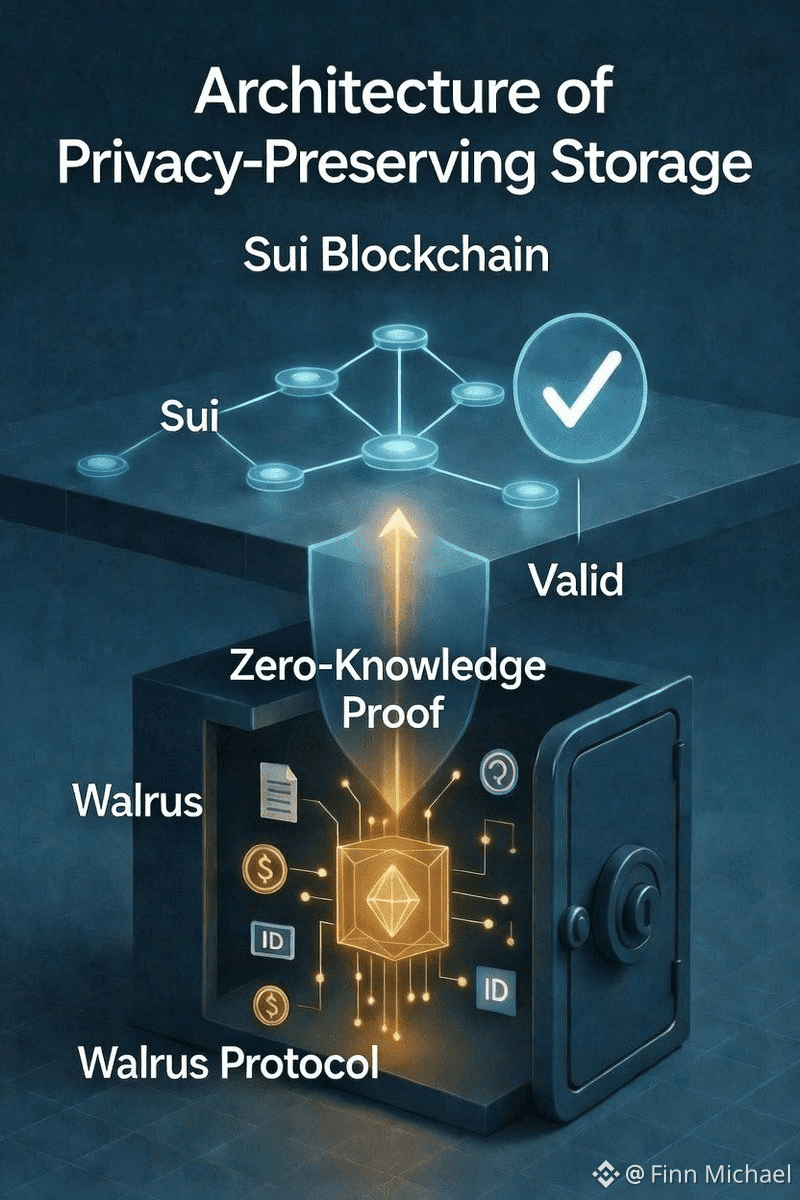
At its core, Walrus is a decentralized protocol designed to store and make data available in a way that does not rely on trust in a single entity. It lives on the Sui blockchain, not because blockchain is fashionable, but because Sui provides the structure needed to coordinate ownership and integrity without carrying the heavy weight of actual data. Walrus understands something important: blockchains should decide truth, not store everything.
So Walrus separates responsibility from burden. The blockchain keeps track of what exists, who owns it, and how it should behave. The data itself lives across a decentralized network, spread out, protected, and constantly watched over by incentives rather than promises.
Instead of treating files like fragile objects sitting on a server, Walrus turns them into blobs, pure pieces of data with an identity that can be verified forever. These blobs are not copied endlessly, wasting space and money. They are transformed using erasure coding, a mathematical process that breaks data into fragments and spreads them across many independent nodes. No single node holds your full data. No single failure can erase it. Even if parts of the network disappear, your data survives.
There is something deeply comforting in that idea. Not because it sounds technical, but because it mirrors how humans survive. We do not rely on one memory, one person, or one place. We distribute our stories, our knowledge, our existence. Walrus does the same with data.
The network itself moves in epochs, rotating responsibilities so nothing becomes static or predictable. This constant motion makes the system stronger over time. It does not freeze data in a fragile structure. It lets it breathe.
Powering all of this is the WAL token, but it does not exist as an empty symbol. WAL is how storage is paid for, how the network is secured, and how decisions are made. When someone stakes WAL, they are not just seeking rewards. They are taking responsibility. They are saying, “I will help keep this data alive.” When users delegate their tokens or vote on governance decisions, they are participating in something closer to stewardship than speculation.
And this is where Walrus becomes more than infrastructure.
Artists who have watched their work disappear when platforms shut down find something reassuring here. Developers tired of duct-taping decentralized apps to centralized storage finally feel alignment. Businesses storing sensitive data see a future without vendor lock-in or silent surveillance. AI builders, drowning in massive datasets, see a way forward that does not compromise integrity or cost.
But beyond all use cases, Walrus speaks to a shared emotional truth: people want stability in a world that feels increasingly temporary.
We live in an age where digital things vanish faster than physical ones. Links rot. Services die. Platforms pivot. Walrus pushes back against that impermanence. It does not promise immortality, but it offers durability rooted in math, incentives, and decentralization rather than trust and convenience alone.
There is no loud rebellion in Walrus. No dramatic slogans. Just a steady insistence that data deserves better. That ownership should mean something. That privacy should not be optional. That the things we create digitally should not disappear quietly when they are no longer profitable for someone else.
Walrus does not ask you to believe in it emotionally. It earns trust slowly, through structure, design, and intention. And maybe that is why it resonates so deeply. Because in a space full of promises about the future, Walrus feels like something solid you can stand on.
In the end, Walrus is not really about storage.
It is about relief.
The relief of knowing that what you build, what you save, and what you care about does not vanish when a server goes dark. The relief of finally feeling that your digital life is not borrowed, but truly yours.