
A quiet weakness in many onchain systems shows up when rules meet reality. On paper, governance exists. Frameworks are defined. Constraints are documented. But when something actually breaks, enforcement often falls back to discussion. Votes are proposed. Edge cases are argued. Temporary exceptions are introduced to keep things moving. This approach holds together while the stakes are low. It starts to crack when real assets, regulation, and external accountability enter the picture. Dusk is built to avoid that crack by pushing enforcement into execution instead of social coordination.
In traditional finance, governance and enforcement are separate by design. Policies define boundaries, but systems enforce them mechanically. Once a rule exists, it applies the same way every time. Many blockchains blur this line. Rules exist, but enforcement depends on interpretation, visibility, or intervention after the fact. Dusk starts from a simpler, less forgiving assumption. If rules matter, they should not depend on judgment calls. They should execute automatically.
This becomes clearer when looking at how Dusk handles privacy alongside compliance. Privacy is not treated as an escape hatch. It does not weaken enforcement. Instead, it controls who can see information while leaving the rules untouched. Transactions and asset states can remain confidential, but compliance checks still run during execution. Whether data is visible or not does not change whether conditions are met. Enforcement happens regardless.
That separation matters when systems are under pressure. During volatile periods, social governance tends to become reactive. Participants push for exceptions. Rules are reinterpreted. Enforcement becomes uneven, even when intentions are good. Protocol-level constraints are harder to bend because they do not respond to urgency or sentiment. They either apply or they do not.
For developers, this changes how applications are designed. Building on Dusk means being explicit from the beginning. Who can interact. Under what conditions. What disclosures are triggered, and when. These are not informal guidelines that can be revisited later. They are execution rules. Once deployed, they behave consistently. That consistency reduces ambiguity and helps prevent governance drift as systems evolve.
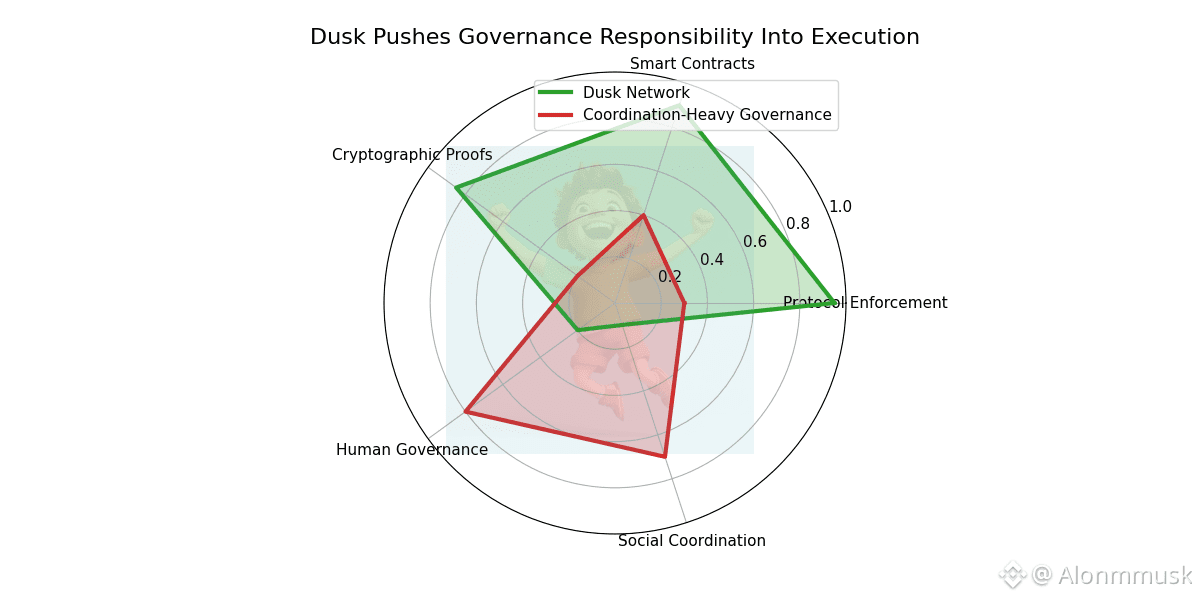
Tokenized assets show why this approach matters in practice. Real-world assets are not static objects. They carry obligations that persist through market cycles and regulatory change. Ownership may need to stay private. Transfers may need to remain conditional. Certain actions may require proof rather than disclosure. Dusk allows these constraints to live inside the asset itself, ensuring that governance decisions result in enforceable behavior instead of expectations.
This design also reflects a security mindset that assumes things will go wrong. Rather than trusting participants to act correctly, Dusk assumes they might not. Constraints are enforced during the execution. If conditions are not met, actions simply do not occur. This limits the damage mistakes in practice, can cause and reduces reliance on remediation after the fact. In systems handling real value, prevention matters more than explanation.
Decentralization takes on a more practical meaning here. It is not about how much information is visible. It is about how consistently rules are applied. A system that enforces constraints uniformly is more decentralized than one that relies on discretionary intervention, even if that intervention is transparent. Dusk strengthens decentralization by removing judgment from enforcement wherever possible.
Censorship resistance benefits from this structure as well. It is not only about whether transactions can be blocked. It is about whether rules can be selectively applied. When constraints live in code, they apply the same way regardless of pressure or identity. That consistency becomes important when systems operate under scrutiny or political influence.
Economic behavior follows the same logic. Systems that rely on frequent governance changes or incentive tweaks introduce uncertainty. Builders struggle to plan. Users struggle to trust long-term behavior. Dusk emphasizes durable rules in practice, and predictable economics, reducing the need for constant adjustment. Stability often often becomes a feature, not a side effect.
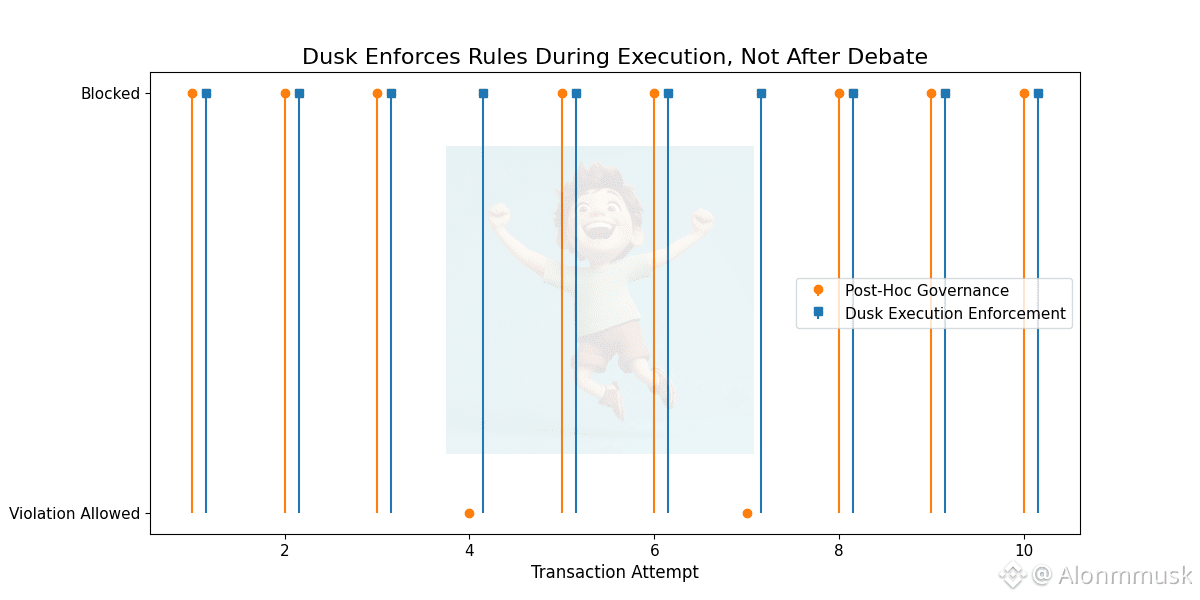
Usability improves almost as a consequence. When rules are clear and enforced in in practice, practice, automatically, users do not need to interpret shifting policies or rely on offchain assurances. Complexity is absorbed into the protocol instead of pushed onto participants. That reduction in uncertainty lowers friction without reducing control.
As the space matures, the limits of coordination-heavy governance become harder to ignore. Systems that depend on interpretation struggle under scale and stress. Infrastructure that turns governance decisions into execution logic behaves more reliably. Dusk Network is aligning with that reality by treating governance as a design problem, not a social process.
What ultimately defines Dusk is not flexibility, but clarity. Privacy scopes information. Compliance constrains behavior. Enforcement happens automatically. Governance sets parameters, but execution applies them without interpretation. That coherence reduces fragility and builds credibility slowly.
Dusk is not removing governance. It is making governance effective by ensuring decisions actually translate into predictable system behavior. In financial infrastructure, that translation is where trust is earned.
As attention moves on and narratives change, systems that rely on execution rather than coordination tend to endure. Dusk is building for that outcome, where privacy is structured, rules are enforced, and trust comes from behavior rather than agreement.
For educational purposes only. Not financial advice. Do your own research.
@Dusk #Dusk #dusk $DUSK
