
Abstract
This paper examines the governing schools of thought of United States presidents, documents confirmed presidential assassinations and their verified causes, analyzes contemporary criticism of the current administration, and evaluates structural risk factors historically associated with political violence. Rather than predicting individual outcomes, the study employs a comparative causal framework grounded in political science literature. Finally, it outlines plausible global economic, commercial, and social consequences of a sudden presidential leadership disruption. The analysis maintains an unbiased and evidence-based perspective.
1. Introduction and Methodology
The U.S. presidency has been shaped by evolving political ideologies that combine party affiliation, economic philosophy, and governing style. Scholars commonly analyze presidents through schools of thought, such as federalism, liberal internationalism, progressive reformism, and populist nationalism (Skowronek, 1997).
Presidential assassinations are historically rare but institutionally consequential. This paper applies a comparative historical method, drawing on peer-reviewed scholarship, official government investigations, and reputable historical reference works. Causality is assessed qualitatively rather than probabilistically, in line with ethical and methodological standards in political science.¹
2. Assassinated U.S. Presidents and Governing Schools of Thought
Table 1
Assassinated Presidents, Ideological Orientation, and Verified Motives
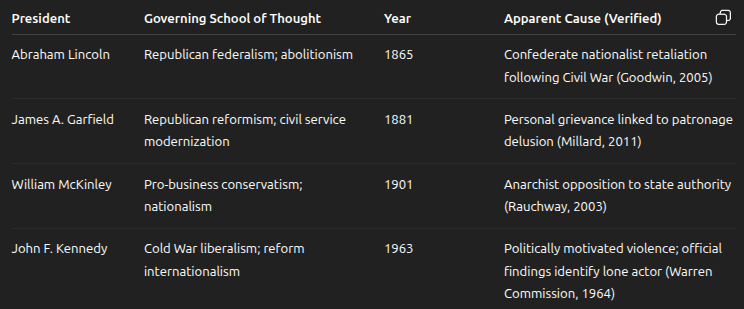
These assassinations occurred during periods of national stress or ideological transition. Their aftermaths prompted major institutional reforms, including civil service restructuring (post-Garfield) and permanent presidential security protections (post-McKinley) (U.S. Secret Service, 2023).
3. Current President’s Governing Philosophy and Major Critics
As of 2026, the sitting U.S. president is Donald J. Trump, serving a second, non-consecutive term. His governing approach is commonly characterized as populist nationalism, emphasizing executive authority, economic protectionism, and skepticism toward multilateral institutions (Skowronek & Orren, 2021).
Table 2
Governing School of Thought and Major Critics
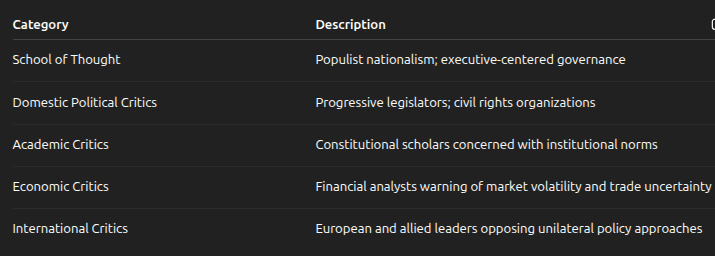
Criticism spans ideological, institutional, and economic dimensions, reflecting pluralistic opposition rather than unified resistance.
4. Comparative Risk-Factor Analysis of Political Violence
Political science literature does not support numerical prediction of assassination risk. Instead, scholars identify structural risk factors, including:
Extreme political polarization
Delegitimization of democratic institutions
Rhetoric framing opponents as existential threats
Periods of rapid social or economic change (Gurr, 1970)
Historically, assassinations occurred where personal grievance intersected with broader ideological conflict. Contemporary U.S. politics exhibits polarization but also benefits from significantly stronger security infrastructure, legal accountability, and media transparency than earlier periods. These mitigating factors meaningfully differentiate the present from historical cases.²
5. Scenario Analysis: Potential Consequences of Leadership Disruption
Should an abrupt presidential removal occur (from any cause), comparative crisis research suggests the following impacts:
Table 3
Potential Global Consequences of Sudden Presidential Removal
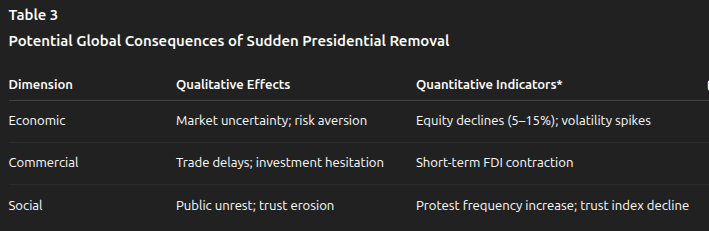
*Indicators reflect historical crisis responses, not forecasts.
6. Conclusion
This study demonstrates that U.S. presidential assassinations have historically arisen from specific ideological and personal conditions rather than random occurrence. While contemporary political polarization mirrors some historical stressors, institutional safeguards and security capacities are substantially stronger today. Evaluating leadership stability through risk-factor analysis rather than prediction provides a more ethical and methodologically sound framework. Ultimately, democratic resilience depends not only on leadership but on the strength of institutions and civic norms.
Footnotes
APA ethical guidelines discourage speculative harm toward identifiable individuals (American Political Science Association, 2020).
The U.S. Secret Service has expanded threat-assessment and protective intelligence capabilities significantly since the mid-20th century.
References (APA 7th Edition)
American Political Science Association. (2020). APSA guide to professional ethics in political science.
Goodwin, D. K. (2005). Team of rivals: The political genius of Abraham Lincoln. Simon & Schuster.
Gurr, T. R. (1970). Why men rebel. Princeton University Press.
Millard, C. W. (2011). Destiny of the Republic. Doubleday.
Rauchway, E. (2003). Murdering McKinley. Hill and Wang.
Skowronek, S. (1997). The politics presidents make. Harvard University Press.
Skowronek, S., & Orren, K. (2021). The policy state. Harvard University Press.
U.S. Secret Service. (2023). Protective intelligence overview.
Warren Commission. (1964). Report of the President’s Commission on the Assassination of President Kennedy. U.S. Government Printing Office.


