
A story most builders know too well
Imagine this.
You’re a developer. Not a crypto maximalist, not a hype chaser just a serious builder. You’ve spent years learning Solidity, setting up wallets, deploying contracts, fixing bugs at 3 a.m., and shipping products that actually need users.
One day, someone slides into your inbox.
“Hey, check out this new Layer-1. Insane tech. Revolutionary consensus. Totally changes everything.”
You click the link. The ideas are impressive. The diagrams are beautiful. The promises are bold.
Then you reach the part that actually matters.
Integration.
Custom wallet support.
New SDKs.
Non-standard tooling.
Months of engineering before your app even works.
You close the tab.
Not because the chain is bad.
Not because the tech isn’t impressive.
But because time is expensive, and friction kills adoption faster than bad code ever will.
This is how many “serious” blockchains don’t die loudly they simply never get adopted.
And this is exactly the problem Dusk is trying to solve.
The real reason blockchains fail (and it’s not hype)
Most people think blockchains fail because:
The token price crashes
Users lose interest
The market moves on
That’s the visible part.
The real failure happens much earlier, in places most people never look:
Exchanges don’t want custom integrations
Wallets don’t want bespoke support
Apps don’t want to rebuild everything from scratch
When a new chain requires months of custom engineering, most teams quietly walk away.
This isn’t laziness. It’s survival.
In the real world, adoption isn’t driven by the question:
“Is this technology impressive?”
It’s driven by:
“How long will this take, and how much will it cost?”
That single question decides the fate of most blockchains.
Why integration cost is the silent killer
Think about exchanges, wallets, and apps as airports.
They don’t want to redesign the entire runway every time a new plane shows up. They want planes that can land using the systems already in place.
Custom Layer-1s often ask for:
New signing methods
New wallet standards
New transaction formats
New security models
Every one of these adds friction. Every one increases risk.
So what happens?
Projects don’t reject you publicly.
They just… don’t prioritize you.
And eventually, your chain becomes a niche ecosystem with good ideas and no traffic.
Dusk looked directly at this problem and instead of pretending it didn’t exist, they redesigned the stack.
The modular idea explained simply
At its core, Dusk’s approach is surprisingly human.
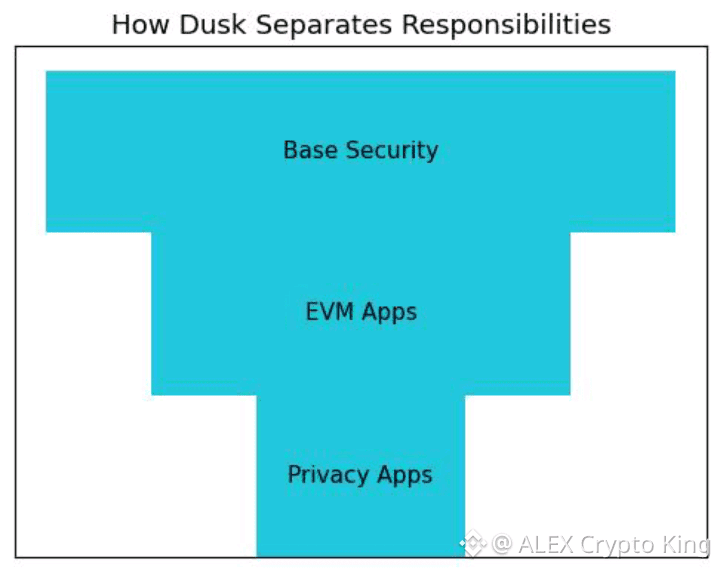
Instead of forcing one layer to do everything, Dusk splits responsibilities into layers that do one thing well.
Think of it like a city:
The foundation keeps everything stable
The roads let people move freely
The buildings are where life actually happens
Trying to cram all of this into one layer makes everything fragile.
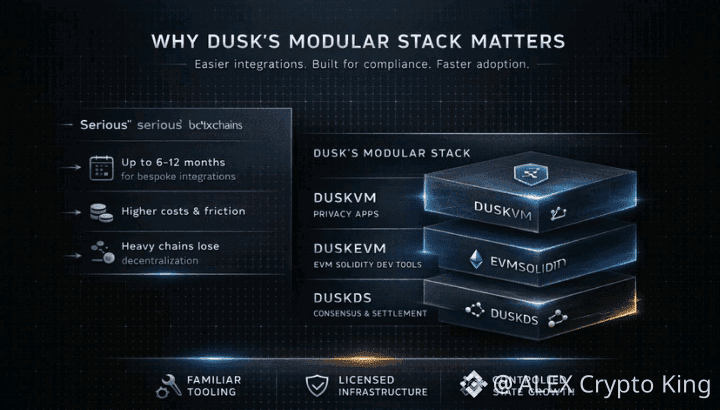
Dusk’s modular stack is built around three layers:
DuskDS the foundation
DuskEVM familiar execution
DuskVM privacy-focused applications
Each layer exists for a reason. Let’s break them down in plain English.
Layer 1: DuskDS the quiet backbone
DuskDS is the base layer. It’s not flashy, and that’s intentional.
This is where the network handles:
Consensus
Data availability
Settlement
Staking
Bridging
In other words, this layer answers the question:
“Can we trust this network to be secure and stable over time?”
Dusk’s philosophy here is restraint.
Instead of piling on complex logic, the base layer is kept lean, using succinct proofs and efficient mechanisms. Why?
Because blockchains don’t just run for a year.
They run for decades.
The overlooked problem: state growth
Here’s something most people don’t think about.
Every transaction adds data.
Every contract adds state.
Every interaction makes the chain heavier.
Over time, running a node becomes harder. More storage. More computation. More cost.
Eventually, only well-funded entities can afford to run full nodes.
And that’s how decentralization quietly dies.
Dusk’s answer is simple but powerful:
Keep the base layer minimal
Push heavier execution upward
Protect long-term accessibility
This isn’t about today’s performance.
It’s about whether the network can still function 10 or 20 years from now.
Layer 2: DuskEVM meeting developers where they already are
Now comes the most important adoption decision Dusk made.
Instead of asking developers to learn everything from scratch, Dusk said:
“What if we just let you use what you already know?”
That’s where DuskEVM comes in.
This layer supports:
Solidity
Existing EVM tooling
Familiar development workflows
For a builder, this changes everything.
Instead of months of learning and integration, teams can:
Deploy in weeks
Reuse existing knowledge
Reduce risk dramatically
This is not a small detail.
Dusk has openly stated that custom Layer-1 integrations can take many months, while EVM-based deployments can happen in a fraction of that time.
In the real world, that difference decides whether builders show up at all.
Layer 3: DuskVM privacy where it actually matters
Now let’s talk about privacy but without the usual drama.
DuskVM is designed for applications that need strong privacy:
Regulated finance
Institutional settlements
Sensitive transactions
This layer allows developers to build privacy-oriented applications without forcing every app to operate under the same constraints.
Why is this important?
Because not all applications need heavy privacy.
But when privacy is needed, it must be done properly.
By isolating privacy logic into its own layer, Dusk avoids:
Bloated base layers
Unnecessary complexity
One-size-fits-all compromises
It’s optional, targeted, and intentional.
The institutional angle most chains ignore
Here’s another uncomfortable truth.
Institutions don’t hate crypto.
They hate uncertainty.
Dusk’s connection to NPEX and its regulatory framing is not an accident. It’s part of the design.
The idea is simple:
One regulatory framework
One stack
Issuance, trading, and settlement under the same umbrella
At the same time, developers still get:
EVM familiarity
Standard tooling
A workflow that doesn’t feel foreign
This balance compliance without developer alienation is rare.
Most chains pick one side and alienate the other.
Dusk is trying to hold both.
Why this approach feels different
Dusk isn’t asking the world to change for it.
It’s changing itself to fit the world that already exists.
That’s the key difference.
Instead of saying:
“Learn our system because it’s better”
Dusk is saying:
“Use what you already know we’ll handle the hard parts.”
That mindset shows maturity.
It recognizes that:
Adoption is emotional and practical
Builders are busy
Infrastructure wins quietly, not loudly
This is not about hype it’s about time
If you strip everything else away, the modular stack is really about one thing:
Time.
Time to integrate
Time to deploy
Time to maintain
Time to scale
Most chains lose because they cost too much of it.
Dusk’s modular architecture is an attempt to respect developers’ time, institutions’ constraints, and the network’s future all at once.
That doesn’t guarantee success.
But it does mean Dusk is solving the right problems.
Final thoughts: quiet design beats loud promises
In crypto, the loudest projects often burn out fastest.
The ones that survive tend to do something less glamorous:
Reduce friction
Respect existing workflows
Think long-term
The modular stack of Dusk is not flashy marketing. It’s an engineering answer to a human problem: adoption fatigue.
By separating concerns, minimizing integration cost, and meeting builders where they already are, Dusk isn’t trying to win today’s attention cycle.
It’s trying to still be relevant when most of today’s chains are forgotten.
And in a space obsessed with noise, that kind of quiet confidence is rare.
