
In complex systems, the most dangerous failures are usually the ones that seem manageable for a long time. Data availability often sits in that category. As long as things mostly work, missing guarantees stay out of sight. The problem only shows up later, when verification becomes slow, incomplete, or impossible. At that point the damage is already done. Walrus is built around a simple idea. Data availability should not depend on vigilance, heroics, or constant attention. It should be routine, auditable, and largely unremarkable.
Modern blockchain stacks are becoming more modular by design. Execution layers focus on processing transactions efficiently. Settlement layers focus on finality. Applications change quickly as teams iterate. Data sits underneath all of this, quietly holding the system together over time. When availability is uncertain at that base layer, every layer above it inherits risk. Walrus makes that dependency explicit by turning availability into a defined service with clear guarantees, instead of treating it as an accidental outcome of participation.
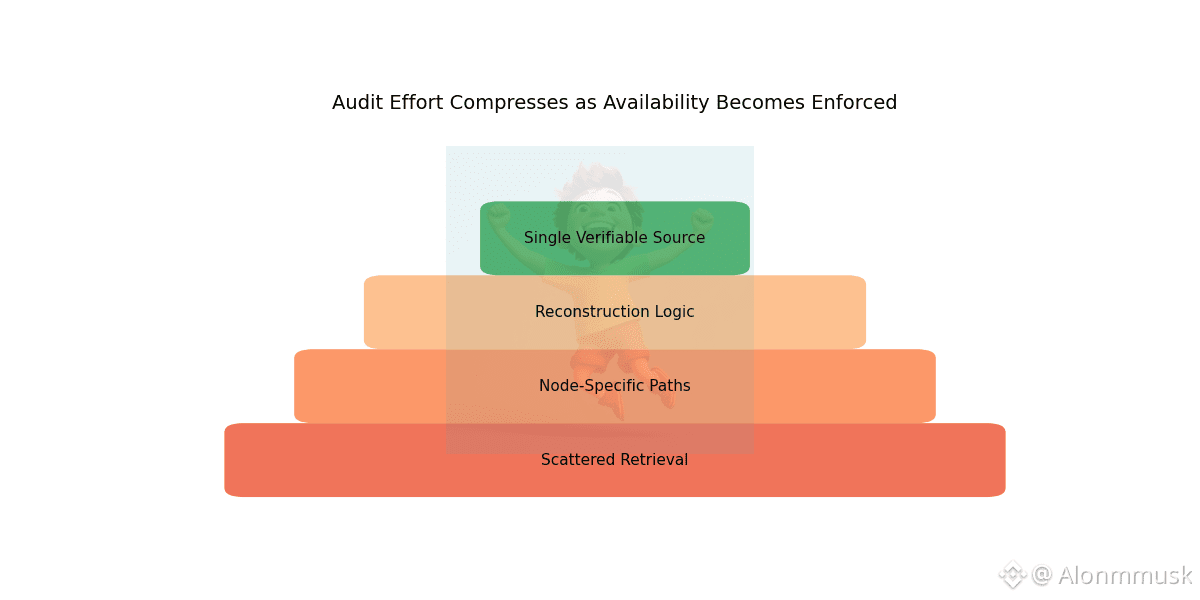
One of the least discussed problems in decentralized systems is audit fatigue. Over time, it becomes harder to answer basic questions about the past. Data is scattered. Retrieval paths differ between nodes. Assumptions accumulate. What should be a straightforward check turns into an investigation. Walrus narrows that problem by anchoring data integrity cryptographically while keeping storage economics predictable. Audits become simpler because the question is simpler. Is the data available and verifiable. Not who still has it or how difficult it is to reconstruct.
This predictability matters for teams building systems meant to last. When availability feels fragile, developers compensate by adding layers of complexity. Redundant storage setups. Custom fallback logic. Ongoing monitoring. Each workaround solves a local problem while increasing overall fragility. Walrus absorbs much of this burden at the infrastructure level. Developers can assume continuity and design simpler systems. In security engineering, simpler systems usually fail less often.
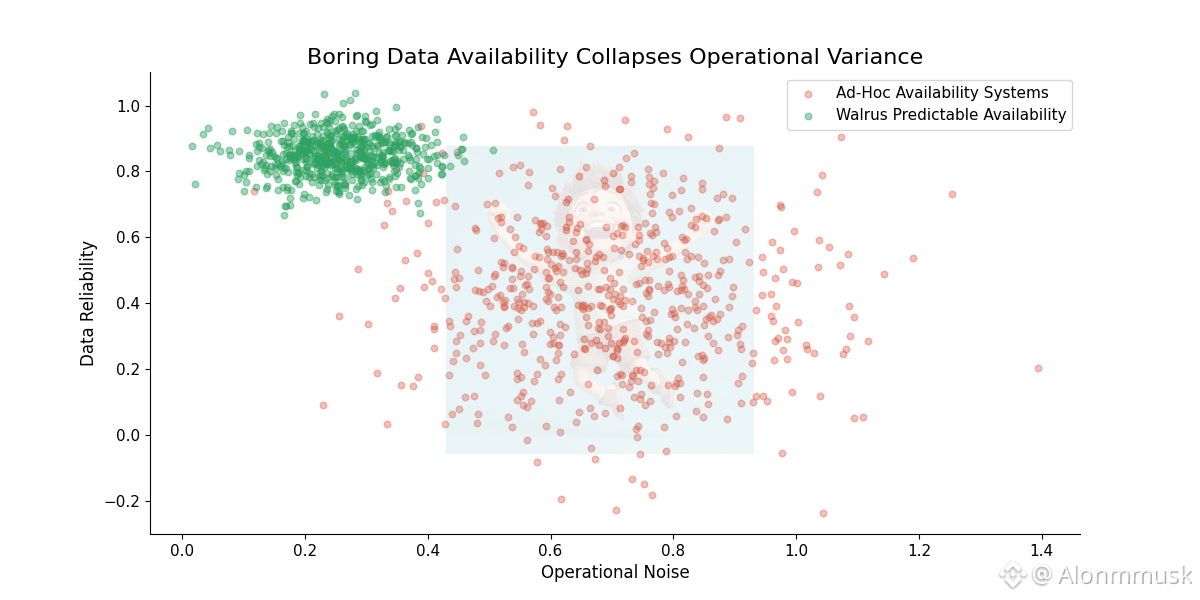
Usability is affected as well, even if end users never touch the data layer directly. Applications built on fragile availability tend to degrade quietly. Verification slows down. Features behave inconsistently. Confidence erodes without a clear breaking point. By making data persistence reliable, Walrus improves user experience indirectly. Systems feel stable because the foundation underneath them is stable. This is the kind of usability people only notice when it disappears.
Responsibility is another area where Walrus is more explicit than most designs. In many systems, data is everyone’s problem and therefore no one’s responsibility. Availability depends on overlapping incentives and informal coordination. Walrus replaces that ambiguity with obligation. Data remains available because the protocol typically requires it, not because participants happen to stay aligned. That shift from coordination to enforcement is subtle, but it matters over long time horizons.
For rollups and Layer 2 networks, this clarity is especially important. Their security models rely on access to historical data for state reconstruction and dispute resolution. If availability weakens, those guarantees weaken too, regardless of how well execution performs. Walrus gives these systems a stable reference point. Instead of embedding fragile assumptions into their own design, they can rely on a dedicated availability layer that is built for persistence.
Economic predictability reinforces this trust. Infrastructure that is meant to support long-lived systems cannot rely on opaque or highly volatile pricing. Builders need to plan years ahead, not just for the next deployment. Walrus emphasizes clearer economic structures that make availability costs understandable over time. Predictable economics reduce the need for constant adjustment and lower the risk of sudden degradation when incentives shift.
Neutrality remains a deliberate choice. Walrus does not try to influence execution design, governance decisions, or application behavior. It does not compete for liquidity or attention. It provides a service that many ecosystems can depend on at the same time without giving up control. That neutrality makes integration easier and reduces the risk that availability becomes tangled up in governance disputes or narrative cycles.
The ecosystem forming around Walrus reflects this mindset. Builders are not optimizing for short-term visibility. They are working on rollups, archival systems, and data-heavy applications where correctness over time matters more than the iteration speed. These teams care about in practice, guarantees that hold through upgrades, governance changes, and market cycles. For them, reliability is not a feature. It is the baseline.
There is also a broader shift in the industry that makes this approach more relevant. As crypto systems begin to support more real economic activity, tolerance for hidden fragility drops. Users may never talk about data availability explicitly, but they feel its absence immediately when systems cannot verify history or resolve disputes. Infrastructure that quietly removes these failure modes becomes indispensable.
Security models that assume failure rather than perfection naturally converge on this layer. Participants leave. Incentives change. Attention fades. Systems that rely on constant engagement eventually degrade. Walrus is designed to remain dependable under those conditions, so memory does not decay just because momentum slows.
What ultimately distinguishes Walrus is restraint. It does not expand beyond its mandate. It does not chase execution narratives or application trends. Each design decision points in the same direction. Make data available. Make it verifiable. Make it predictable. Over time, that focus compounds into trust.
In decentralized systems, credibility is built by what continues to work after excitement fades. Walrus is building for that phase. Quietly ensuring that history remains intact, audits remain possible, and verification remains objective. That kind of reliability rarely draws attention, but it is what allows entire ecosystems to endure.
For educational purposes only. Not financial advice. Do your own research.
@Walrus 🦭/acc #Walrus #walrus $WAL

