

@Walrus 🦭/acc did not enter institutional awareness by chance. When the Grayscale Walrus Trust was formed in June 2025, it was not an attempt to capitalize on hype or perfect narrative timing. It was a response to a slower, more persistent pressure that has been building across DeFi capital seeking exposure without being dragged into operational risk it never intended to manage.
At first glance, the trust looks familiar. Grayscale introduces a vehicle, accredited investors participate through private placement, transfers are restricted for a year, and the market speculates about eventual public listing or ETF conversion. That description is accurate but superficial. The more important story lives beneath it, in forms of friction that rarely appear in metrics or market commentary.
On-chain systems have optimized aggressively for access while neglecting time. Capital can move instantly, yet it can become immobilized just as quickly. Custody complexity, key management, validator exposure, protocol-level operations, and liquidity constraints all shape behavior long before price signals do. For large allocators, these frictions are not minor inconveniences they warp decisions. Exposure becomes tactical instead of structural. Position sizes are dictated less by conviction than by what internal systems can safely support.
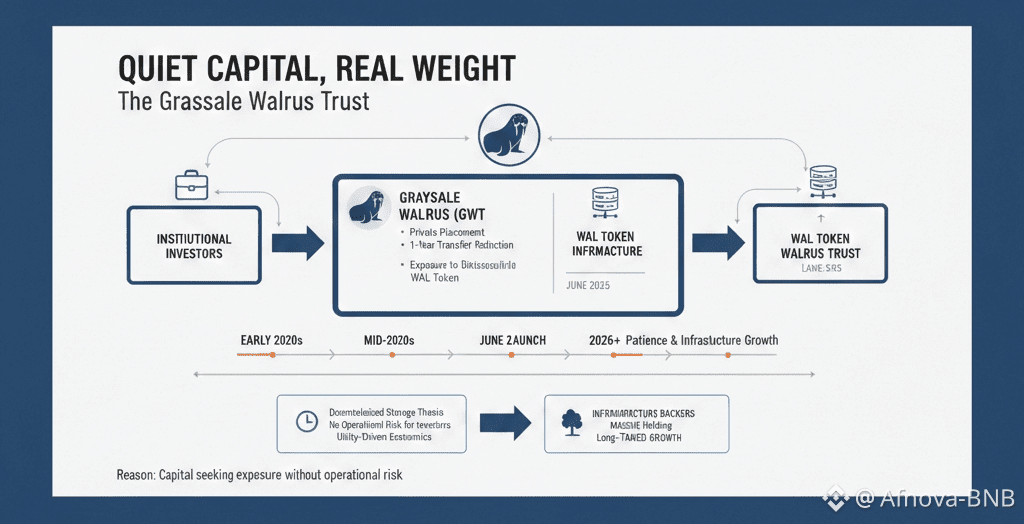
The Walrus Trust exists because that misalignment had no clean outlet.
By offering exposure to WAL without requiring interaction with wallets, validators, or custody infrastructure, the trust removes a layer of forced expertise. Institutions are not trying to demonstrate technical fluency in crypto operations. They are evaluating whether an underlying system merits long-term capital. Everything else is distraction. The trust absorbs that operational noise and presents WAL as an investment instrument rather than an ongoing technical responsibility.
That distinction carries more weight than it appears.
A significant amount of value in DeFi is lost not through outright failure, but through imposed time horizons. Volatility forces premature exits. Complexity encourages defensive positioning. Governance tokens are treated like short-dated options because holding them feels like uncompensated work. Over time, this dynamic rewards short-term behavior while quietly penalizing anyone attempting to think in multi-year cycles.
Walrus operates in a layer where these pressures intensify. Storage lacks spectacle, but it is relentlessly governed by economics. Data is indifferent to narratives. It responds to cost, availability, and reliability. When those conditions hold, usage grows steadily and persists. When they break, users drift away long before price reflects the change.
The trust does not claim to repair these fundamentals, nor does it obscure them. Instead, it aligns exposure with reality. Investors holding WAL through the trust are not seeking governance leverage or yield extraction. They are backing an infrastructure thesis that decentralized storage, if designed without hidden subsidies and priced honestly, can function as a utility rather than a speculative instrument.
Even the pricing framework reinforces this posture. The trust references the CoinDesk Walrus Reference Rate, a volume-weighted price derived from major trading venues. The goal is not to capture peak enthusiasm, but to reflect where liquidity actually settles. For institutional capital, that difference is decisive. It limits the risk of valuing assets based on sentiment rather than execution.
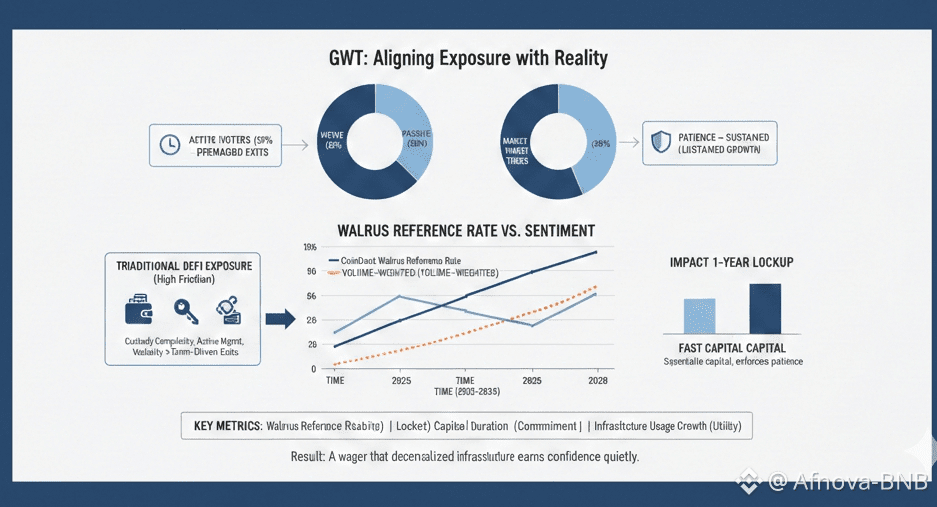
The one-year transfer restriction often draws criticism, yet it serves a clear purpose. It screens out capital that demands immediate flexibility. Lockups enforce patience, and patience tests whether a thesis survives periods of inactivity. Previous cycles offered harsh lessons liquid governance tokens attracted fast capital, fast capital exited, and governance eroded long before the technology failed.
Walrus is attempting to avoid that pattern quietly, without slogans.
There is also a governance implication that rarely gets attention. When every token holder is nominally expected to vote, most do not. Governance becomes symbolic, dominated by those with surplus time rather than aligned incentives. Institutional exposure via a trust does not resolve governance challenges, but it removes the pretense that every holder must engage directly. Some forms of conviction are better expressed silently.
That silence can be constructive.
None of this ensures success. Storage economics are unforgiving. Costs shift. Demand assumptions break. Integrations slip. Models that appear elegant on paper often unravel under real usage. Walrus is exposed to all of these risks, and the trust offers no insulation from them.
What the trust does indicate is that the project is being judged on its capacity to absorb capital without warping itself. That standard is more demanding than attracting users. It requires discipline in token design, restraint in roadmap commitments, and a willingness to grow at the pace demand allows rather than forcing acceleration.
In a market conditioned to hunt for catalysts, the Grayscale Walrus Trust is intentionally understated. It offers no yield promises, no governance acceleration, no artificial liquidity. It simply gives long-duration capital permission to remain still.
Over time that stillness matters. The protocols that endure are rarely the ones that move the fastest, but the ones that allow capital to stay patient without penalty. Walrus is making a quiet wager that decentralized infrastructure can earn that kind of confidence. If it succeeds, the result will not be loud it will last.

