

@Dusk Network exists because many on-chain systems are designed around an oversimplified view of markets. I have heard the same concern echoed repeatedly from traders, builders, and institutional players alike even if they phrase it differently each time decentralized finance works well right up until real capital, real regulation, and real timing constraints collide. That is usually the point where weaknesses stop being theoretical and start causing damage.
What stood out to me early on is that Dusk does not attempt to patch superficial problems. It does not compete for headline throughput figures or abstract decentralization scores. Instead, it confronts a reality that most protocols sidestep: financial markets are inherently constrained. Capital operates under regulation, identities matter even when they must remain private, and finality is not a matter of preference or ideology it is a legal necessity.
Many DeFi systems build consensus around openness and speed, not discretion. Validator identities are public, stake distributions are transparent, and block production follows patterns that can be observed, modeled, and eventually exploited. That approach holds until capital scales to a point where predictability itself becomes a vulnerability. Transparency sounds virtuous in theory, but in practice it enables front-running during settlement windows and targeted pressure against known block producers. Privacy failures rarely announce themselves loudly more often, they erode value gradually.
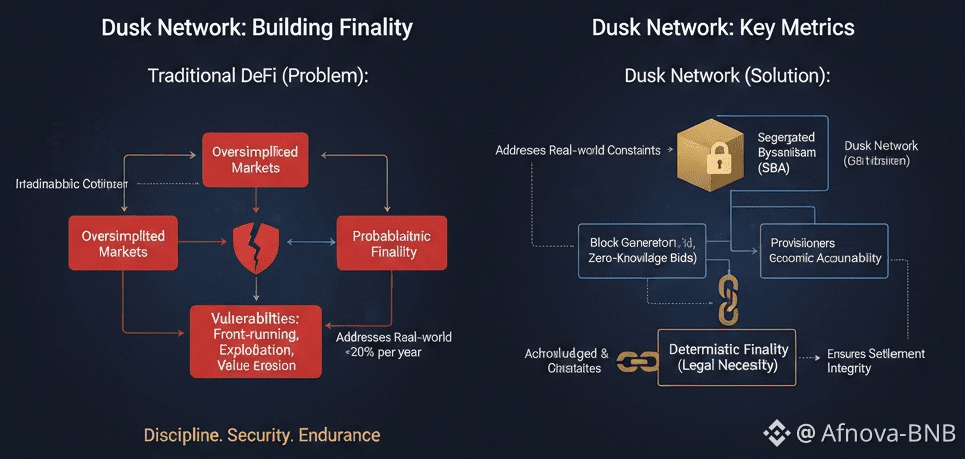
Dusk’s Segregated Byzantine Agreement is designed to address that slow erosion. Rather than assuming visible stake is benign, it treats exposure as a first-class risk. Separating block generators from provisioners is not an aesthetic choice it reflects the understanding that different roles in a financial system should not carry identical visibility. When generators submit blind bids through zero-knowledge mechanisms, the goal is not ideological concealment. It is to limit the informational edge that adversaries accumulate over time.
Proof of Blind Bid is sometimes criticized as overly complex. In my experience, that criticism usually comes from those who have not watched capital freeze because a validator set became too legible. Complexity is not the real threat here. Poorly chosen simplicity is. By allowing anonymous participation in block proposal while maintaining public economic accountability for provisioners, the protocol strikes a balance between discretion and auditability. That balance is uncommon—and consequential.
The block lifecycle itself may appear rigid, but rigidity is precisely what settlement demands. Experimental chains tolerate probabilistic finality because users accept reversions as part of exploration. Markets do not afford that luxury. When an equity transfer or bond issuance is recorded, reversal is not an inconvenience it is a breach. I have seen entire DeFi proposals dismissed in minutes once this distinction becomes clear. Deterministic finality may lack excitement, but it is non-negotiable.
One of Dusk’s more understated qualities is how it reshapes incentives without drawing attention to itself. Block generators are not rewarded for being visible. Provisioners are not rewarded for raw speed alone. The system quietly discourages behaviors that appear profitable in the short term but undermine settlement integrity. There is no performative governance promising alignment someday. Either incentives align by construction, or they do not.
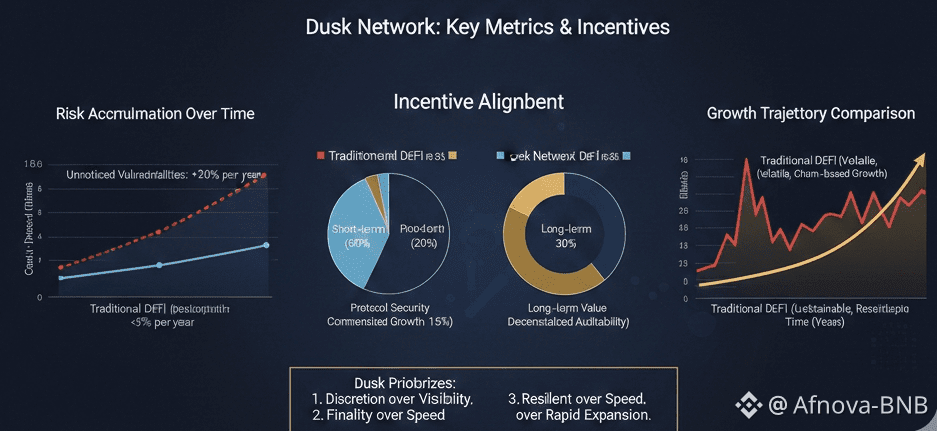
I have been asked whether this approach constrains growth. My answer has always been the same: it constrains the wrong kind. Growth driven by churn, reflexive leverage, and brittle incentives rarely survives stress. Dusk does not optimize for participants who need instant exits regardless of cost. It is designed for capital that must remain deployed without being pushed into poor decisions by the protocol itself.
Over long horizons, the most dangerous risks are those that accumulate unnoticed validator concentration, governance exhaustion, exposure patterns no one models until pressure arrives. Dusk does not claim to eliminate these risks entirely, but it acknowledges them from the outset. That alone distinguishes it from systems that only confront their limits when markets turn adversarial.
This protocol matters not because it promises dramatic transformation, but because it respects how money behaves under pressure. It does not seek attention. It does not rush outcomes. It settles. And in financial infrastructure, that quiet discipline often determines whether a system endures multiple cycles or simply survives until the next one.
