

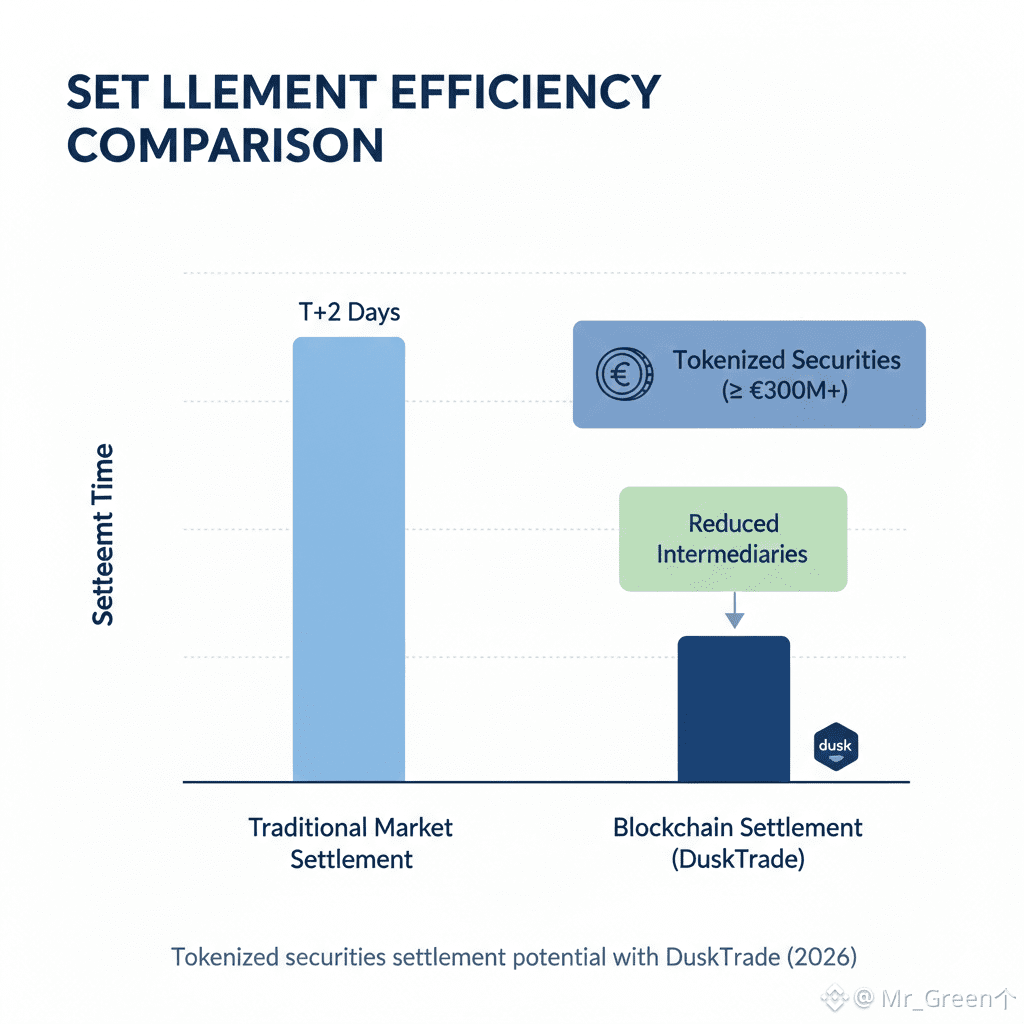
The first time I made a trade, I felt like I was entering the future. I pressed a button, saw the chart move and got my order confirm instantaneously. It was instant, the digital era catching up to the speed of money. Then I found out what goes on beneath that slick interface. Settlement still takes time. Paperwork still exists, just hidden. Custody remains multiple layers removed from where they interpose. And the more serious the asset becomes, stocks, bonds, regulated instruments, the more quietly the system reverts to form: delays, gatekeepers and complexity you don’t feel until something goes wrong.
That gulf between what trading appears like and the way it works is one of the primary reasons real-world assets haven’t moved on-chain meaningfully. Not because blockchains can’t move value fast; they can be faster, and speed does matter. They’re about rules. They’re about compliance. They’re about privacy. They’re about audit trails. And that’s precisely why DuskTrade is such a sign.
Founded in 2018, Dusk wasn’t created as “just another Layer 1.” It is designed for regulated financial infrastructure that is privacy-preserving, where privacy and auditability are not mutually exclusive, but rather co-dependencies. That intention does matter, because the most difficult part of bringing real-world assets on-chain isn’t minting a token. It is creating an environment where those assets can live, and trade, settle and be in compliance in the way that we would expect real world financial products to operate.
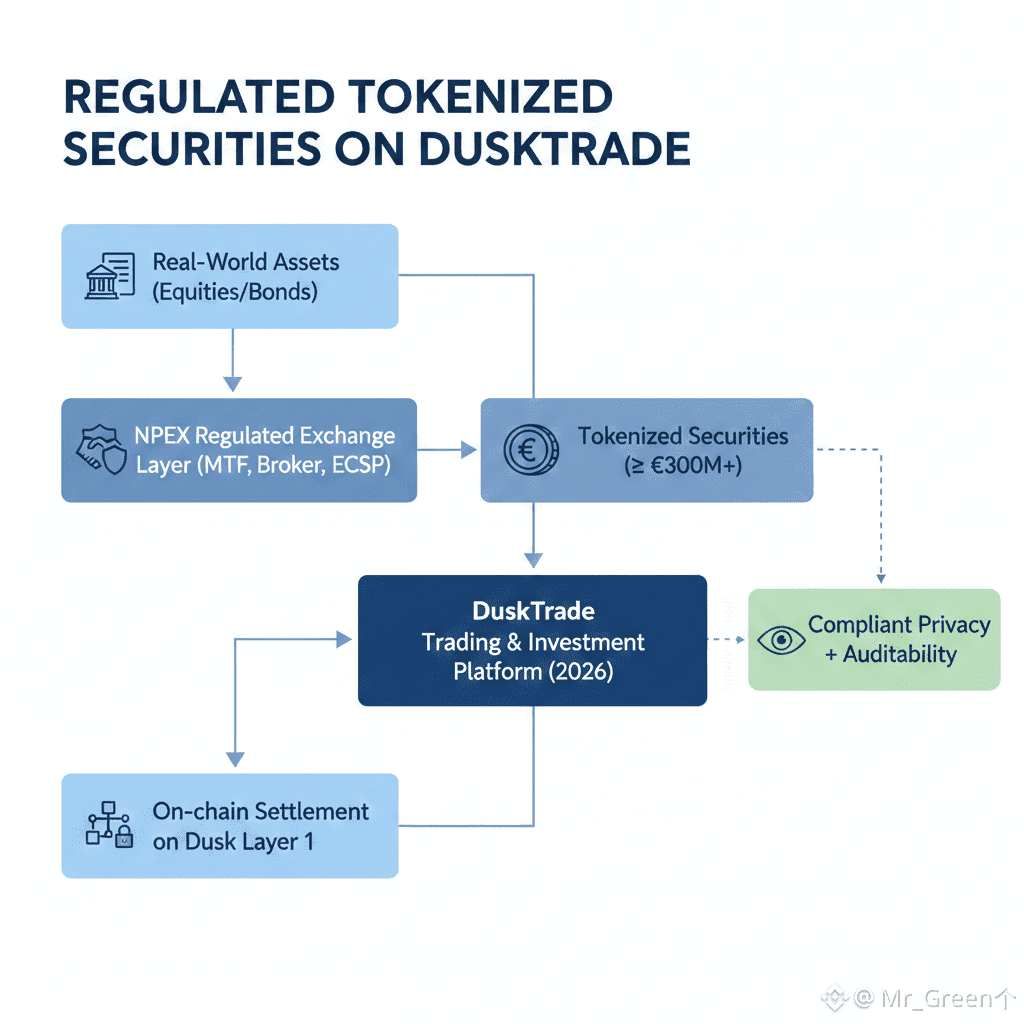
DuskTrade is set to go live in 2026, and it’s being presented as Dusk’s first major use case: a compliant trading and investment platform, working with NPEX, a regulated market from the Netherlands. The headline detail isn’t the mere fact of “tokenized assets”; it’s how they fit into a framework. NPEX has MTF, Broker and ECSP licenses, and aims to onboard €300M+ tokenized securities on-chain. That’s not a demo. That’s not a vibe. That is a serious effort to make blockchain into market infrastructure that real institutions can use.
A lot of crypto has attempted to tell the RWA story. But RWAs are one of those narratives that disintegrate the moment you ask a practical question: who is legally allowed to issues this, who makes sure investors follow onboarding rules, how do I ensure market integrity or keep privacy, without breaching transparency obligations?
So that’s where DuskTrade becomes something more than a “product launch.” It becomes a blueprint.
When you build with a regulated exchange, you can’t just add credibility but are compelling the system to be real. “Licensing is the line between a token that exists and an asset that can be traded under compliance.” The trust layer in traditional markets is the exchange. In crypto, exchanges are often little more than venues. DuskTrade is combining those worlds into something more akin to what regulated finance really wants: a contemporary on-chain venue that is engineered with the legal frameworks necessary so that it can run as an actual market.
Now imagine a simple scenario.
A relatively young European business is looking to raise up some money. In the old world, this is a cumbersome process of paperwork, middlemen, delays and fragmented ownership records. In a tokenized world, the “share” or “bond” is a digital asset, but it still requires compliant onboarding, clear auditability and trading rails that don’t lay everybody’s positions and strategies out in public.
With DuskTrade’s guidance, the flow looks cleaner. A user signs up, goes through KYC process when the service is available in his/her country and gets compliant access to tokenized investment products. The investor does not have to understand cryptography to derive value from it; they encounter a more seamless market. Under the hood, the infrastructure is built to manage those things that count in regulated settings: privacy where it should be and auditability where it must be.
And here’s the part most people miss: privacy is not a “nice-to-have” for finance.
In the crypto space, transparency is too frequently taken as an unambiguous good. But in professional trading, complete transparency is a weakness. A big investors’ visible positions are a liability. If a plan can be made, it can be undone. If counterparties can be compromised relationships can be profiled and leveraged. That’s why finance with sensitive activity is protected by traditional finance, and that’s why the public-by-default blockchains have a hard time being serious market rails.
And Dusk’s approach is built for that reality. With its EVM layer, Dusk’s smart contracts will allow for standard Solidity smart contracts to be deployed; settling straight onto the Dusk Layer 1 removes the “hassle” slowing down integration. It matters, because the number one way to drive adoption of web tools is not forcing it on world to learn new ones; it’s making developers more productive where they already are.
And then there is the privacy layer that makes it institution-grade.
Hedger enables privacy-preserving yet auditable transactions on EVM using zero-knowledge proofs and homomorphic encryption, designed for regulated financial use cases. That’s an important phrase: compliant privacy. Not privacy as an escape hatch, but privacy as a feature that can coexist with oversight.
If you’re a developer reading this, here’s why this is a big deal.
For years, building in crypto has meant choosing between two unpleasant extremes: fully transparent DeFi apps that leak like a sieve, and privacy systems that are miserable to use because they can’t add up or worry about integrating with the rest of the world. Another option here, and one that is third way in Dusk’s direction, if you like, is to make sure there should be a path for an EVM-like environment to feel completely comfortable running privacy-preserving logic without crossing over the regulated barrier. Which means you could build investment flows, tokenized asset interactions or compliant DeFi mechanics without having to assume your users are cool with sharing their financial life in public.
The timing also matters. DuskEVM mainnet is planned for the second week of January, which means builders aren’t just looking at an idea; they’re looking at an execution layer that can be built on. When execution is a reality, ecosystems emerge more quickly: tooling, integrations and applications begin to appear.
Now flip the perspective.
If you’re a client, an institution, an issuer or to be honest just a serious investor, DuskTrade matters because it points to the idea that tokenized assets are not merely interesting experiments. Rather, they exist in a system meant to be used by the regulated entities. It’s not just that “can we trade this,” but also “can we trade this legally, at scale, with privacy and with good market structure?”
That’s what makes the NPEX partnership unique. NPEX is not just a name in a press release; it’s a regulated exchange Counterparty with licenses that determine what market activities are feasible. The key point in the 2026 launch of DuskTrade lies in the combination of NPEX’s licensing framework with Dusk’s privacy-centric Layer 1 infrastructure.
Even the minutiae are signals. With the waitlist going live in January, it seems clear that the platform is entering a kind of early onboarding stage, not necessarily building quietly behind the scenes, but genuinely setting up access to potential users. Unlike in an unregulated market, where viral hype can go a long way, this is the kind of orchestrated rollout that carries weight.
Ultimately, DuskTrade is boring due to the fact its about RWAs coming. It’s an interesting one, because it targets the hardest version of that problem: Taking regulated securities on-chain in a way that can actually survive reality. Compliance is not like a patch. Privacy isn’t an afterthought, either. Developers aren’t made to abandon their current EVM workflows. And the product vision is unambiguous: a compliant trading and investment platform that has real-world scale ambitions.
That’s how trading starts to feel like the future again, not just on your screen, but in the infrastructure that underlies it.
