
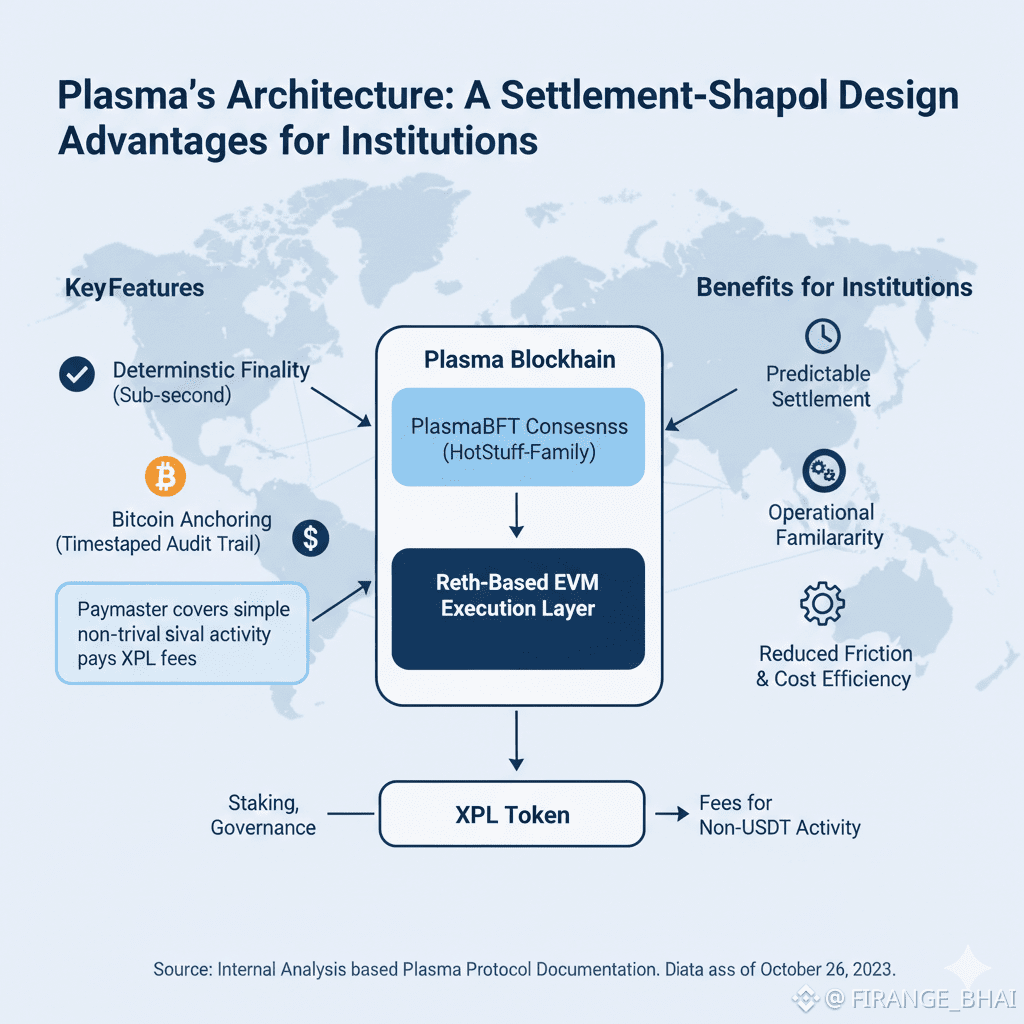
If you look past the launch hype, Plasma reads like an attempt to turn stablecoin settlement into a deterministic primitive that institutions can operationalize without surprises. PlasmaBFT is a HotStuff-family BFT design, so finality is deterministic once a block is committed, not probabilistic “final enough” after extra confirmations. That sounds academic until you map it to payments. A treasury desk cares less about theoretical peak throughput and more about knowing exactly when a transfer is irrevocable for reconciliation, crediting, and fraud controls. In that frame, Plasma’s “sub-second” claim is really a promise about predictability under load, not just speed on an empty network.
The execution layer choice reinforces the same intent. By building around a Reth-based EVM stack, Plasma is not asking institutions to learn a new VM or rewrite internal playbooks. It is asking them to reuse mature Ethereum tooling and audits on a chain where the settlement window is tighter. Compared with Solana’s speed-first runtime, Plasma is prioritizing deterministic confirmation and operational familiarity over maximum parallel compute. Compared with Polygon-style approaches, Plasma is skipping the layered complexity that can blur who “owns” finality at any moment, because payments teams want a single clock they can trust, not a stack of moving parts.
The stablecoin-first gas model is where Plasma becomes genuinely differentiated. Gasless USDT transfers remove the biggest non-crypto-native friction point, needing a separate token just to move dollars. Under the hood, paymaster-style sponsorship covers simple USDT sends, while non-trivial activity still pays fees to validators in XPL. That split is the strategy: make everyday dollar movement feel instant and fee-free, while keeping a monetizable surface for smart contracts, routing, and anything that looks like “institutional behavior” rather than simple wallet-to-wallet transfers. It is a narrow design choice, but it is also what makes Plasma credible as settlement infrastructure instead of yet another general-purpose chain wearing a payments narrative.
Bitcoin anchoring is the least understood component, and the most institutionally legible. Anchoring is not “Bitcoin security” as a vague badge, it is an external, timestamped audit trail that is hard to socially rewrite. For regulated settlement, the nightmare scenario is not just double-spends, it is disputed ordering, delayed finality, or governance-driven history changes that complicate auditability. Anchoring gives Plasma a credible court-of-record story, and it signals neutrality in a way many Layer 1s struggle to communicate: Plasma wants to feel like a payments rail first and a crypto ecosystem second.
Live chain stats already hint at the intended trajectory. Plasma has processed well over one hundred million transactions with one-second block times, and observed throughput remains modest relative to headline-driven chains. That does not look like a benchmark network chasing maximum TPS, it looks like continuous payment plumbing accumulating volume over time. From here, the adoption bottleneck is less “can it go fast” and more “can it integrate cleanly,” because institutions do not fail to adopt blockchains due to missing features, they fail because the last mile is onboarding, monitoring, sanctions screening, reporting, and predictable cost accounting. Plasma’s architecture is shaped around reducing those sources of variance rather than winning a speed contest.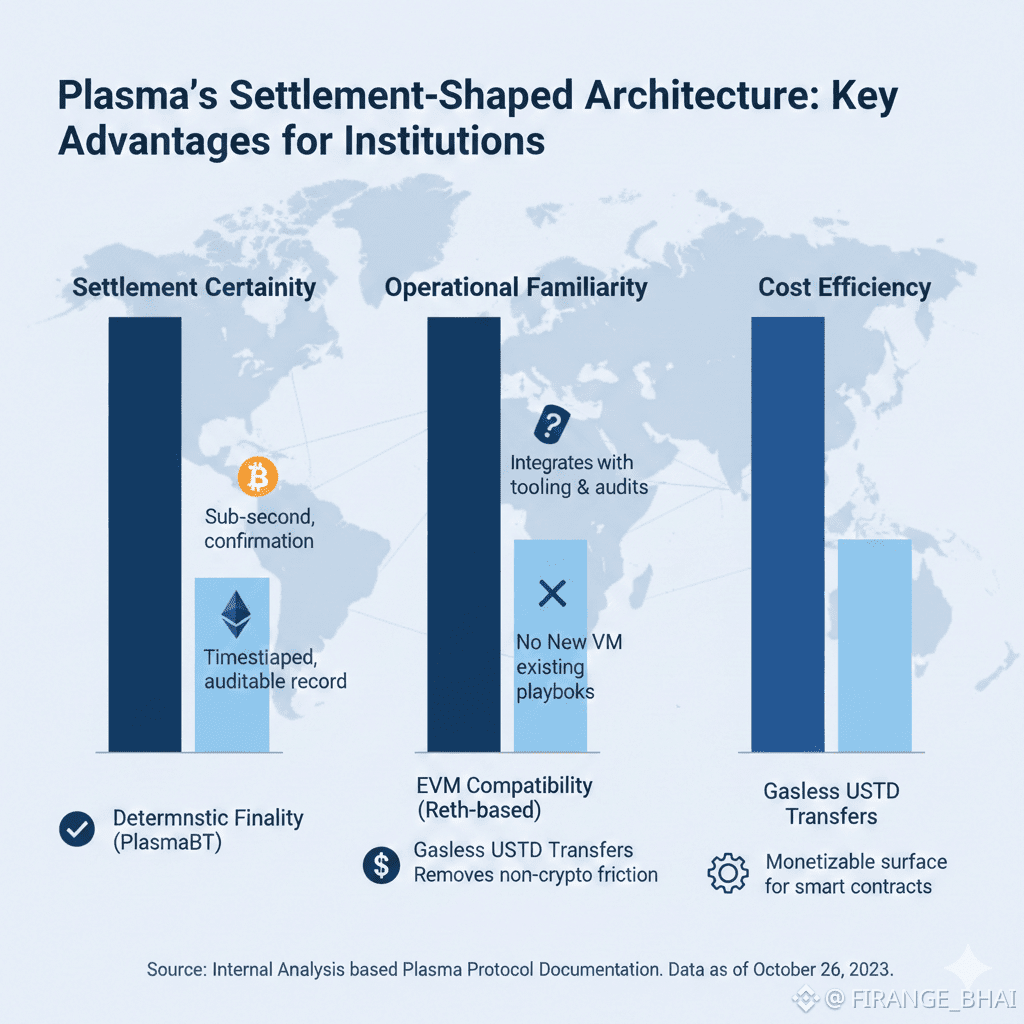
XPL token economics are where the model gets stress-tested. Plasma reduces the need for end users to hold XPL for basic USDT transfers, which usually breaks value capture. The way Plasma resolves that is by making XPL the control plane: validators stake it, non-USDT activity pays fees in it, and governance coordination runs through it. The token’s large total supply and ecosystem allocations reflect a network that needs wide distribution to build a payments rail, not a scarcity-driven narrative. If Plasma succeeds, XPL value accrual will look less like “everyone needs gas” and more like “institutions pay for settlement guarantees indirectly through the activity they actually run.”
The deeper takeaway is that Plasma’s moat is not speed in isolation, it is settlement-shaped architecture. Deterministic finality, fee abstraction designed around stablecoin behavior, and a security narrative that auditors can explain without hand-waving form a coherent whole. The competitive risk is that other chains copy gas abstraction while keeping broader ecosystems, turning Plasma’s differentiation into a feature rather than a category. Plasma’s counterweight has to be execution that institutions reward, conservative upgrades, measurable reliability, and real integrations that make stablecoin settlement feel boring in the best possible way.

