

@Walrus 🦭/acc is a crypto project that deliberately avoids hype-driven storytelling. Rather than promoting bold visions or speculative narratives, it concentrates on a practical issue that nearly every blockchain application encounters sooner or later: the need to store and retrieve large volumes of data in a way that is decentralized, dependable, cost-efficient, and suitable for real-world deployment. Built on the Sui blockchain, Walrus is a decentralized data storage and availability protocol designed to manage data types that blockchains were never meant to handle directly. Large files such as videos, images, datasets, AI models, application backups, and other data-heavy assets are indispensable for modern software, yet placing them directly on-chain is prohibitively expensive and technically inefficient. Walrus addresses this mismatch by providing a decentralized alternative to traditional cloud storage.
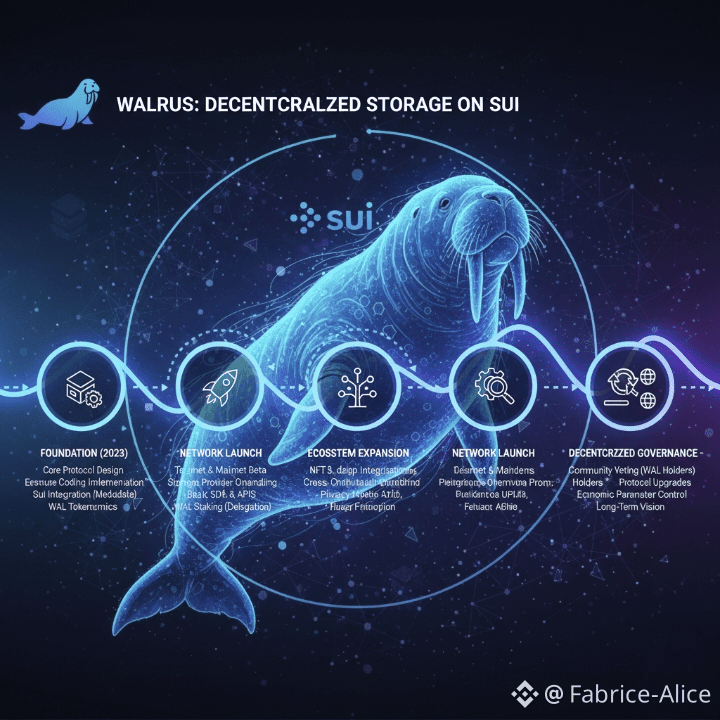
The core philosophy behind Walrus is a clear division of responsibilities. Blockchains are excellent at coordination, verification, and economic enforcement, but they perform poorly when tasked with storing large amounts of data. Walrus builds on this reality instead of fighting it. The blockchain is used as a coordination, payment, and verification layer, while the actual data is stored off-chain in a decentralized network. This is not a workaround—it is a deliberate architectural choice. Only critical metadata and proofs of data availability are written to Sui, while the bulk data itself is fragmented and distributed across independent storage nodes. This structure minimizes costs without sacrificing persistence, censorship resistance, or verifiability.
To understand how Walrus works in practice, consider the lifecycle of a large file entering the system. When a user uploads data, the file is divided into smaller fragments using erasure coding. This method allows the original data to be reconstructed even if some fragments become unavailable. Compared to simple replication, erasure coding is significantly more efficient because it avoids storing full copies of the same file. Each storage node holds only a subset of the data, and no single node can independently reconstruct the entire file. These fragments are then allocated across a decentralized network of storage providers who commit to maintaining availability for an agreed-upon duration.
Sui plays a crucial but restrained role in this architecture. The blockchain records metadata such as fragment locations, storage duration commitments, and whether providers are fulfilling their obligations. It also enforces payments and penalties. By keeping these responsibilities on-chain while excluding raw data, Walrus achieves transparency and trust without overwhelming the blockchain. The outcome is a system that remains verifiable and cohesive while still scaling to real-world data requirements.
The WAL token underpins the economic structure of the protocol. Rather than serving purely as a speculative asset, it functions as the medium through which storage is paid for, providers are incentivized, and governance decisions are made. Users pay in WAL to store data, and those funds are distributed over time to storage providers as compensation. To participate, providers must stake WAL, creating a financial incentive to act honestly. If a provider fails to meet availability requirements or breaks protocol rules, a portion of its stake can be slashed. This mechanism directly links economic rewards to reliability and data integrity.
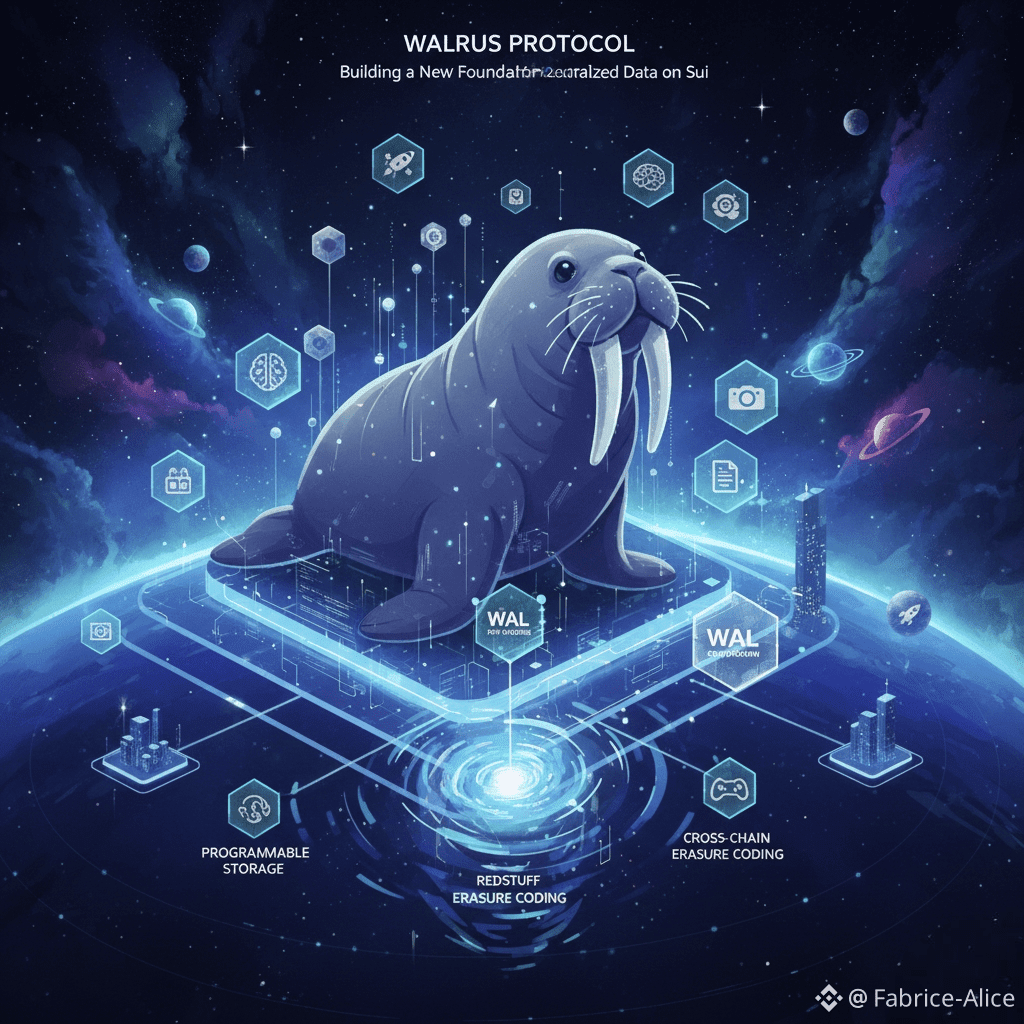
WAL also supports delegation for users who prefer not to operate storage infrastructure themselves. Token holders can stake their WAL with trusted storage providers and receive a share of the rewards, lowering the barrier to participation while reinforcing network security. Governance is another key function of the token. WAL holders can vote on protocol changes, economic parameters, and future upgrades, gradually decentralizing control as the network matures and reducing reliance on the original development team.
Walrus integrates naturally into the broader blockchain landscape because it addresses a universal need rather than a narrow use case. Almost every serious decentralized application eventually requires off-chain storage. NFT projects need to host media and metadata, games require asset storage and historical state, AI-focused crypto initiatives rely on large datasets and model files, and blockchains themselves need dependable storage for archives and checkpoints. Walrus positions itself as a general-purpose storage layer that these systems can rely on, with Sui as its native foundation but not necessarily its ultimate limit.
Importantly, Walrus is already being used in live environments rather than remaining a theoretical solution. Projects are leveraging it to host decentralized websites, store blockchain snapshots, manage AI-related resources, and handle large application files that would otherwise be delegated to centralized providers. The launch of its mainnet marked a shift from experimentation to operational reality, accompanied by growing developer interest and substantial funding. This matters because storage networks only gain real value when they are actively used, and Walrus appears to be moving in that direction.
Despite its promise, Walrus faces real challenges. Decentralized storage is inherently complex, both technically and economically. The protocol must carefully balance incentives so that providers are sufficiently compensated while keeping costs acceptable for users. It also competes with established decentralized storage networks that already benefit from strong brand recognition and existing ecosystems. Long-term sustainability, security risks, and regulatory uncertainty remain important considerations as the network expands and begins handling more valuable or sensitive data.
Looking ahead, Walrus seems focused on becoming dependable, low-profile infrastructure. Rather than targeting end users directly, it aims to be the default storage layer that developers trust when building on Sui and potentially other ecosystems. Enhancements in developer tooling, cross-chain support, and decentralized governance are likely to shape its next stage of growth. If Walrus succeeds, it may never achieve mainstream visibility—and that may be intentional. The best infrastructure often operates quietly, enabling complex systems without drawing attention to itself.
Within the broader evolution of Web3, Walrus reflects a move toward practicality and maturity. It recognizes that decentralization must function in real-world conditions, not just in theory, and that meaningful applications require scalable data solutions. By addressing one of the most unglamorous yet critical challenges in the ecosystem, Walrus positions itself as foundational infrastructure for the decentralized web, rather than just another token competing for attention.

