
Blockchain technology promised a new financial future, but for large institutions that future never fully arrived. The problem was never speed or decentralization. The real issue was exposure. Public blockchains reveal too much. Every transaction, every balance, every interaction is visible forever. For banks, funds, and regulated markets, this level of transparency is not innovation. It is risk.
Dusk Network starts from this uncomfortable truth. If blockchain wants to serve real financial systems, privacy cannot be optional. It must be structural. Dusk is not trying to make existing blockchains slightly more private. It is building a Layer One chain designed specifically for confidential finance from the ground up.
Most networks focus on open participation and public data. Dusk focuses on controlled transparency where privacy and compliance exist together. This design choice changes everything from consensus to smart contracts to identity.
Traditional blockchains rely on economic incentives and public verification. While this works for open systems, it fails when legal ownership and confidential strategies are involved. Financial institutions require certainty. They need transactions that are final. They need privacy that does not break regulation. They need systems that behave predictably under law.
Dusk addresses this by redesigning the base layer itself.
At the center of Dusk is a consensus mechanism built for legal settlement rather than speculation. Instead of probabilistic confirmation, Dusk introduces immediate finality. When a block is confirmed, it is final. There are no reorgs. There is no waiting period. Ownership becomes legally certain the moment consensus is reached.
This is achieved through a structure where roles are separated. Block creation and block validation are handled by different participants. Block producers are selected through cryptographic randomness. Their identity remains hidden until the block is published. This protects the network from targeted attacks and manipulation.
Validation is performed by a rotating committee that reaches agreement through a Byzantine process. Once the required threshold is reached, the block is sealed permanently. This model mirrors how traditional settlement systems operate but without centralized control.
Privacy alone is not enough. The execution environment must also support confidential logic. This is where most blockchains fail. Existing virtual machines were never designed for zero knowledge computation. They treat privacy as an external feature rather than a core function.
Dusk solves this by introducing its own virtual machine built specifically for zero knowledge workloads. The Piecrust virtual machine is optimized for cryptographic efficiency. It allows smart contracts to run complex logic while generating proofs without leaking sensitive data.
This matters because financial contracts are not simple transfers. They include conditions, permissions, eligibility rules, and regulatory checks. Piecrust allows all of this logic to execute privately while remaining verifiable.
Developers can build applications where balances, counterparties, and internal rules remain hidden, yet the outcome is mathematically proven to be correct. This changes how decentralized applications can function in regulated environments.
Underneath this execution layer lies advanced cryptography. Dusk relies on modern zero knowledge proof systems that support flexibility and scalability. Instead of requiring a separate setup for every application, the network uses a universal proving system. This allows new applications to launch without repeating trust assumptions.
This design choice reduces friction for developers and lowers security risks. It also ensures that the network can evolve without constant cryptographic resets.
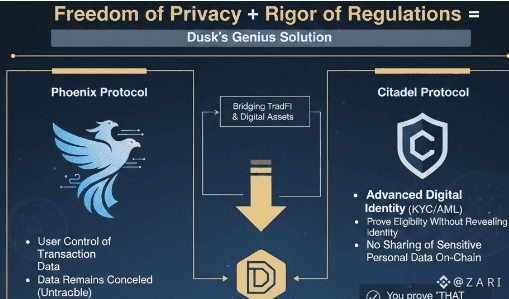
Privacy without compliance is useless for institutions. Dusk recognizes this and treats regulation as a technical constraint rather than an external process. Instead of handling identity off chain, Dusk integrates identity into the protocol itself.
Through a self sovereign identity framework, users can prove eligibility without revealing personal data. They do not submit documents to applications. They generate cryptographic proofs that confirm they meet specific criteria.
This approach allows applications to enforce rules automatically. A financial asset can check whether a user is allowed to hold or transfer it. If the conditions are not met, the transaction simply cannot occur.
This transforms compliance from a manual responsibility into a programmable rule. It reduces legal risk while preserving user privacy.
Assets built on Dusk are not generic tokens. They are aware of regulation by design. Ownership transfers follow legal logic embedded directly into the contract. This makes them suitable for securities, funds, and real world financial instruments.
The result is a blockchain that behaves more like financial infrastructure than a speculative playground.
Dusk does not try to compete for attention. It does not rely on hype cycles or narrative rotations. Its value lies in engineering discipline and long term relevance. The network is built for markets that require trust, discretion, and legal certainty.
As the blockchain industry matures, the demand for quiet reliability will grow. Systems that can support real capital at scale will matter more than systems designed for visibility and speed alone.
Dusk Network represents a different philosophy. It accepts that privacy is not a feature. It is a requirement. It treats compliance as code. It designs finality as law.
In doing so, it quietly rebuilds what blockchain was always supposed to become.
Can a truly global financial system exist without privacy built into its foundation?
