
Most blockchain projects grow by expanding outward. New verticals, new narratives, new promises. Over time, that expansion often creates internal contradictions: privacy versus transparency, decentralization versus compliance, speed versus reliability. Dusk is taking a different path. Instead of expanding, it is converging.
Recent developments show Dusk pulling multiple complex requirements into a single, coherent execution layer: regulated finance, privacy, and programmability. That convergence is difficult, slow, and unglamorous — but it is exactly what real financial infrastructure demands.
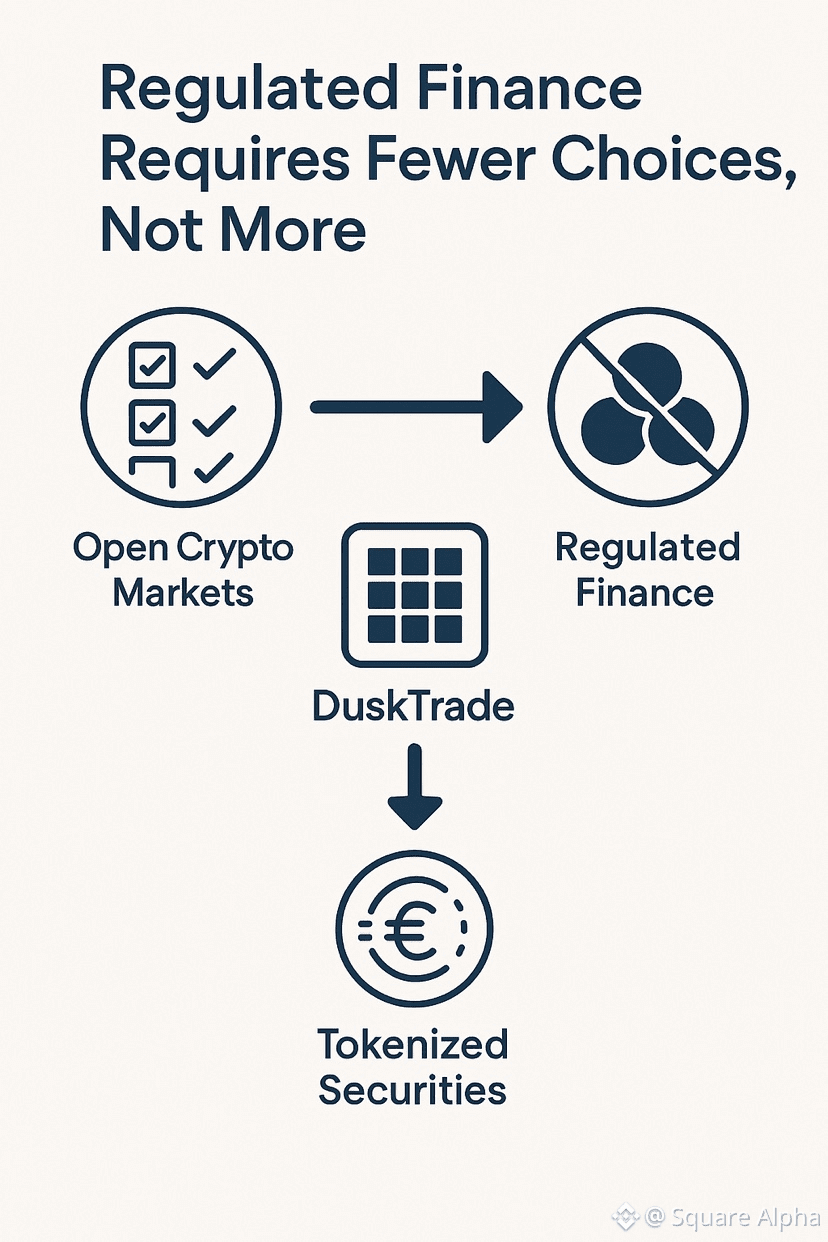
Regulated Finance Requires Fewer Choices, Not More
In open crypto markets, optionality is celebrated. In regulated finance, optionality is risk. Institutions prefer constrained systems where outcomes are predictable and responsibilities are clear.
DuskTrade reflects this philosophy clearly. Scheduled for launch in 2026, DuskTrade is not positioned as a generalized marketplace. It is a compliant trading and investment platform built alongside NPEX, a licensed Dutch exchange operating under MTF, Broker, and ECSP frameworks. That collaboration immediately limits what the platform can do — and that limitation is its strength.
Targeting over €300 million in tokenized securities, DuskTrade is designed for assets that already exist within legal structures. By bringing them on-chain without altering their regulatory nature, Dusk avoids the common failure mode of RWA projects: attempting to reinvent finance rather than integrate with it.
The waitlist opening in January is a subtle but important signal. It marks readiness for controlled onboarding, not public experimentation.
DuskEVM Solves a Practical, Not Ideological, Problem
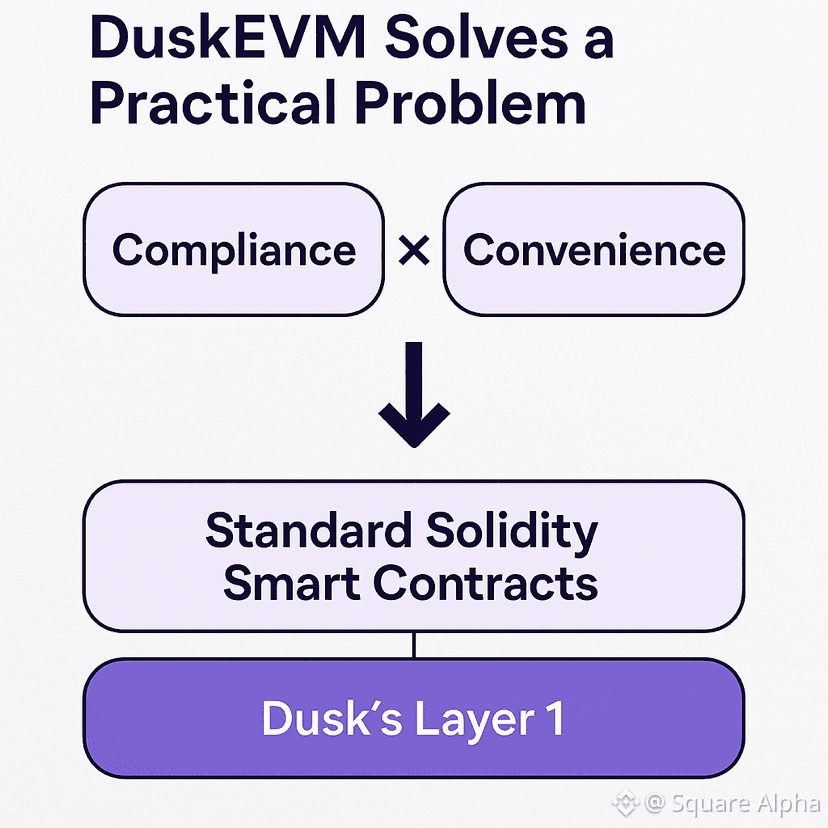
Compatibility is rarely exciting, but it is often decisive. The upcoming DuskEVM mainnet launch in the second week of January addresses a practical constraint that limited Dusk’s reach: execution familiarity.
By enabling standard Solidity smart contracts to settle on Dusk’s Layer 1, DuskEVM eliminates the need for developers and institutions to choose between compliance and convenience. They no longer have to abandon existing tooling to access a regulated settlement layer.
This is not about chasing the EVM ecosystem for volume. It is about making Dusk usable inside environments where internal audits, legal reviews, and engineering standards already exist. DuskEVM lowers institutional friction without weakening Dusk’s underlying privacy and compliance guarantees.
That balance is rare.
Hedger Reframes Privacy as an Operational Requirement
Privacy is often discussed in absolutes: either everything is public, or everything is hidden. Financial systems do not operate at either extreme. They operate on selective disclosure.
Hedger introduces that logic directly into the execution layer. Using zero-knowledge proofs and homomorphic encryption, Hedger allows transaction data to remain confidential while still being auditable under defined conditions. The fact that Hedger Alpha is live reinforces that this is no longer conceptual.
This matters because institutions cannot rely on privacy tools that obscure accountability. Hedger does the opposite. It enforces structure around confidentiality. Data is protected, not erased. Visibility is controlled, not denied.
In regulated environments, that distinction determines whether blockchain is usable at all.
Convergence Creates Structural Demand, Not Narrative Demand
As Dusk’s components come online together, the role of $DUSK becomes less abstract. The token underpins staking, transaction execution, and application activity across both Layer 1 and DuskEVM.
As DuskTrade introduces regulated trading volume and EVM-based applications begin settling transactions, usage becomes systemic. Demand emerges from operations, not speculation. This does not produce rapid spikes, but it does create continuity.
Infrastructure tokens tend to mature slowly because they mirror the systems they support. That appears to be the trajectory Dusk is choosing deliberately.
Timing Reveals Intent
What makes the current phase especially notable is timing alignment:
DuskEVM mainnet launching in January
Hedger already operating in live alpha
DuskTrade waitlist opening ahead of a 2026 launch
This sequencing suggests disciplined execution rather than opportunistic announcements. Core layers are stabilized before market-facing applications are scaled. That order reduces integration risk and supports long-term reliability.
It is a builder’s timeline, not a marketer’s timeline.
Conclusion: Dusk Is Designing for Permanence
Dusk is not trying to become the most visible blockchain. It is trying to become one that is difficult to remove once adopted.
By converging regulated asset issuance, compliant execution, and auditable privacy into a single stack, Dusk positions itself as infrastructure rather than platform. Infrastructure is judged differently. It is evaluated on resilience, predictability, and legal survivability.
If blockchain adoption in finance is going to happen at scale, it will not look like early crypto. It will look like systems quietly doing their job.
Dusk is building for that outcome.
