
In today's digital world, we store huge amounts of data — photos, videos, documents, and more — mostly on big company servers like Google or Amazon. But these centralized systems have drawbacks: they can be expensive, vulnerable to hacks, and give one company too much control over your files. Walrus Protocol is changing that. Built on the fast and efficient Sui blockchain, Walrus offers a decentralized way to store data, spreading it across many computers worldwide for better security, lower costs, and true user ownership.
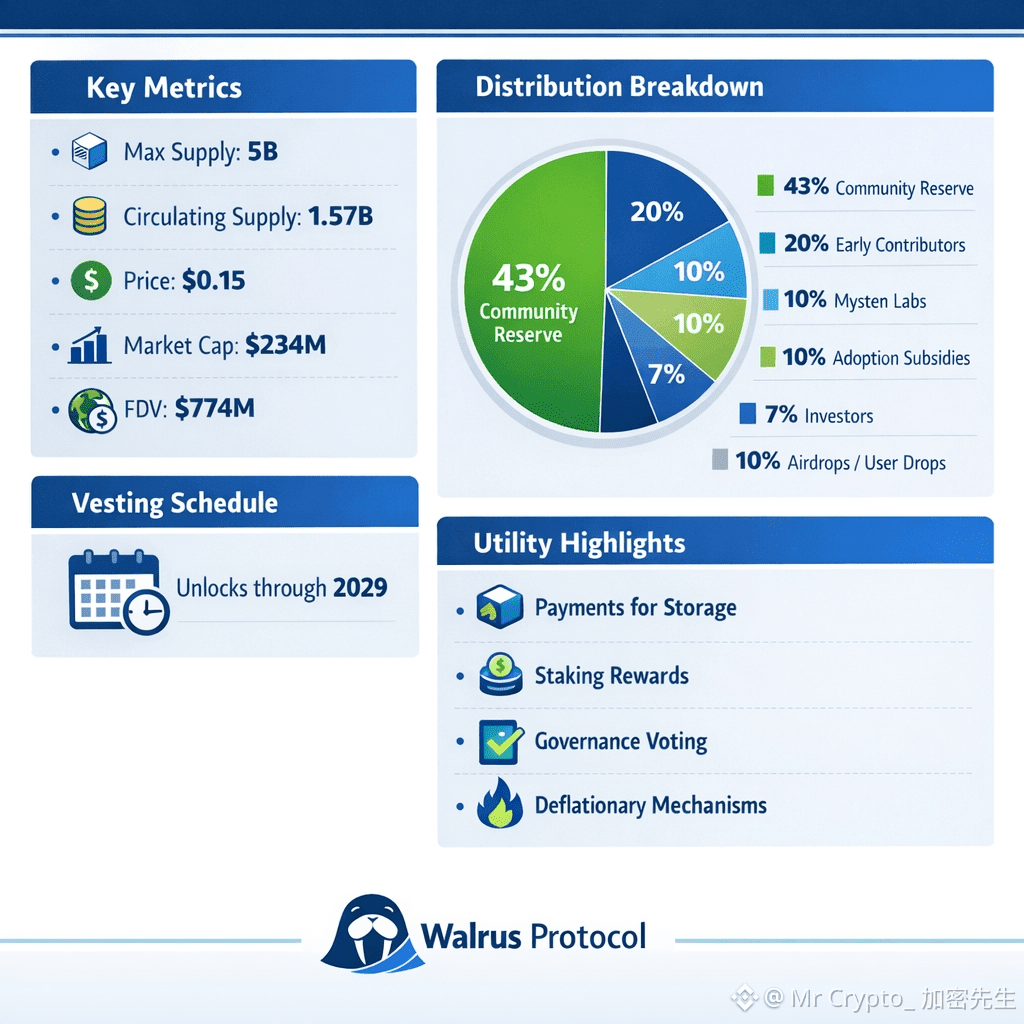
At the center of Walrus is its native token, $WAL. This isn't just a speculative coin; it has real uses in the network. People use $WAL to pay for storing files for set periods, making costs predictable and straightforward. Holders can stake their tokens to help run the network, earning rewards in return. Plus, $WAL gives voting rights, letting the community decide on future updates and rules. There are even built-in features that burn tokens over time — like when nodes underperform or people move stakes quickly — which reduces supply and can increase value for long-term holders.
What makes Walrus stand out is the strong support it's received. In early 2025, the project raised an impressive $140 million in a private token sale. The round was led by top investors like Standard Crypto and a16z crypto, with participation from Electric Capital and Franklin Templeton. This kind of backing from big names shows real confidence in Walrus as a key building block for the next generation of the internet.
Looking at the numbers, $WAL has a total supply capped at 5 billion tokens, with about 1.57 billion currently circulating. As of January 2026, the token trades around $0.15, giving it a market cap of roughly $234 million and a fully diluted valuation near $774 million. That's solid positioning for a project in the competitive decentralized storage space, with plenty of room to grow as more users and apps join.
The token distribution is designed for fairness and long-term health. A large portion — around 43% — goes to community reserves for growth initiatives. Another 10% is set aside for user airdrops and rewards, while 10% supports adoption through subsidies. Early contributors get 20%, the core team at Mysten Labs 10%, and investors just 7%. Most of these are locked with vesting periods stretching to 2029, meaning tokens enter the market slowly. This setup avoids big price swings and encourages steady building.
Walrus isn't just about cheap storage; it's built for modern needs like AI datasets, NFTs, gaming assets, and social media files. Developers can even program directly with the stored data using smart contracts on Sui. In a world moving toward Web3, where people want control over their digital lives, Walrus provides a reliable, censorship-resistant alternative to traditional clouds.
With strong funding, practical token utility, thoughtful economics, and ties to the growing Sui ecosystem, $WAL looks like a promising player in decentralized infrastructure. For anyone interested in the future of data storage and ownership, Walrus Protocol is definitely worth watching.

