There is a certain tension that has always lived inside finance, long before blockchains existed. Capital is meant to grow over time, but life rarely moves in straight lines. Opportunities appear suddenly. Costs emerge unexpectedly. Markets shift faster than conviction. And so, time and again, people are pushed into the same uncomfortable corner: sell now or stay locked in. Liquidity has never been free. It has always demanded urgency, compromise, or regret.
Crypto promised a cleaner alternative. Yet as the ecosystem evolved, it carried this same tension forward under a different name. Smart contracts replaced intermediaries, but the underlying mechanics stayed familiar. To access value, you exited your position. To stay invested, you accepted illiquidity. The technology improved, but the experience remained rigid.
Walrus enters this story not as a loud disruption, but as a quiet correction.
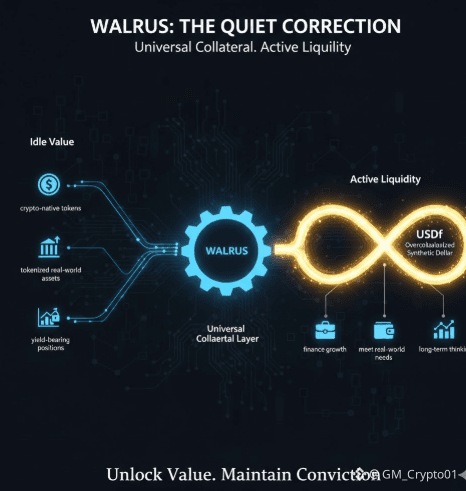
Rather than chasing novelty, Walrus focuses on something foundational: how collateral itself behaves. In most on-chain systems, collateral is treated as static. You lock it, borrow against it, and hope volatility does not turn your flexibility into forced liquidation. Walrus challenges this framing by building universal collateralization infrastructure that treats assets as active components of a liquidity layer, not as frozen guarantees.
The protocol allows users to deposit liquid assets, including crypto-native tokens and tokenized real-world assets, and use them to issue USDf, an overcollateralized synthetic dollar. On paper, this may sound familiar. In practice, the philosophy behind it is different. USDf is not designed to extract maximum leverage or promise artificial stability. It exists to give users room to breathe.
That breathing room changes behavior in meaningful ways. When liquidity no longer requires selling, long-term thinking becomes easier. A holder can stay aligned with their original thesis while still meeting real-world needs. A treasury can access capital without dismantling its balance sheet. Builders can finance growth without permanently giving up upside. The asset remains owned, relevant, and productive.
What makes this especially important today is the changing composition of on-chain capital. Real-world assets are no longer theoretical. They are arriving with expectations shaped by decades of traditional finance, expectations around predictability, risk management, and transparency. Forcing these assets into aggressive DeFi structures is a recipe for mismatch. Walrus takes a more measured approach, allowing different forms of value to coexist within a single collateral framework without pretending they all behave the same.
The overcollateralized nature of USDf reflects this mindset. Instead of chasing efficiency at any cost, Walrus prioritizes resilience. Volatility is treated as a given, not an exception. Stability becomes the outcome of conservative design rather than optimistic assumptions. In a market that has learned hard lessons about fragility, this feels less like caution and more like progress.
There is also a deeper shift happening beneath the mechanics. Walrus subtly changes the relationship between users and their assets. Ownership stops feeling conditional. Liquidity stops feeling like a threat. Capital is no longer something that must be constantly repositioned to stay useful. It can remain where it is, supporting both conviction and flexibility at the same time.
From this angle, Walrus is not simply offering another synthetic dollar. It is redefining what financial continuity looks like on-chain. Instead of forcing people to choose between holding and acting, it allows both to happen together. That may sound like a small adjustment, but in finance, removing a single persistent friction can reshape behavior at scale.
As the on-chain economy matures, the systems that endure will be the ones that feel less like experiments and more like reliable infrastructure. Walrus seems to understand that trust is built not through speed or spectacle, but through alignment with how people actually live, plan, and think about value.
In the end, Walrus is building for moments that don’t show up on price charts. The moments when liquidity is needed without drama. When conviction doesn’t have to be broken to stay solvent. When capital can pause, adapt, and move forward without being forced to start over