The first time it became clear to me that privacy and regulation don’t have to conflict was during a routine compliance process. A friend running a small investment firm was onboarding a client for a private placement. Nothing dramatic — just identity checks, suitability forms, and audit records.
What stood out wasn’t the money. It was the sensitive information: client identity, portfolio details, and private deal terms. In traditional finance, this data is protected by default, while regulators still maintain oversight. On most blockchains, however, everything is either fully public or hidden so completely that compliance becomes impossible.
This is the gap Dusk Network is designed to fill.
A Blockchain Built for Regulated Finance
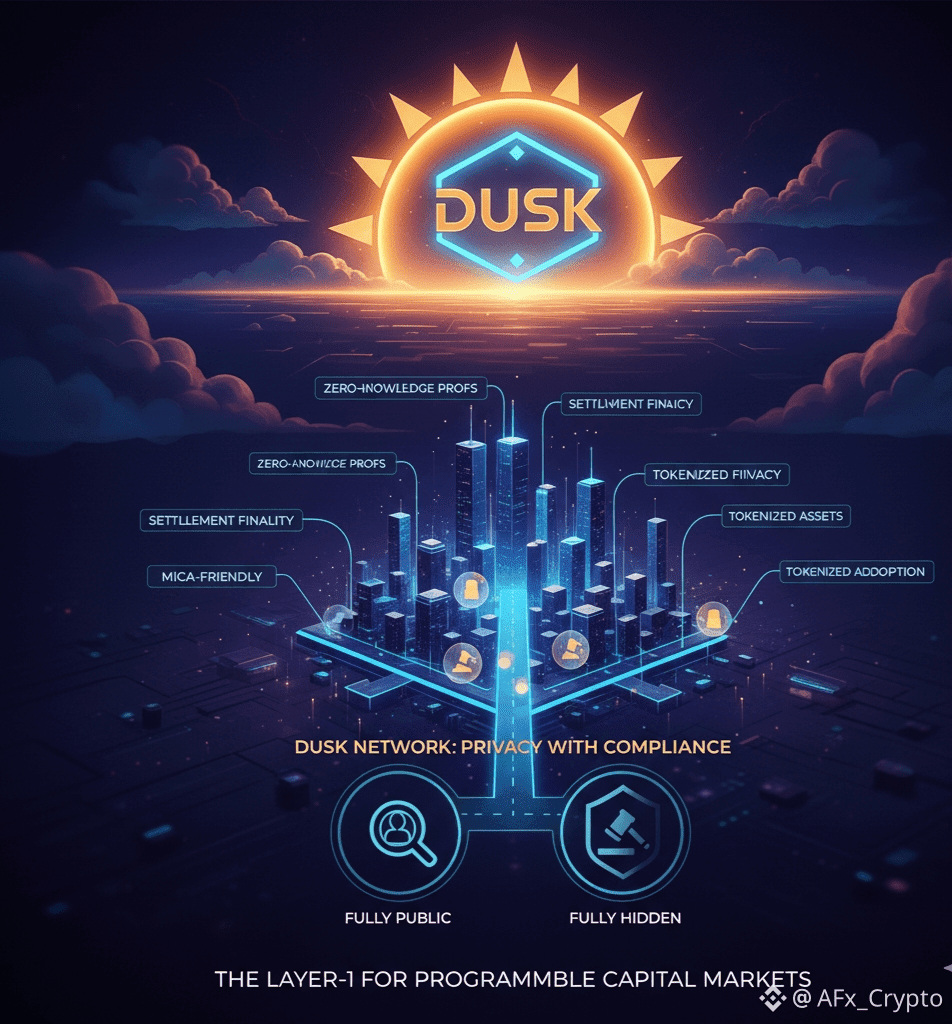
Dusk is a Layer-1 blockchain created specifically for financial markets where both confidentiality and regulatory oversight matter. Instead of treating privacy as a feature, Dusk treats it as infrastructure. At the same time, it accepts a reality many crypto narratives avoid: institutions cannot scale without audits, lawful access, and reliable settlement.
Rather than trying to remove rules from finance, Dusk aims to make finance programmable without turning it into a surveillance system.
Privacy Without Losing Trust
The key question for investors is simple: how does Dusk protect sensitive data while keeping transactions verifiable?
The answer lies in its cryptographic design. Dusk enables privacy-preserving smart contracts using zero-knowledge techniques. Transactions can be validated without exposing private inputs. This allows financial rules — such as transfer restrictions, eligibility checks, and disclosure requirements — to be enforced without revealing confidential details.
In regulated markets, this matters far more than raw transaction speed.
Settlement That Institutions Can Rely On
For tokenized equities, bonds, or funds, settlement finality is not a nice-to-have feature. It’s a legal necessity.
Dusk uses a Proof-of-Stake system based on Succinct Attestation, designed to provide clear and reliable finality. The goal isn’t just fast blocks — it’s the ability to confidently say a trade is complete, irreversible, and legally sound.
Why Regulated Assets Need Privacy
Regulated assets come with rules: who can own them, how they move, what must be disclosed, and what authorities can request.
On transparent blockchains, sensitive market data becomes public.
On fully anonymous systems, compliance becomes impossible.
Dusk positions itself in the uncomfortable middle — offering privacy that survives regulation and compliance that doesn’t destroy confidentiality.
Infrastructure, Not Just an Ecosystem
Dusk’s collaboration with NPEX and Chainlink in late 2025 highlights its focus on real-world infrastructure. By adopting CCIP interoperability and regulated-grade data tools, Dusk supports official pricing, cross-chain settlement, and compliant market connectivity.
This is essential for institutions that need more than just tokens — they need reliable data, settlement rails, and regulatory alignment.
A Practical Example
Imagine a European SME issuing tokenized shares through a regulated platform. Investors want fast on-chain settlement, but not public exposure of their positions. Regulators need audit access without violating privacy.
Most blockchains force a choice between transparency or anonymity.
Dusk aims to offer both: confidential transactions that remain provably valid, with compliance logic embedded directly into smart contracts.
That’s the difference between crypto trading and programmable capital markets.
Slow Trust, Not Fast Hype
Dusk isn’t built for viral cycles. It’s built for institutional trust.
Regulated finance doesn’t move based on excitement — it moves when systems prove reliability, legal compatibility, and operational stability. That’s why Dusk’s progress feels slow to some traders, but meaningful to long-term infrastructure investors.
Market Position
As of January 17, 2026, DUSK trades around $0.116–$0.119, with a market cap in the mid-$50M range and a maximum supply near 1B tokens. Compared to general-purpose Layer-1s, it’s still small — which is exactly why some overlook it and others see asymmetric potential.
The Bigger Picture
Dusk doesn’t promise a flashy future. It’s built around a simple truth:
If on-chain finance becomes mainstream, it cannot be fully public — and it cannot ignore regulation.
Dusk is trying to be the Layer-1 that accepts both realities without sacrificing either. That balance between confidentiality and compliance may ultimately decide whether tokenized securities become a serious market or remain a niche experiment.
If Dusk succeeds, it won’t look like a meme rally.
It will look like quiet adoption the kind you notice only after it’s already real.