
I didn’t start paying attention to stablecoin infrastructure because of some new DeFi trend or a viral token launch. It happened much more quietly. I kept seeing everyday people use USDT like digital cash — sending money across borders, paying freelancers late at night, or moving funds when traditional banking systems were slow or simply unavailable. In many parts of the world, stablecoins aren’t an experiment anymore. They’re already part of daily financial life.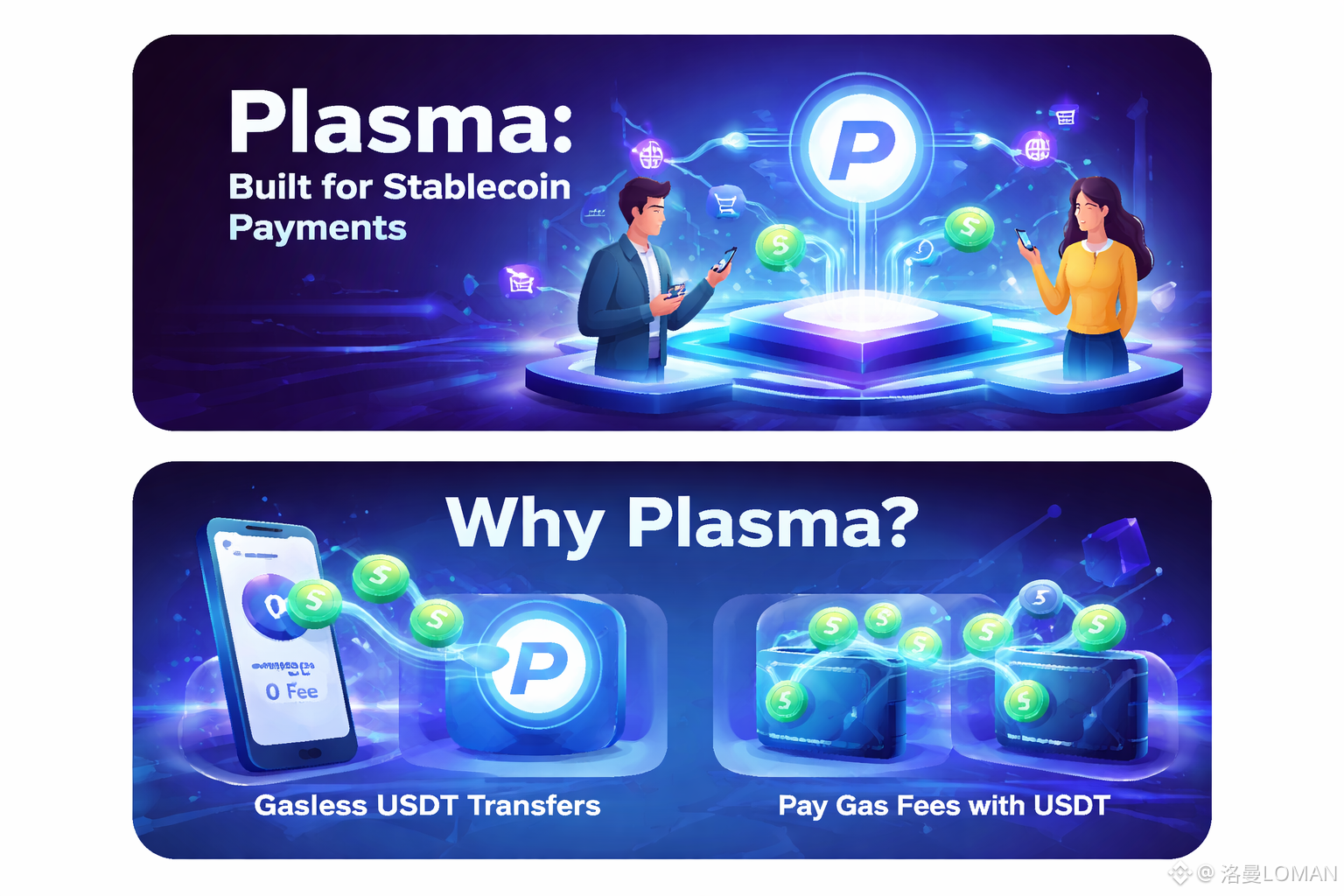
What felt strange was this: while stablecoins are being used for very real, practical purposes, the blockchains carrying them often feel overengineered for something else. They’re multipurpose networks built for trading, speculation, and complex applications — not for simple, reliable payments. That gap is exactly where Plasma seems to be positioning itself.
Plasma presents itself as a Layer 1 blockchain designed specifically for stablecoin settlement, with a strong focus on USDT. Instead of trying to serve every possible use case, it narrows its scope to one core job: moving stablecoins quickly, reliably, and with minimal friction. When you think about payments from a non-trader’s perspective, that focus starts to make sense. Most people don’t want to learn about gas fees, native tokens, or network congestion. They just want to send money and know it arrived.
One of Plasma’s most talked-about ideas is surprisingly simple: gasless USDT transfers. According to its design goals, sending USDT on Plasma does not require paying transfer fees. This might sound like a small detail, but it matters a lot for real-world usage. Many stablecoin transactions are small — remittances, daily expenses, peer-to-peer transfers. Even minor fees can feel like an unnecessary tax on users. Removing that friction isn’t about competing on “cheap crypto,” it’s about making digital dollars behave more like a practical payment tool.
Plasma also takes a stablecoin-first approach to transaction fees more broadly. Instead of forcing users to hold a separate native token just to move their funds, the network is designed so fees can be handled using stablecoins themselves. Anyone who has onboarded a new crypto user knows how often things break down at this step: someone finally gets USDT, tries to send it, and then realizes they can’t because they don’t own the right gas token. Eliminating that extra hurdle may seem unglamorous, but it directly improves the user experience.
From a developer perspective, Plasma doesn’t try to reinvent everything either. It’s built to be fully compatible with the Ethereum Virtual Machine, allowing existing smart contracts and tooling to be reused. By relying on familiar infrastructure, Plasma lowers the barrier for integrations — wallets, payment apps, onramps, and merchant tools don’t need to start from scratch. For a settlement network, ecosystem compatibility can matter more than novel features.
Speed is another area where Plasma focuses on what actually matters for payments: finality. Instead of emphasizing raw transaction throughput alone, the network is designed to provide fast and consistent settlement confirmation. In payment systems, certainty is critical. Merchants, processors, and users don’t want transactions that are “probably final.” They want to know, clearly and quickly, that a payment is completed.
Plasma also emphasizes a security model anchored to Bitcoin, positioning itself as a Bitcoin-secured sidechain. Regardless of where someone stands philosophically, the logic is understandable. If a blockchain aims to support large-scale stablecoin flows, neutrality and resistance to interference become practical concerns, not abstract ideals. Financial infrastructure tends to attract pressure, and anchoring security to a widely recognized network is one way to address that risk.
All of this makes Plasma’s intended audience fairly clear. It isn’t built only for traders or speculative users. It targets regions where stablecoins are already heavily used, as well as businesses that care about predictable settlement — remittance services, fintech platforms, payment processors, and applications that benefit from moving dollars at internet speed.
What stands out most is that Plasma doesn’t treat stablecoins as a future narrative. Stablecoins are already one of crypto’s strongest real-world use cases. Plasma’s approach suggests that the missing piece hasn’t been demand, but infrastructure designed specifically around that demand. Its positioning as “stablecoin-native” reflects that belief.
None of this guarantees adoption. Payments is a difficult space, and success depends on distribution — wallet support, exchange connectivity, onramps, and real integrations. Strong engineering alone is not enough. Still, when you look at Plasma purely as a product response to how stablecoins are actually used today, the choices feel internally consistent: reduce fees, simplify onboarding, stay compatible with existing tools, prioritize fast final settlement, and aim for credible neutrality.
If I had to describe Plasma in one simple, human sentence, it would be this: it’s trying to make stablecoin payments feel boring. And in finance, boring isn’t a weakness. Boring means predictable. Boring means reliable. And for stablecoin settlement, that kind of boring might end up being the most valuable feature of all.

