

@Plasma is a Layer 1 blockchain engineered specifically to function as a settlement network for stablecoins, targeting long-standing inefficiencies in the digital dollar ecosystem. Most stablecoins today operate on general-purpose blockchains such as Ethereum or Tron—networks that were not designed for high-frequency, payment-focused activity. As a result, users and institutions often deal with inconsistent confirmation times, fluctuating fees, and the inconvenience of holding native tokens solely to pay transaction costs. Plasma addresses these issues by introducing a blockchain optimized exclusively for stablecoin payments, prioritizing speed, predictability, and simplicity. Its objective is to give stablecoins a native environment where transfers are fast, inexpensive, and secure—making digital dollar payments feel as effortless as sending a message.
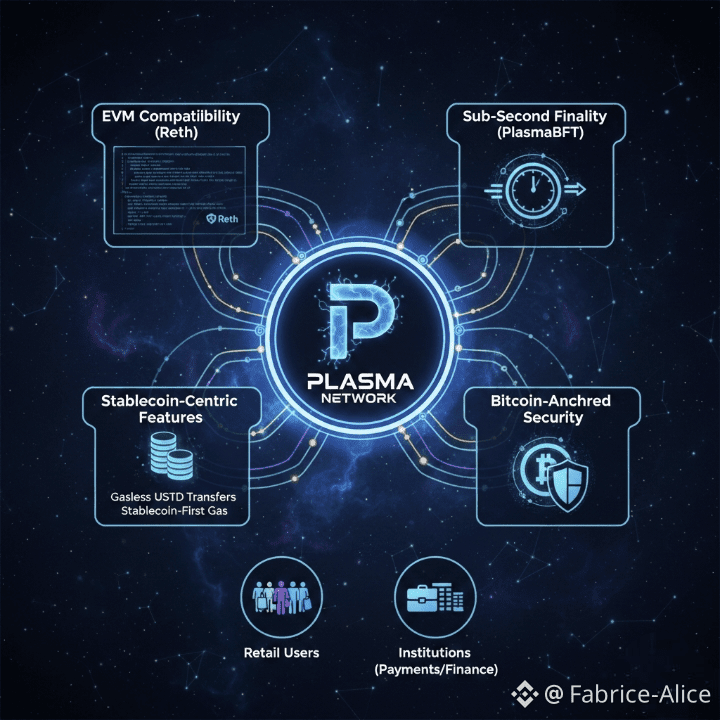
Plasma’s core design blends elements from both Bitcoin and Ethereum to deliver performance and flexibility. For transaction execution, the network runs a high-efficiency Ethereum Virtual Machine written in Rust, known as Reth. This ensures full compatibility with existing Ethereum smart contracts, allowing developers to deploy applications without rewriting code. Familiar development tools such as MetaMask, Hardhat, and Foundry work seamlessly on Plasma, minimizing friction for teams migrating from Ethereum. While Reth handles execution, transaction ordering and finalization are managed by PlasmaBFT, a Byzantine Fault Tolerant consensus protocol derived from HotStuff. By pipelining proposal, voting, and commitment phases rather than processing them sequentially, PlasmaBFT achieves block finality in under a second. This rapid finality is essential for payment use cases, enabling stablecoin transactions to settle almost instantly even during periods of heavy network activity.
Security and neutrality are reinforced through Plasma’s integration with Bitcoin. The network periodically anchors its state to the Bitcoin blockchain by committing recent block data through a trust-minimized bridge. These checkpoints make Plasma’s transaction history independently verifiable against Bitcoin’s ledger, effectively inheriting Bitcoin’s resilience and censorship resistance. This approach also opens the door for BTC to be used within Plasma, bridging the Bitcoin and Ethereum ecosystems and supporting new classes of Bitcoin- and stablecoin-backed applications. By combining EVM programmability with Bitcoin-level security assurances, Plasma distinguishes itself from other emerging Layer 1 platforms.
Stablecoin usability is further enhanced through protocol-level features designed for everyday payments. One of the most notable is gasless USDT transfers, enabled by a paymaster mechanism that covers transaction fees for standard USDT payments. Users can send stablecoins without owning Plasma’s native token, XPL, eliminating a major onboarding hurdle. For transactions that do require fees, Plasma allows payment in stablecoins or BTC via an automatic conversion system, avoiding the need to hold a separate gas token. The roadmap also includes confidential transaction support, where zero-knowledge proofs will obscure transaction amounts and recipient details while preserving auditability for regulatory compliance. Together, these features make Plasma accessible to users, businesses, and developers at scale.

The XPL token underpins Plasma’s economic and security model. Validators stake XPL to participate in consensus and are rewarded through a combination of newly issued tokens and transaction fees. The token design aims to balance long-term sustainability with network incentives by partially burning fees to offset inflation and by avoiding excessive slashing penalties. Beyond validation, XPL serves as collateral within decentralized finance applications and as a liquidity asset throughout the ecosystem. Importantly, Plasma’s architecture allows the majority of stablecoin transfers to occur without users directly holding XPL, while still ensuring the token remains integral to network security and value capture.
Plasma is designed as an interoperable settlement layer rather than a closed ecosystem. Its EVM compatibility enables direct integration with Ethereum-based protocols, while Bitcoin anchoring connects it to the broader crypto economy. DeFi platforms such as Aave are already leveraging Plasma’s stablecoin infrastructure to offer faster and cheaper financial services. Decentralized exchanges are exploring deep USDT liquidity on the network, and major stablecoin issuers—including Tether—are actively supporting its deployment. Additionally, banks and fintech companies are building fiat on-ramps and payment corridors that link traditional financial systems to Plasma, enabling efficient movement of funds between fiat and stablecoins. This positioning allows Plasma to act as a neutral bridge across Bitcoin, Ethereum, stablecoin issuers, and legacy finance.
Early adoption indicators are encouraging. At launch, the network attracted billions of dollars in USDT liquidity, with exchanges, wallets, and DeFi protocols prepared to operate from day one. Retail users benefit from near-instant, gasless transfers using familiar Ethereum tooling, while institutions gain a platform for treasury management, corporate payments, and cross-border settlements with reduced complexity. In regions where stablecoins already play a major role—particularly emerging markets—Plasma offers a fast, low-cost alternative to traditional payment rails.
Nevertheless, Plasma faces notable risks. Competition among stablecoin-focused blockchains is intense, with established networks like Tron and Avalanche, as well as newer Layer 1s, competing for liquidity and adoption. XPL’s supply structure and token unlock schedule could exert downward pressure on price if network usage does not expand in tandem. PlasmaBFT, while innovative, has yet to be tested under extreme real-world conditions, and any flaws in consensus could be costly. Regulatory uncertainty surrounding stablecoins and cross-border payments remains an external risk, and gas-sponsorship mechanisms must be carefully managed to prevent abuse. Validator decentralization is also still evolving and will be critical for long-term resilience.
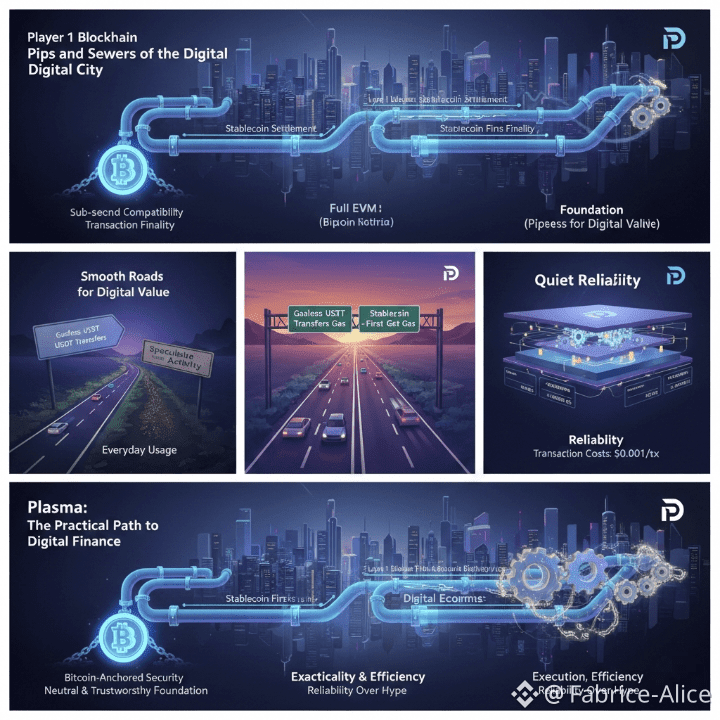
Looking ahead, Plasma aims to mature into a full-scale financial infrastructure layer. Near-term goals include expanding gas payment options, increasing the frequency of Bitcoin anchoring, activating staking, and growing validator participation. Medium-term plans focus on improving decentralization, reducing latency further, and broadening native support for stablecoins and BTC. Long-term ambitions include private stablecoin transfers, on-chain governance for XPL holders, and enterprise-grade compliance tooling. Strategically, Plasma seeks to capture a significant share of the expanding stablecoin market by eliminating friction in settlement and payments.
Plasma’s vision is to establish itself as the default blockchain for stablecoins—offering the speed of modern payment systems, the security of Bitcoin, and the programmability of Ethereum. While its early momentum and technical design are promising, long-term success will depend on sustained adoption and flawless execution. If Plasma can deliver on its roadmap, it has the potential to become a foundational settlement layer for global digital money flows rather than a niche alternative.

