
Introduction: When Skepticism Becomes Instinct
If you’ve been around crypto long enough, skepticism isn’t a choice it’s a reflex.
You’ve seen it before. A new decentralized storage or privacy-focused DeFi protocol launches with bold claims, glossy diagrams, and confident founders. For a while, everything looks promising. Then real users arrive. Real data. Real costs. And suddenly the project fades into silence, leaving behind a few blog posts and an abandoned Discord.

After years of watching this cycle repeat, doubt becomes muscle memory. You don’t ask what a protocol promises anymore. You ask what happens when things go wrong.
That’s why Walrus caught my attention not because it shouted louder than others, but because it didn’t. Instead of promising perfection, Walrus felt oddly comfortable with limitation. And that restraint, in today’s crypto culture, feels almost radical.
The more time I spent exploring Walrus, the more it felt like a system built with the assumption that the real world will push back hard and that survival depends on respecting that friction, not denying it.
The Weight of Experience in Decentralized Infrastructure
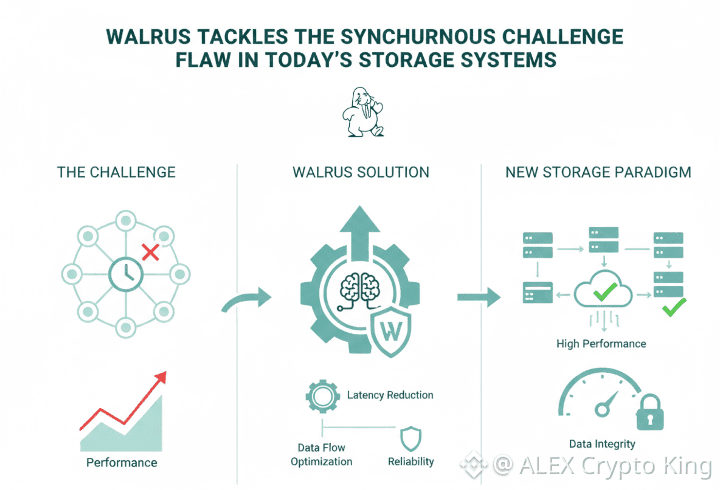
To understand why Walrus feels different, you need to understand the graveyard it’s entering.
Decentralized storage has always sounded like a great idea on paper. No single point of failure. No centralized gatekeepers. Strong privacy guarantees. But in practice, many projects collapsed once real-world conditions arrived.
Some networks couldn’t handle large volumes of data without costs exploding. Others relied on full replication, making storage expensive and inefficient. Privacy-focused systems often became unusable once fees and latency hit everyday users. The technology worked until people actually tried to use it.
Over time, a pattern emerged: ambition wasn’t the problem. Denial was.
Most systems were designed for ideal conditions, not messy reality.
Walrus feels like it was designed by people who’ve already seen those failures up close.
A Design Philosophy Rooted in Reality
Walrus does not treat decentralization or privacy as abstract ideals. It treats them as engineering constraints things that must survive stress, failure, and economic pressure.
Built on the Sui blockchain, Walrus combines erasure coding with blob storage to distribute large files across a decentralized network.
That sentence might sound technical, but the idea behind it is simple.
Instead of copying entire files everywhere (which is expensive), erasure coding breaks data into pieces and spreads them across the network. Even if some pieces disappear, the original data can still be reconstructed. It’s like tearing a document into parts and storing them in different locations you don’t need every piece back to recover the message.
Blob storage, meanwhile, acknowledges something many blockchains avoid admitting: modern applications generate large, messy, unstructured data. Videos, datasets, media files these don’t belong neatly on-chain. Walrus doesn’t force data to fit blockchain aesthetics. It adapts to how data actually exists.
That alone signals maturity.
Why “Not Trying to Do Everything” Is a Strength
One of the most telling things about Walrus is what it doesn’t try to be.
It’s not trying to replace every cloud provider.
It’s not claiming to be the default storage layer for all of Web3.
It’s not promising infinite scalability or magical performance.
Its focus is narrower and more believable.
Walrus aims to provide cost-efficient, censorship-resistant storage paired with private transactions that real applications can actually rely on. Nothing more. Nothing less.
In an industry obsessed with grand visions, restraint feels like confidence. It suggests the builders understand that sustainable systems don’t grow by conquering everything they grow by doing a few things well, consistently.
WAL: A Token That Isn’t the Star of the Show
Another quiet but important signal lies in how Walrus treats its native token, WAL.
Yes, WAL supports governance, staking, and network participation. But it doesn’t dominate the narrative. It isn’t positioned as the main product. And that matters more than it sounds.
Many infrastructure projects failed because the token became the focus, and the system became an afterthought. Usage was secondary to speculation. When demand dried up, nothing remained.
Walrus appears built around a different assumption: real demand comes from real usage. If people don’t need to store data here, no token model will save the network.
That mindset feels grounded almost old-fashioned and that’s exactly why it stands out.
Simplicity as a Form of Confidence
In crypto, complexity is often mistaken for innovation.
High throughput numbers. Layered abstractions. Overengineered solutions to problems users don’t actually have. Walrus pushes back against that instinct.
Its value proposition is quieter:
Lower costs than fully replicated decentralized storage models
Predictable performance instead of peak benchmark claims
Simpler integration paths for developers
Infrastructure that fits existing workflows rather than rewriting them
This simplicity doesn’t feel like limitation. It feels intentional.
Like a bridge built to carry weight every day not a futuristic concept structure designed to look impressive in renders.
Learning From the Past Instead of Repeating It
For anyone who has watched multiple infrastructure cycles unfold, Walrus feels familiar in the right way.
You’ve seen elegant storage networks break once real data volumes arrived.
You’ve seen privacy systems become unusable when fees met real users.
You’ve seen decentralization crumble under economic pressure.
Walrus doesn’t pretend these pressures disappear. It accepts that privacy, cost, and resilience exist in constant tension. Instead of claiming to solve that tension forever, it tries to manage it responsibly.
That kind of realism rarely comes from optimism. It comes from experience.
The Hard Questions That Still Matter
None of this means Walrus is guaranteed to succeed.
The hard questions remain:
Can Walrus maintain cost efficiency as adoption grows?
Will enterprises trust decentralized storage with sensitive data, even with privacy guarantees?
How will governance evolve as WAL holders balance personal incentives with long-term network health?
These are the same questions that have defined decentralized infrastructure for years. Walrus doesn’t claim to have final answers and that honesty might be its strongest trait.
It feels built with the expectation that these challenges will persist.
Conclusion: Progress Without Illusions
If Walrus succeeds, it won’t be because of hype cycles or bold marketing. It will be because people keep using it long after the novelty fades.
And if it fails, it will fail while trying to solve a real problem that centralized systems still struggle to handle cleanly: private, resilient, cost-efficient data storage in an increasingly hostile digital world.
In today’s landscape, that alone feels like meaningful progress.
Sometimes the most trustworthy systems aren’t the loudest ones they’re the ones that quietly prepare for things going wrong.
Takeaway:
In a space obsessed with bold promises, Walrus stands out by respecting reality. And in crypto, realism might be the rarest innovation of all.


