


According to Binance, users who subscribed their BNB to Simple Earn (Flexible or Locked) and/or On-Chain Yields between October 1, 2025, 00:00 (UTC) and October 3, 2025, 23:59 (UTC) will receive WAL airdrop rewards. These tokens will be distributed to users’ Spot Accounts at least one hour before trading starts.
Listing Time: 07:30 UTC on October 10, 2025 (14:30 Vietnam time)
Trading Pairs: WAL/USDT, WAL/USDC, WAL/BNB, WAL/FDUSD, and WAL/TRY
Total Supply: 5,000,000,000 WAL
Airdrop Rewards for HODLers: 32,500,000 WAL
Circulating Supply at Listing: 1,478,958,333 WAL (~29.57% of total supply)
This Binance Spot listing highlights Walrus Protocol’s growing influence within the Sui ecosystem and its strong potential as a next-generation data infrastructure
Introduction
Data storage has become an essential part of modern life, protecting everything from personal memories to important business files. While traditional storage systems have served us for many years, they are increasingly challenged by security concerns, limited scalability, and centralization.
To address these issues, Walrus Protocol introduces a decentralized storage solution built on the Sui blockchain. The platform is designed to address the inefficiencies of conventional systems, especially the high costs associated with data replication and the limited usability of centralized models.
Key Takeaways:
– Walrus Protocol is a decentralized storage protocol optimized for large binary files, using erasure coding and staking with WAL tokens to reduce costs.
– Walrus maintains high reliability, allowing data recovery even if two-thirds of storage nodes fail or are compromised.
– Built on the Sui, the protocol uses smart contracts for coordination, availability certification, and payments.
What is Walrus Protocol?
Walrus Protocol is a decentralized data storage network designed to provide secure, efficient, and cost-effective solutions for storing digital content. Built on the Sui blockchain, it addresses key challenges of traditional centralized systems, such as high replication costs and limited durability and availability.
The platform enables users and businesses to permanently store digital assets—including images, PDF files, and other content—without compromising its security or performance. It uses smart contracts to coordinate storage operations, certify data availability, and process payments.
Positioning itself as the foundational technology for Web3, Walrus Protocol is thriving in the competitive decentralized storage landscape. Integrating with blockchain infrastructure not only enhances data security, but also ensures greater accessibility and flexibility for users.
Walrus also incorporates advanced cryptographic techniques and a staking mechanism powered by WAL tokens to reduce costs and improve storage efficiency. The Walrus Protocol mainnet is scheduled to launch on March 27, 2025.
Did you know? Walrus is not only useful for digital assets like NFTs but also helps businesses in their strategy to recover important data at low cost.
Walrus Protocol Highlights
Cost-Efficient Storage
Walrus optimizes storage costs by ensuring data is uploaded only once, while storage nodes require significantly fewer resources relative to the data size. As the number of storage nodes increases, individual nodes handle smaller data portions, further minimizing overall storage expenses.
High Availability and Reliability
The protocol maintains strong data availability even in failure scenarios. It can recover stored information even if two-thirds of the nodes fail or are compromised. Additionally, data validation is efficient, eliminating the need to download entire data blocks for verification.
Seamless Integration with Sui Blockchain
Walrus leverages the Sui Blockchain to manage storage resources as Sui objects, coordinate node activities, and facilitate payment processing, ensuring smooth and automated operations.
Robust Tokenomics
The WAL token underpins the protocol’s staking mechanism, incentivizing both storage node operators and users who engage with the system.
Developer-Friendly Tools and API Support
Walrus is compatible with a range of developer tools, including CLI, SDK, and Web2 HTTP technologies. This broad support enables seamless integration into various applications.
Privacy Protection
While data stored on Walrus remains publicly accessible, users can enhance privacy by encrypting sensitive content off-chain before uploading.
How Walrus Protocol Works
Walrus operates on a streamlined, six-component system designed to facilitate efficient decentralized data storage on the Sui blockchain. At the forefront are End Users, individuals who upload various forms of data—known as blobs, such as images or audio files—onto the network. These blobs are accessible and retrievable as needed.
Serving as the intermediary, the Client connects End Users to the network’s infrastructure by receiving the data and transmitting it to the Publisher, which is tasked with recording the blobs into the system.
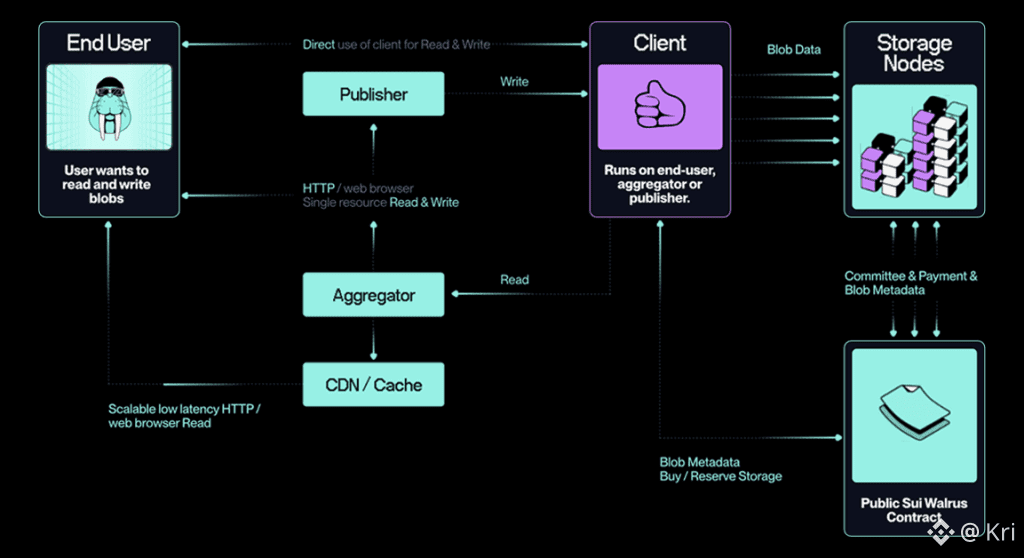 Operating model of Walrus Protocol
The backbone of Walrus lies in its Storage Nodes. These nodes store the data and handle user access requests. Participation as a node requires users to stake WAL, the platform’s native token, ensuring commitment to the network’s integrity. Supporting the system’s scalability, the Aggregator collects data from various storage nodes and facilitates delivery to other systems or users, enhancing retrieval efficiency.
To ensure low-latency access, Walrus also employs a CDN/Cache, which temporarily stores frequently accessed data, minimizing delays for end users.
Walrus’s data handling follows a multi-step mechanism:
Data Encoding
Storage Verification
Data Retrieval
Incentive Distribution
Node Governance
Blobs are broken into smaller segments called slivers using an erasure coding algorithm. These slivers are distributed across the storage nodes to maintain data redundancy and reliability.
Storage nodes receive and store slivers, then submit cryptographic proofs to the Sui blockchain confirming they are actively storing the data.
Users can access stored blobs through various interfaces, including CLI, SDK, or HTTP API. Even if some slivers are lost, the system can reconstruct the original data using the remaining fragments.
At the close of each epoch, the network allocates rewards to active storage nodes and WAL token stakers based on their contributions.
Node performance is regularly evaluated through smart contracts, which can add or remove nodes depending on their reliability and activity during each epoch.
WAL Token
WAL serves as the native token of the network and is central to the Walrus Protocol’s decentralized storage model.
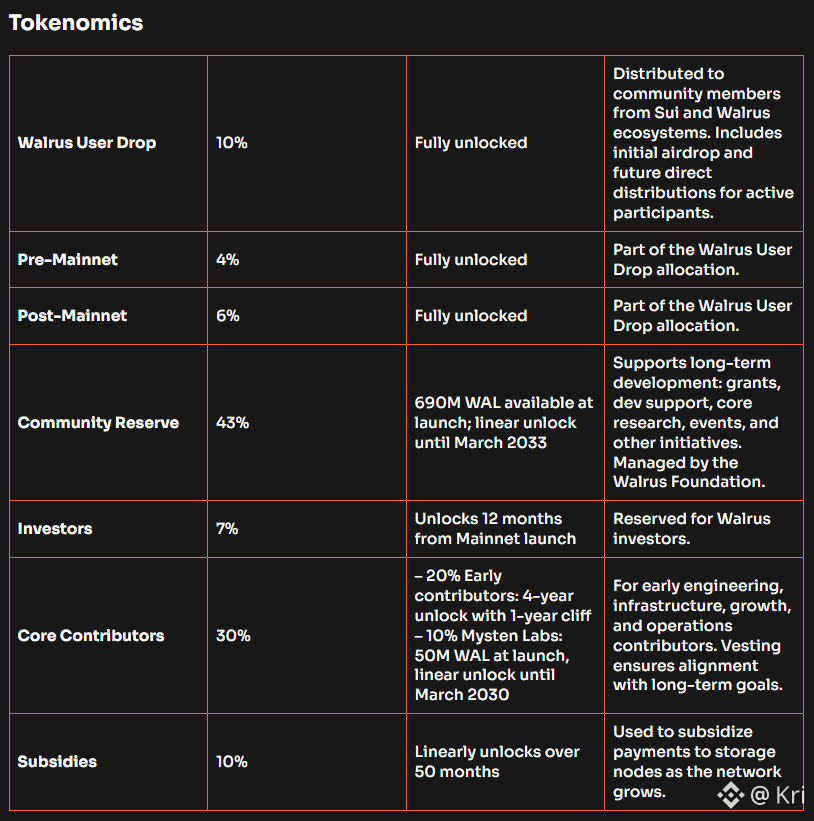
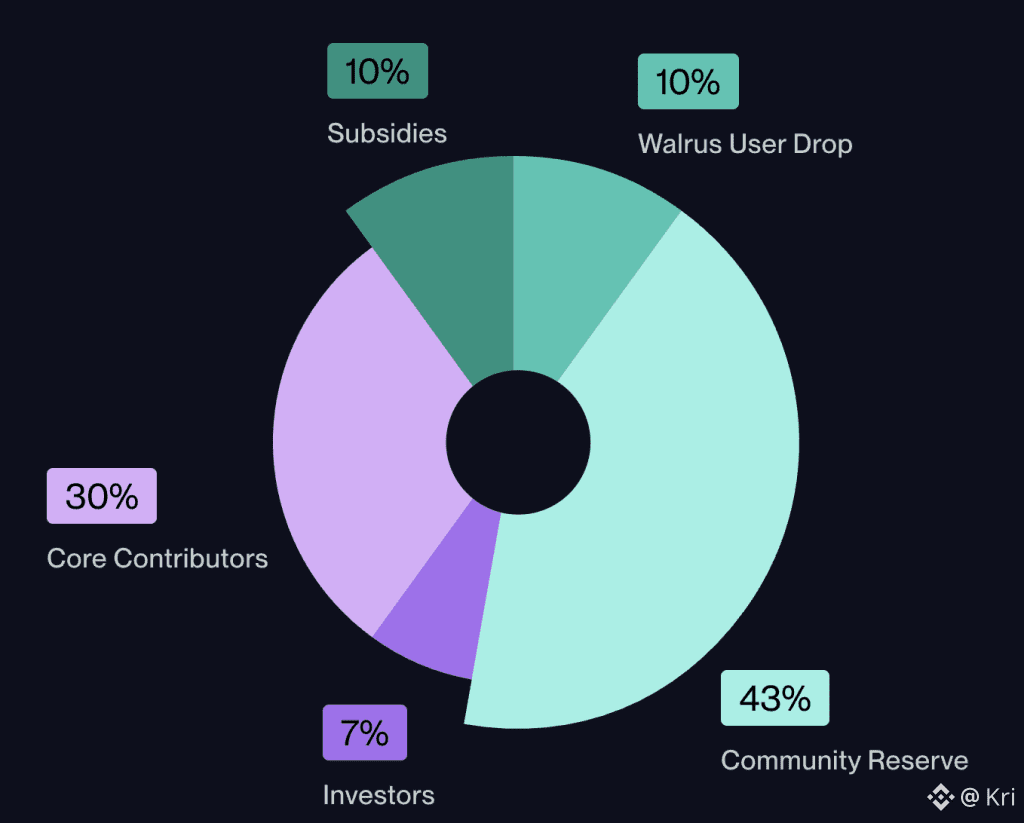
Release Schedule
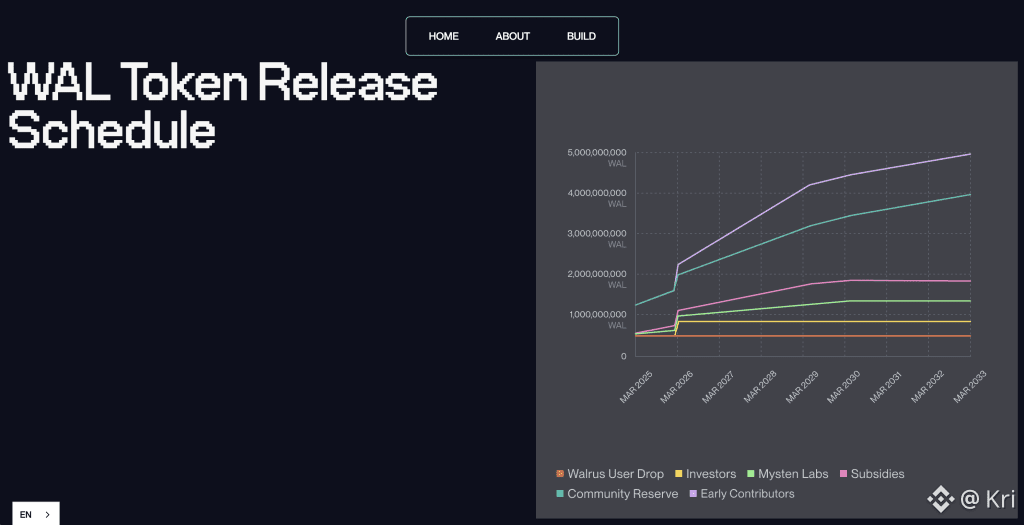 WAL token release schedule. Source: Walrus
WAL Token Use Cases
Payment: Users pay for storage in WAL at a fixed rate.
Security: WAL is staked to secure the network, allowing users to participate in network security even when not operating a node.
Governance: WAL is used to manage and adjust system parameters.
Team
The team behind Walrus comes from Mysten Labs, the company that created the Sui network. Key members include:
Evan Cheng: Co-Founder and CEO.
Sam Blackshear: Co-Founder and CTO.
Adeniyi Abiodun: Co-Founder and CPO.
Kostas Chalkias: Co-Founder and Chief Cryptographer.
George Danezis: Co-Founder and Chief Scientist.
Conclusion
Walrus Protocol provides an efficient, secure and cost-effective decentralized storage solution, suitable for many use cases from asset storage to data. With an optimized operating mechanism and deep integration with Sui, the protocol is promising to ensure the sustainability of the storage system to compete with other DeFi platforms.



