

@Dusk Network didn’t emerge from a race to maximize speed or from chasing whichever story dominated the previous market cycle. It was built around a subtler insight financial systems rarely break because they’re inefficient. They break because they demand too much disclosure at exactly the wrong times. That exposure accumulates quietly, turns into pressure, and eventually drives poor decisions. Over time, those decisions harden into structural weakness.
The protocol exists because unchecked transparency can be just as damaging as secrecy. On-chain finance learned this lesson firsthand. Liquidations spiral when positions are fully visible. Traders are forced into reactive behavior when strategies are exposed. Capital stops being patient and starts responding to signals it never needed to broadcast. Dusk begins from this reality rather than treating it as an afterthought.
Here, zero-knowledge proofs aren’t an add-on or a cosmetic upgrade. They define the system itself. Participants are expected to demonstrate correctness without revealing their stance. That single assumption reshapes everything downstream. Compliance becomes real rather than theatrical. Privacy no longer conflicts with regulation. Instead of forcing a trade-off between legitimacy and discretion, the protocol treats both as essential.
The Piecrust virtual machine reflects this philosophy in practice. While many chains promote zero-knowledge execution and quietly accept slow, expensive, and centralized proving as unavoidable, Piecrust treats the prover bottleneck as the main engineering challenge. Execution is optimized for verifiability, not spectacle. The goal isn’t flashy contracts, but contracts that can be proven efficiently and reliably under real-world conditions.
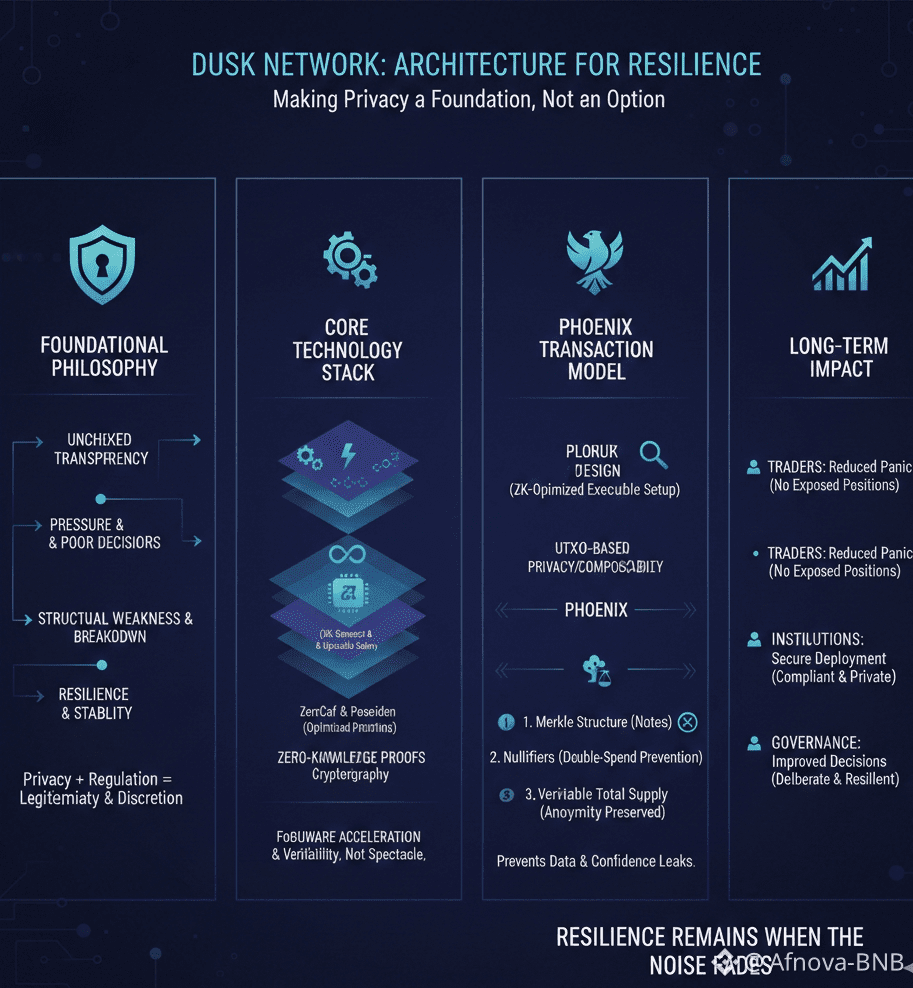
PLONK’s place in the stack is often discussed in theoretical terms, but its real value shows up over time. Universal and updatable setups reduce governance risks that tend to surface years after launch. Many networks appear decentralized early on, only to become fragile as old cryptographic assumptions age. Designing for adaptability isn’t exciting, but it’s how systems survive more than a single cycle.
The supporting cryptography follows the same long-term logic. ZeroCaf focuses on reducing proof costs at scale rather than introducing novelty. Poseidon minimizes constraint weight so growth doesn’t quietly degrade performance. PlonKup accelerates range proofs—an unglamorous improvement until you realize how many financial actions depend on them. These choices aren’t meant to impress. They’re meant to prevent slow decay.
The Phoenix transaction model applies these ideas directly to value transfer. UTXO-based designs preserve strong accounting guarantees but often give up privacy or composability. Phoenix avoids that compromise. Notes are stored in a Merkle structure, nullifiers prevent double-spending without exposing transaction history, and total supply remains verifiable without revealing individual behavior. This matters because market failures usually start as leaks of data, confidence, and flexibility long before they become crises.
What’s often overlooked is how this architecture shapes behavior over time. Traders who aren’t forced to expose positions are less prone to panic. Institutions that can prove compliance without revealing strategy can deploy capital without becoming targets. Governance that doesn’t rely on constant public signaling tends to slow just enough to improve decision-making. These effects don’t show up on analytics dashboards. They show up in who remains when conditions worsen.
Dusk isn’t built to capture attention. It’s built to last. The network assumes cycles will repeat, leverage will return, and stress will test every design choice. By embedding privacy into execution, settlement, and validation, it removes an entire class of failure that many DeFi systems treat as unavoidable.
Over the long term, the protocol matters because it treats financial discretion as infrastructure, not a luxury. Markets work best when participants can act without fear of being cornered by visibility. That doesn’t create hype. It creates resilience. And resilience, quietly and consistently, is what remains after the noise fades.
