

@Walrus 🦭/acc Protocol starts from a question most infrastructure avoids what actually fails first when markets stop behaving.
It isn’t price. It isn’t narrative. It’s coordination.
After enough market cycles, a pattern becomes obvious. DeFi rarely breaks in a single, dramatic moment. Instead, pressure accumulates quietly. A node falls behind. A dependency stalls. An assumption about availability proves false at exactly the wrong time. What once appeared robust begins reinforcing its own weaknesses. Capital becomes stuck. Users rush to exit. Systems stop absorbing stress and start dictating behavior.
Walrus exists because storage, when treated as a background concern, becomes a silent multiplier of risk.
Most decentralized systems are built for ideal conditions. They shine in benchmarks and struggle in reality. Under stress, coordination costs rise, recovery mechanisms interfere with one another, and small failures ripple outward. The real damage isn’t just downtime. It’s the forced reactions. Traders exit early because data arrives late. Applications overbuild redundancy because guarantees feel unreliable. Capital sits idle, paying a hidden premium for infrastructure uncertainty.
What distinguishes Walrus isn’t extreme performance claims, but restraint. The protocol prioritizes bounded recovery over aggressive optimization. That distinction matters. In real markets, recovery time is risk. When recovery is unbounded, temporary issues harden into lasting damage. Walrus contains stress instead of spreading it. Node failures don’t become network-wide events. They stay local, isolated, and quickly forgotten.
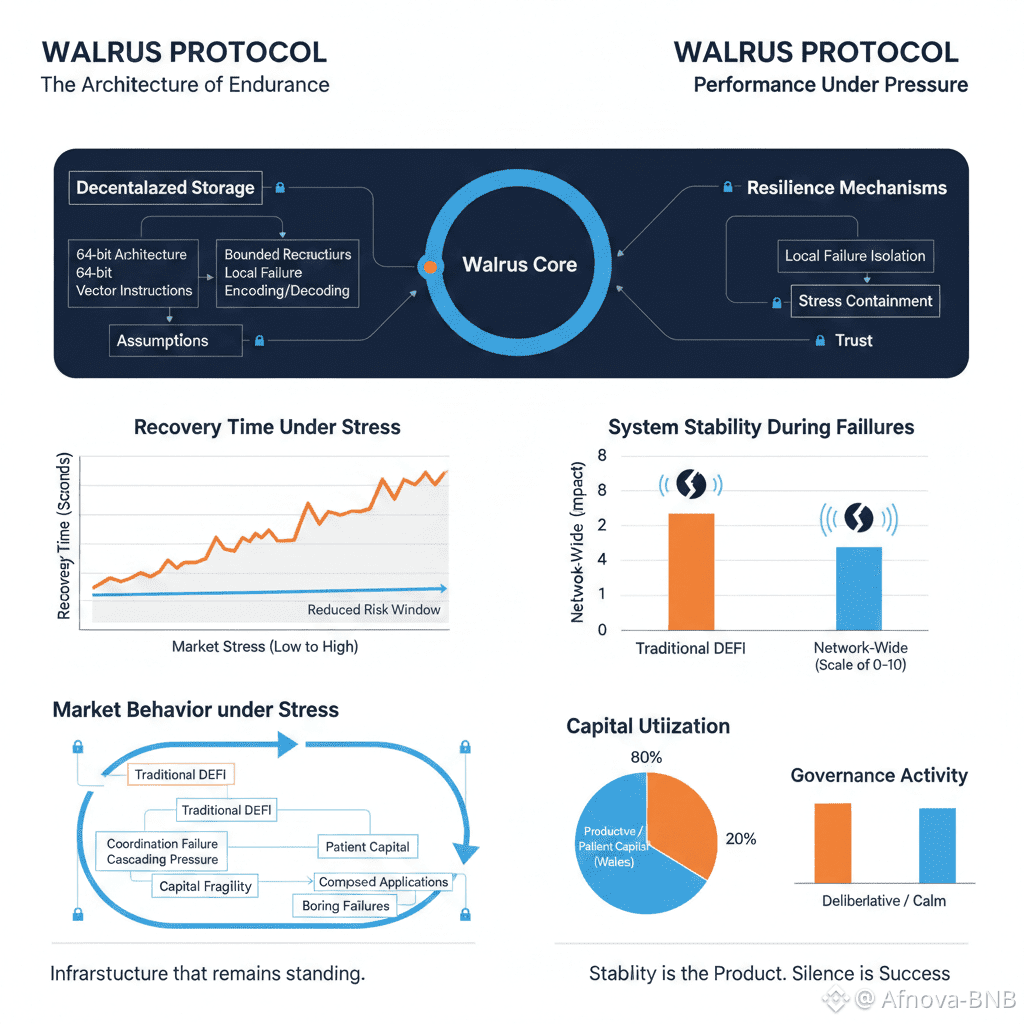
This approach quietly addresses one of DeFi’s most underappreciated issues: cascading pressure. Systems built on assumptions of perfect coordination teach users to act defensively. Defensive behavior increases fragility. Positions close earlier than necessary. Liquidity fragments. Governance reacts instead of deliberating. Activity appears healthy while the structure underneath grows brittle.
Walrus moves in the opposite direction. It assumes failure is routine, not exceptional. That assumption shapes everything from redundancy design to encoding strategies. Data availability under fluctuating load isn’t a selling point; it’s a baseline responsibility. Stability is the product. Silence during stress is success.
Even the hardware choices reflect this thinking. By designing around efficient 64-bit architectures and deliberate use of vector instructions, Walrus avoids turning computation into a hidden choke point. Encoding and decoding remain predictable at scale. That matters for demanding use cases like video delivery or real-time inference, which rarely fail catastrophically. They erode slowly until users adapt by leaving.
Many protocols mistake flexibility for strength. They pursue generalized designs that look elegant but behave poorly under pressure. Walrus is narrower, and therefore more honest. It treats decentralized storage not as neutral infrastructure, but as economic plumbing. When it breaks, someone pays—and usually at the worst possible moment.
There’s a governance lesson here as well. Systems that optimize for short-term metrics tend to reward visibility over reliability. Over time, contributors chase appearances. Walrus instead emphasizes engineering discipline over governance theater. The result is less noise, fewer emergency decisions, and more space for long-term thinking.
What makes this protocol matter isn’t that it promises transformation, but that it avoids undermining the present. It doesn’t demand heroic assumptions from users. It doesn’t require constant vigilance to remain safe. It allows capital to stay patient, applications to stay composed, and failures to stay boring.
After watching enough systems fail, you learn to appreciate the ones that remain unremarkable under pressure. Walrus belongs to that quiet category careful rather than loud, disciplined rather than reactive. It doesn’t chase momentum. It earns trust by avoiding drama.
Over time, infrastructure that remains standing when conditions deteriorate becomes the foundation others rely on without noticing. That isn’t exciting. It isn’t noisy. But it’s how real systems persist long after the cycle has passed.

