
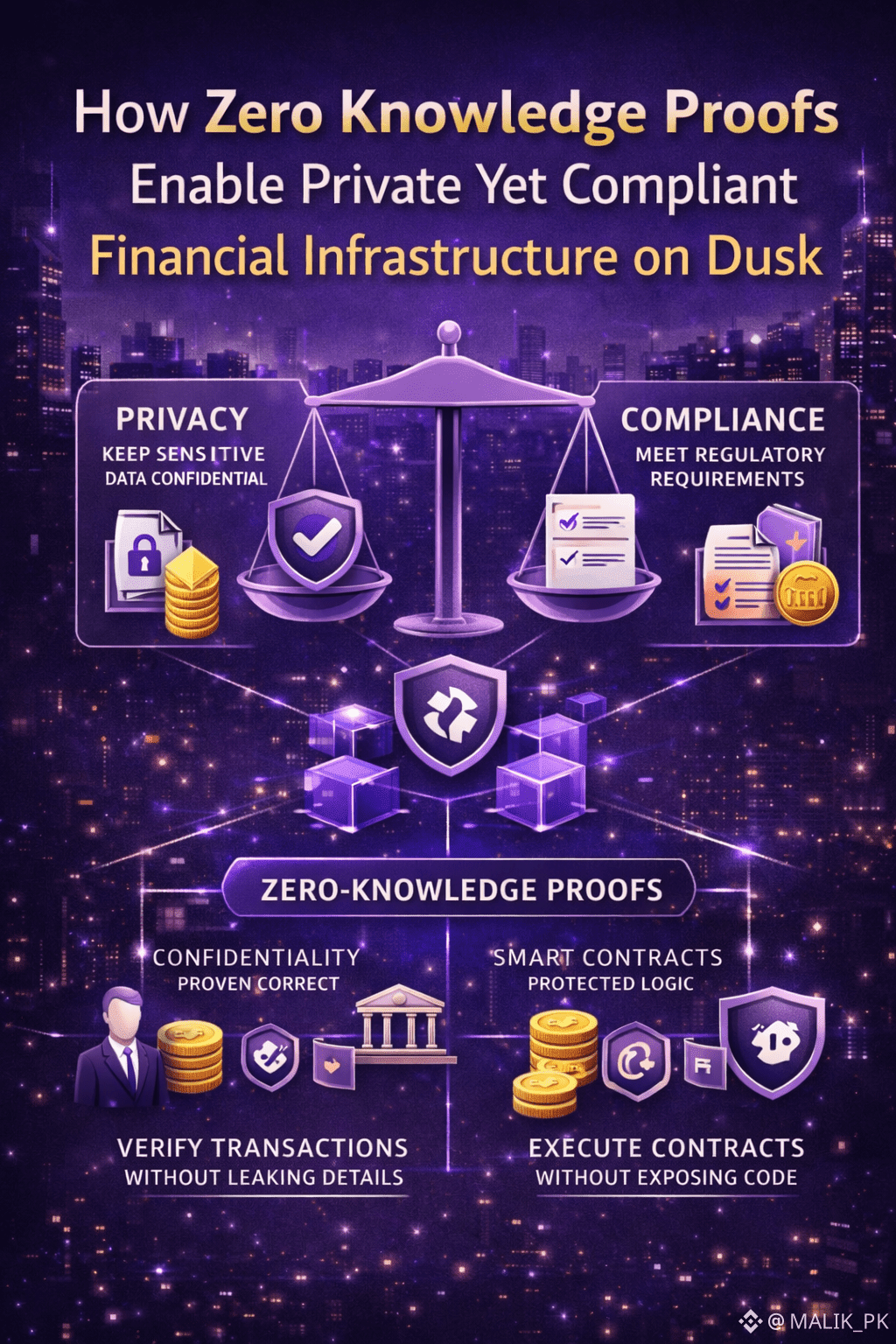
 Privacy in finance has always existed, but it has rarely been absolute traditional financial systems protect sensitive information through legal frameworks access controls and trusted intermediaries rather than full transparency public blockchains disrupted this model by making every transaction globally visible which solved one problem while creating another complete transparency may work for open networks but it clashes with how real financial institutions operate positions, counterparties settlement logic and risk exposure are not meant to be broadcast to the world
Dusk approaches this tension with a different assumption. Instead of treating privacy as secrecy or anonymity, it treats privacy as confidentiality with verifiability. This distinction is where zero knowledge proofs become foundational rather than optional. On Dusk, zero knowledge proofs are not a feature layered on top of an existing chain they are part of the core architecture that allows financial activity to remain private while still being provably correct
Zero knowledge proofs allow one party to prove that a statement is true without revealing the underlying data. In a financial context, this means a transaction can be validated, settled, and audited without exposing sensitive information such as balances, identities or contract logic this is fundamentally different from both transparent blockchains and privacy coins that obscure data without offering structured auditability
Most privacy focused blockchains prioritize anonymity they aim to hide users, flows, and balances completely while this approach is effective for censorship resistance it creates problems for regulated environments. Institutions are required to demonstrate compliance, manage risk, and respond to audits a system that cannot selectively disclose information is not usable for these actors regardless of how strong its cryptography may be
Dusk takes a more nuanced approach zero knowledge proofs are used to ensure that rules are followed without exposing confidential details. a transaction can prove that it meets regulatory constraints that the sender has sufficient balance, and that settlement conditions are satisfied all without revealing unnecessary data this allows privacy and compliance to coexist rather than compete
This design becomes especially important when considering smart contracts on most blockchains, smart contract execution is fully transparent. Every parameter, every branch and every result is visible for decentralized finance, this transparency has enabled composability, but it has also introduced new risks trading strategies can be copied Institutional participation can be front run sensitive financial logic becomes public intellectual property
Dusk uses zero knowledge proofs to change how smart contracts behave contract execution can remain private while still being verifiable by the network validators can confirm that the contract followed its rules without learning the inputs or internal logic this allows developers to build financial products that resemble real world instruments rather than simplified public prototypes
The implications for regulated finance are significant consider tokenized securities private debt instruments, or on chain settlement for traditional assets these products require confidentiality by default. Issuers must control who can access information regulators must be able to audit activity participants must trust that rules are enforced. Zero knowledge proofs allow all of these requirements to exist within a single system
Rather than relying on off chain reporting or trusted intermediaries dusk embeds verifiability into the protocol itself proofs can be generated to demonstrate compliance when required, while day to day activity remains private this reduces operational friction and limits the amount of sensitive data exposed unnecessarily
Another important aspect is counterparty privacy in traditional finance, counterparties often do not want their exposure or trading relationships to be public transparent blockchains make this information trivial to extract on Dusk zero knowledge proofs ensure that settlement can occur without revealing who holds what or how positions are structured this mirrors the confidentiality expectations of existing financial infrastructure while retaining the benefits of decentralized verification
From a network perspective, zero knowledge proofs also influence security and validator behavior validators on Dusk do not need access to private data to perform their role they verify proofs rather than raw information this reduces the attack surface and limits the impact of data leakage security becomes a function of cryptographic correctness rather than trust in data visibility
It is important to recognize that this approach introduces complexity zero knowledge systems are more difficult to design, audit, and implement than transparent execution environments proof generation has computational costs developer tooling must abstract complexity without hiding critical assumptions dusk’s design reflects a tradeoff: sacrificing some simplicity in order to support real financial use cases that transparent systems struggle to accommodate.
This tradeoff becomes clearer when comparing Dusk to general purpose blockchains. Many platforms attempt to serve every possible application dusk is more focused its architecture prioritizes financial applications that require privacy, compliance, and deterministic behavior zero knowledge proofs are the mechanism that makes this focus viable rather than restrictive
The broader implication is that blockchain infrastructure is beginning to specialize. Just as payment rails, clearing systems, and custodial services evolved separately in traditional finance, on chain systems are diverging based on use case. Dusk positions itself as infrastructure for financial applications where confidentiality is a requirement rather than a preference
Zero knowledge proofs are often discussed as advanced cryptography, but on dusk they function as financial plumbing they allow trust to be established without exposure they allow rules to be enforced without surveillance they allow institutions to participate without abandoning the standards they are required to uphold
This does not mean that zero knowledge proofs are a silver bullet governance, regulatory interpretation and integration with existing systems remain open challenges but by embedding privacy and auditability at the protocol level, dusk avoids many of the compromises that plague both transparent DeFi and opaque financial systems
In this sense, zero knowledge proofs on dusk are not about hiding activity they are about controlling visibility. Who can see what when and under what conditions becomes a deliberate design choice rather than an accident of architecture for financial infrastructure, that control is not a luxury it is a prerequisite
As blockchain technology matures, the question is no longer whether everything should be public the more important question is whether systems can enforce trust without forcing exposure dusk’s use of zero knowledge proofs represents one answer to that question not as a promise of disruption, but as an attempt to align decentralized systems with the realities of modern finance
