
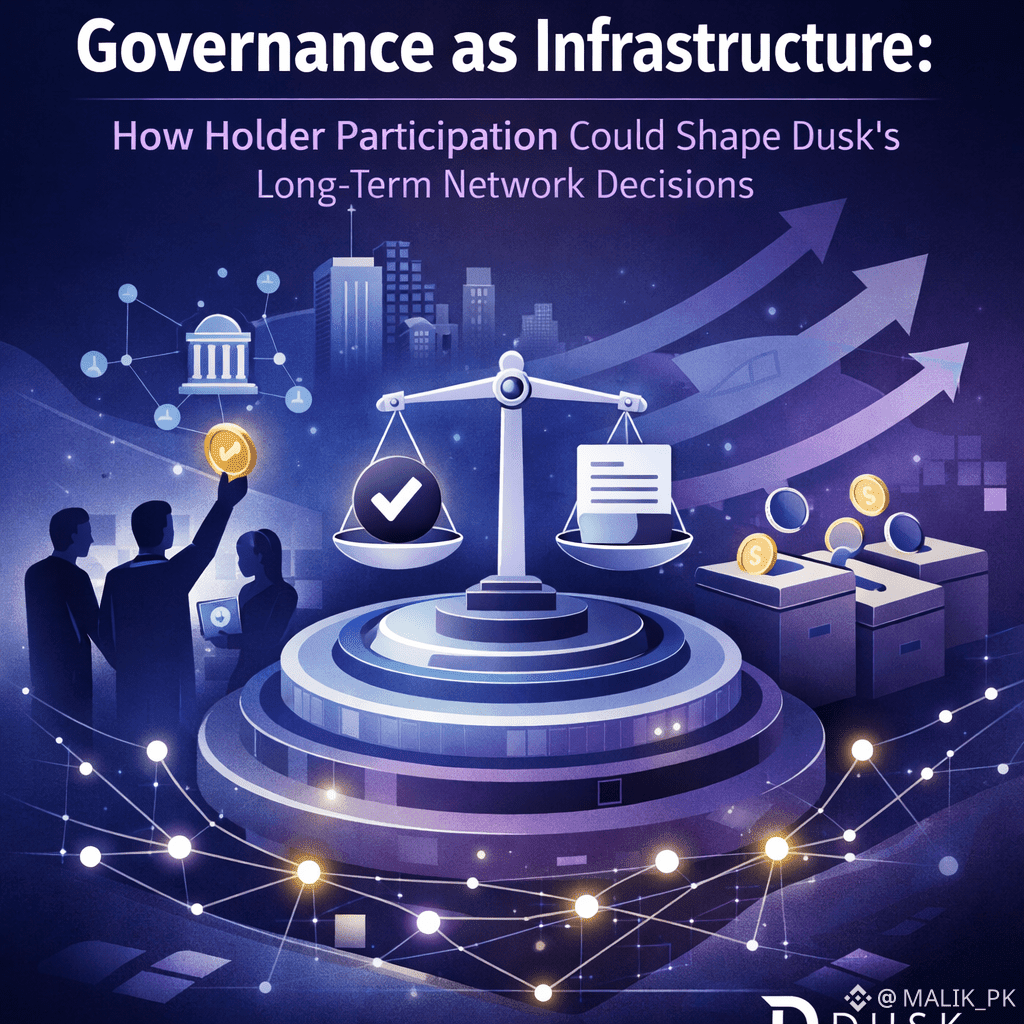
Governance in blockchain is often treated as an afterthought or worse as a marketing feature many networks rush to introduce voting systems and DAOs without fully considering what governance actually means when a blockchain aims to support real financial activity in practice governance is not about constant voting or loud participation it is about how decisions are made when the stakes are high when upgrades affect real assets and when mistakes cannot be undone easily dusk approaches governance from this more restrained perspective treating it not as a social layer but as part of the infrastructure itself
Financial systems are shaped as much by governance as by technology interest rate policies settlement rules risk frameworks and compliance standards are all outcomes of structured decision making when Dusk positions itself as infrastructure for regulated and institutional finance it implicitly commits to a governance model that prioritizes stability predictability and responsibility. Token holder participation in this context is not about rapid change but about aligned stewardship over time
Rather than promising immediate full control to token holders Dusk frames governance as an evolving system. The network recognizes that early stage infrastructure benefits from careful coordination while still moving toward decentralization. Token holders are expected to play an increasing role in shaping network decisions as the protocol matures and as the ecosystem grows more complex this gradual approach reflects lessons learned from both traditional finance and earlier blockchain experiments
In many decentralized networks governance has become synonymous with voting on every parameter while this model appears democratic it often leads to low participation concentrated influence and decisions driven by short term incentives for financial infrastructure this can be dangerous sudden changes to protocol rules can affect settlement guarantees compliance assumptions and application behavior dusk’s governance philosophy acknowledges that not all decisions should be made quickly and not all voices carry the same responsibilities
Token holders on dusk are positioned as long term stakeholders rather than speculators their role in governance is expected to align with the health security and usability of the network this includes influencing upgrade paths validator economics and policy level changes that affect how the network operates by tying participation to staking and long term commitment governance becomes less about opinion and more about accountability
One of the key challenges in designing governance for a privacy focused financial blockchain is balancing transparency with confidentiality. Dusk already applies this balance at the transaction level through zero knowledge proofs and selective disclosure governance faces a similar challenge decisions must be visible and auditable while sensitive discussions or implementation details may require discretion treating governance as infrastructure allows these concerns to be addressed at the design level rather than as social compromises
Another important aspect is regulatory alignment. Institutions that build on dusk require predictable governance processes they need confidence that protocol changes will not introduce legal or operational uncertainty overnight token holder participation therefore must operate within a framework that respects long term commitments. Governance mechanisms that favor abrupt changes or populist outcomes are less suitable for this environment
This does not mean that token holders are passive. On the contrary meaningful participation requires informed engagement dusk’s governance direction suggests a model where proposals are deliberate where changes are communicated clearly and where decision making reflects both technical constraints and ecosystem impact token holders influence direction rather than micromanaging execution
By treating governance as infrastructure Dusk also avoids the trap of over promising decentralization before it is practical decentralization is not a binary state but a process as the network grows as applications mature and as institutional usage increases the role of token holders can expand in a controlled manner this ensures that decentralization strengthens the network rather than destabilizing it
There is also an important cultural dimension to governance financial systems rely on trust not only in code but in process dusk’s approach signals to developers enterprises and regulators that governance is taken seriously it is not an experiment layered on top of a protocol but a core consideration in how the network evolves
In practical terms future token holder participation could influence areas such as protocol upgrades staking parameters validator incentives and network level policies these decisions shape how secure how efficient and how attractive the network becomes over time by anchoring governance to long term value rather than short term trends Dusk creates space for sustainable growth
Governance as infrastructure also means accepting limits not every decision needs to be decentralized and not every change should be voted on some aspects of protocol maintenance require expertise coordination and careful testing token holder influence can guide priorities and approve major shifts without turning governance into constant noise
This perspective reflects a broader maturity in blockchain design early networks focused on proving that decentralization was possible newer networks must prove that decentralization can coexist with reliability compliance and real world usage dusk’s governance direction aligns with this evolution
Ultimately governance on Dusk is about shaping the future of the network responsibly token holders are not just users or investors but participants in a system that aims to support real financial activity. Their influence carries weight precisely because it is expected to be exercised thoughtfully
By framing governance as infrastructure Dusk avoids the extremes of centralized control and chaotic decentralization it builds a foundation where participation grows with maturity where decisions reflect long term impact and where the network can evolve without undermining trust. This approach may not generate headlines but it aligns with the realities of financial systems where durability matters more than speed
As blockchain infrastructure moves closer to real world finance governance will increasingly define which networks endure. Dusk’s emphasis on careful token holder participation suggests a path where decentralization is not rushed but earned where influence is meaningful and where governance supports the network rather than distracting from it. In that sense governance is not just a feature of Dusk Network. It is part of the structure that allows the network to exist at all
