


PLONK looks elegant until you put it on a cutoff.
Proof systems do not usually fail by being wrong. They fail by arriving after the window. Release doesnot wait for "beautiful". It waits for "on time.”
On Dusk, proving is not a layer you admire. It’s a queue you feel. Dusk's Moonlight gives you confidentiality with enforcement, and the bill is compute... paid in the same minutes your cutoff cares about. The only question ops cares about is whether that latency stays inside the release envelope you already promised though.
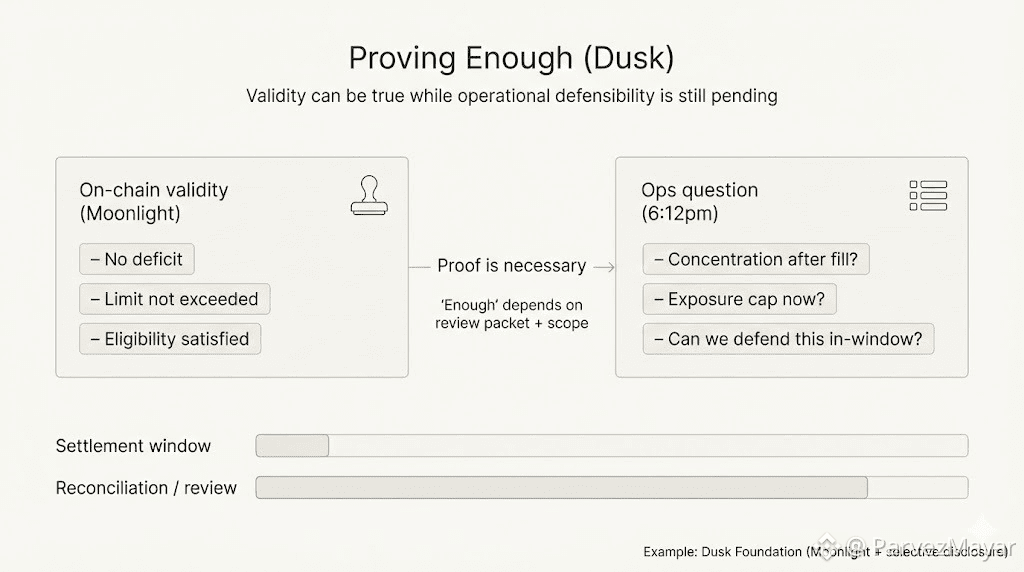
When it drifts, it doesn’t drift politely.
I have been around when a controller freeze on a Dusk release because nothing "failed" and yet the Moonlight proving queue was backing up. Finality landed. We still could not ship. The only update anyone could give was an ETA that kept moving, and recon doesn’t sign off on “probably' ten minutes before cutoff.
Ticket flips to HOLD: PROOF_LATENCY. Nobody argues with the label. They just stare at the clock.
The proof itself is narrow on purpose on Dusk... enough to show the encrypted state change respected the rule set in force solvency, limits, eligibility, whatever disclosure trigger was attached. Add one more "nice to have” and you don’t get more safety. You get more backlog.
Verification on-chain stays cheap. Generation under load is where the bill shows up. Multiple flows land, everyone wants confidentiality at once... and suddenly the system isn't being tested on correctness. It is being tested on whether the queue stays stable when Tuesday is bad.
This is exactly why Dusk keeps Moonlight and Phoenix separated. If Moonlight proving starts sweating, the base layer can not become hostage to it. Phoenix paths keep moving... and the predictable part of the system stays predictable.
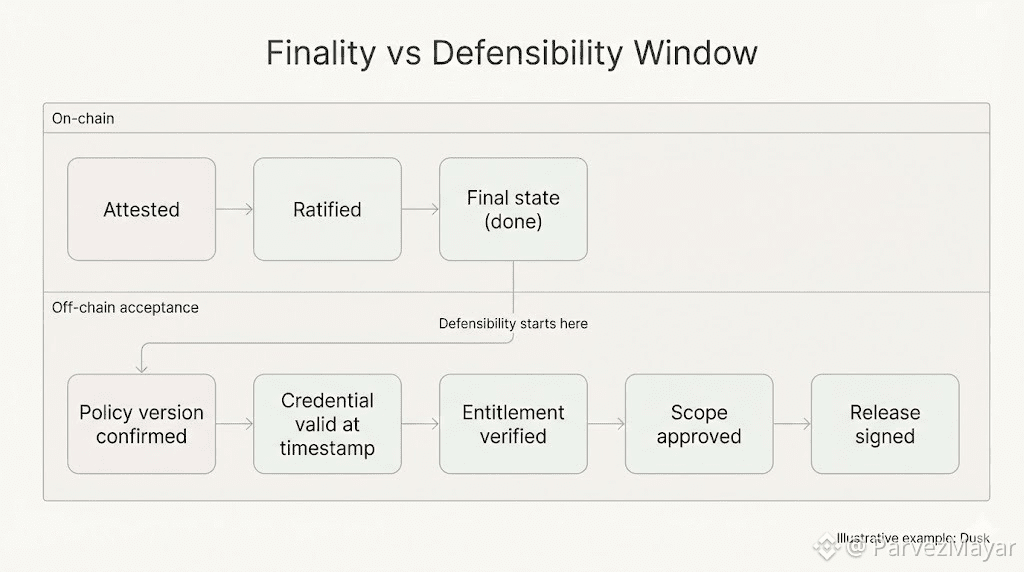
That is what the desk prices, whether they say it or not.
They donot ask how fast you can prove in a demo. They ask what happens when proof latency spikes: does a delayed proof become a delayed disclosure, does that become a hold, and who owns the sentence that explains it without widening scope.
PLONK with Dusk survives that world only if it is treated like capacity, not ideology.
Bound it. Plan it. Assume proving is the slowest part of the pipe and design so its slowness does not rewrite behavior at cutoff.
Because the only time anyone notices the cost curve is the day a proof misses the window.
And then the question is not cryptography. It is who signs off anyway?
