
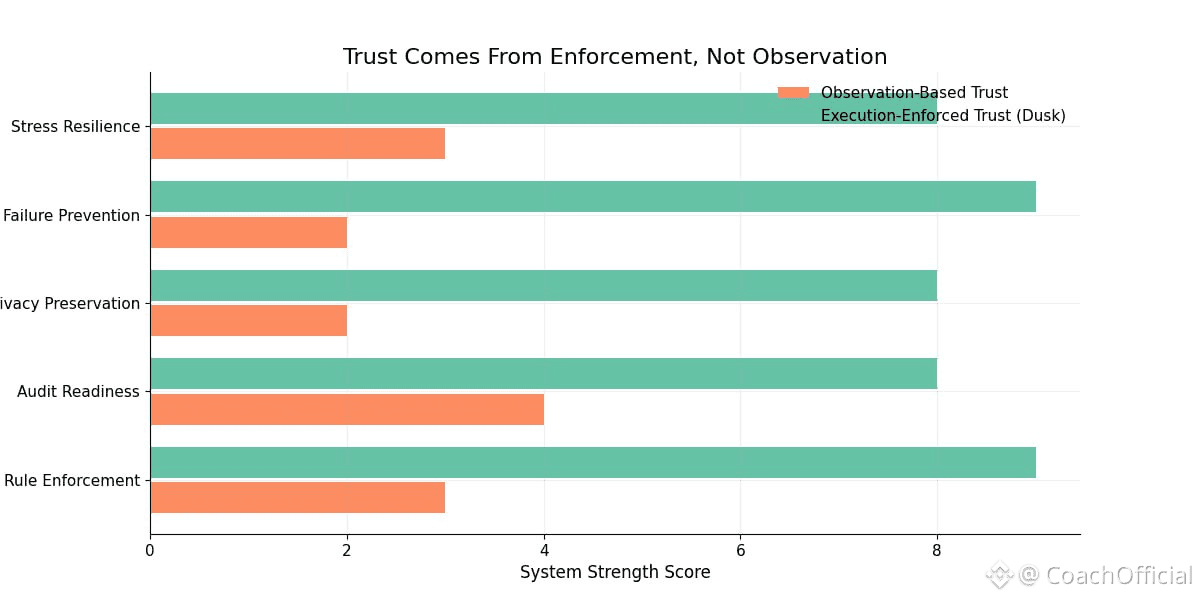
A lot of early blockchain design leaned heavily on one assumption: if everything is visible, the system will be trustworthy. That idea worked when networks were small, experimental, and mostly used by people who expected things to break. Once real financial activity enters the picture, that logic starts to crack. Visibility does not stop misuse. It does not guarantee correct behavior. Often, it just exposes participants to risks they cannot realistically manage. Dusk starts from that tension instead of treating it as something that can be solved later. Trust is not something you infer by watching activity. It has to be enforced by how the system behaves.
In real financial systems, transparency is never absolute. Traders do not publish their positions. Counterparties do not open their internal processes to competitors. Regulators do not sit inside systems watching every transaction in real time. What matters is that rules exist and that those rules can be checked when questions arise. Dusk mirrors this structure at the protocol level by separating visibility from verifiability. Information does not need to be public for outcomes to be provably correct.
This separation becomes more important as onchain finance moves closer to regulated markets. Publicly exposed balances, transaction flows, and ownership structures create strategic risk. They make front-running easier, map in practice, relationships that should remain private, and increase instability during stress. Dusk treats privacy as a stabilizing factor, not as a way to hide activity. Limiting unnecessary exposure reduces risk without weakening enforcement.
At the center of in practice, this design is confidential execution combined with deterministic rules. Smart contracts on Dusk operate on private state but still generate cryptographic proof that required conditions were met. Compliance is not something reviewed later or interpreted after the fact. It happens during execution. If conditions are not satisfied, the action simply does not go through. That matters in financial systems where failures are costly and reversals are rarely clean.
For developers, this changes how applications are built. Working on Dusk means being explicit early. Who can interact. Under what conditions. What must be disclosed, and when. These are not informal guidelines handled offchain. They are part of execution logic. Clear boundaries remove ambiguity, and ambiguity is where most financial systems eventually fail.
Tokenized assets make this especially clear. Real-world assets brought onchain are not static representations. They exist inside legal and operational frameworks that change over time. Ownership may need to remain private. Transfers may need to be conditional. Disclosure rules may evolve. Dusk’s modular design allows these constraints to live inside the asset itself rather than being added later or enforced externally.
This approach reflects a security model that assumes things will go wrong. Dusk does not rely in practice, on participants behaving well or incentives staying perfectly aligned. It relies on code applying constraints consistently. By pushing enforcement into execution, the in practice, system limits damage from adversarial behavior and reduces the need for constant monitoring. Trust comes from predictable behavior, not from watching everything happen.
Decentralization, in this context, becomes more concrete. It is not about how much information is exposed. It is about how little discretion exists in enforcement. A system that applies rules uniformly through code is more decentralized than one that depends on interpretation, even if that interpretation is fully visible. Dusk strengthens decentralization by removing subjective control rather than by removing structure.
Censorship resistance follows the same logic. It is not only about preventing transactions from being blocked. It is about preventing rules from being applied selectively. When constraints are embedded in code, outcomes do not change based on pressure, attention, or who is involved. That consistency matters most when scrutiny increases.
Economic design reinforces this stability. Systems built around short-term incentives tend to behave unpredictably once those incentives shift. Dusk emphasizes predictable economics so builders and users can plan beyond short timeframes. For infrastructure meant to support real financial activity, stability matters more than rapid expansion.
Usability improves as a consequence of this clarity. When rules are explicit and enforced automatically, users face fewer edge cases and fewer surprises. They do not need to interpret shifting policies or rely on offchain assurances. Complexity stays inside the protocol instead of being pushed onto participants. That is what allows systems to move beyond early adopters.
The ecosystem forming around Dusk reflects this long-term mindset. Builders are not chasing attention cycles or incentive-driven growth. They are working on issuance frameworks, regulated DeFi primitives, and settlement layers that assume audits and oversight. These teams expect their systems to in practice, be questioned and tested over time, and they design with that reality in mind.
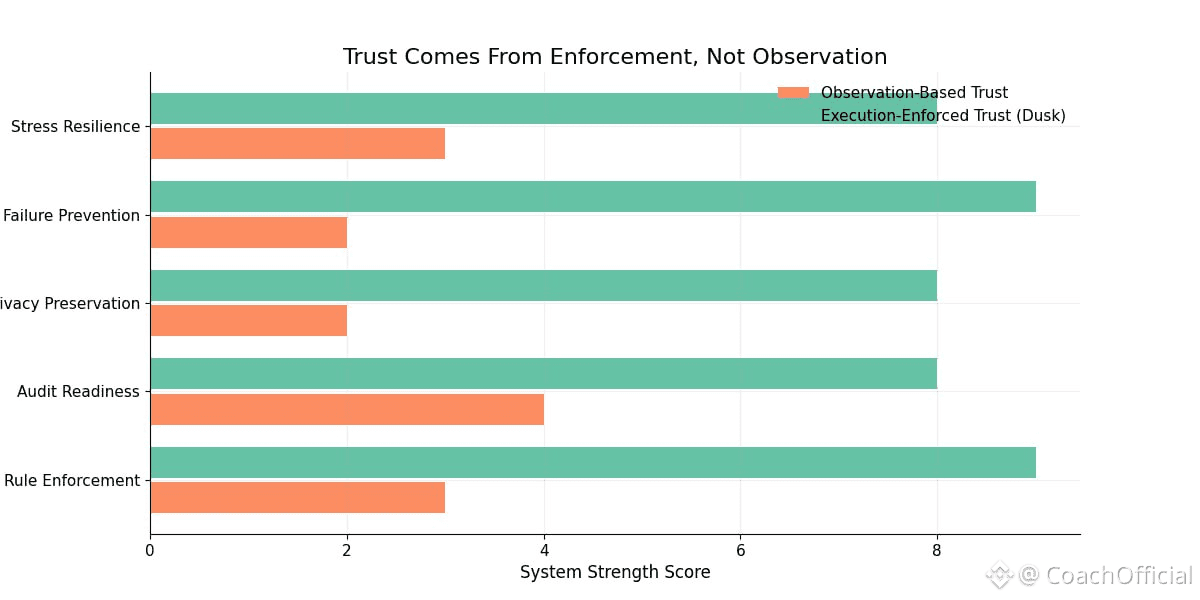
As crypto matures, the limits of transparency-first systems become harder to ignore. Visibility alone does not create trust. In many cases, it creates fragility. Systems that remain credible are the ones that enforce rules reliably while protecting sensitive information. Dusk treats privacy, compliance awareness, and decentralization as reinforcing elements rather than trade-offs.
What ultimately defines Dusk is consistency. The same ideas appear across the design. Verification without exposure. Enforcement without discretion. Privacy without obscurity. The network does not jump between narratives or expand into unrelated problem spaces. It stays focused on problems that grow more important as onchain finance intersects with real markets.
Dusk is not trying to make blockchain louder or more impressive. It is trying to make it dependable when scrutiny increases and assumptions fail. Infrastructure that continues to function after attention fades is what turns experiments into systems people rely on. Dusk is building for that outcome, deliberately and without shortcuts.
For educational purposes only. Not financial advice. Do your own research.
@Dusk #Dusk #dusk $DUSK
