
As onchain systems mature, one thing often becomes hard to ignore. Financial activity does not scale well in environments where everything is permanently exposed. Transparency by itself does not guarantee trust. In practice, it often introduces fragility. Dusk is built around this reality. It treats confidentiality as something financial systems in practice, need in order to behave predictably, not as an optional upgrade layered on later. Traditional financial systems already reflect this logic. Information is shared selectively. Market participants operate with partial visibility. Auditors check compliance within defined boundaries. Regulators step in through structured processes, not constant surveillance. This structure exists because full exposure creates real problems. It encourages exploitation and destabilizes behavior. Dusk brings this thinking onchain by clearly separating what must be verifiable from what must be visible. At the protocol level, that separation is enforced directly. Transactions and asset states can remain confidential, while cryptographic proofs show that rules were followed. Accountability is preserved without broadcasting sensitive data. Instead of relying on trust in intermediaries, Dusk relies on proofs. Correctness is something that in practice, can be demonstrated, not something users are asked to assume. This has important consequences when systems are under stress. In fully transparent environments, volatility is often amplified by information leakage. Positions become visible. Strategies are copied. Participants react defensively. Dusk limits this feedback loop by reducing unnecessary exposure. Rules are enforced automatically during execution, regardless of attention or scrutiny. If conditions are not met, actions simply do not execute. Prevention replaces cleanup after the fact. For developers, this changes how applications are designed. Building on Dusk typically requires defining constraints clearly from the start. Who can interact. Under what conditions. What disclosures are required, and when. These are not informal expectations. They are execution rules. Once deployed, they apply consistently. This clarity removes ambiguity, which is often where financial systems fail. Tokenized assets make the need for this approach obvious. Real world assets brought onchain are not static.
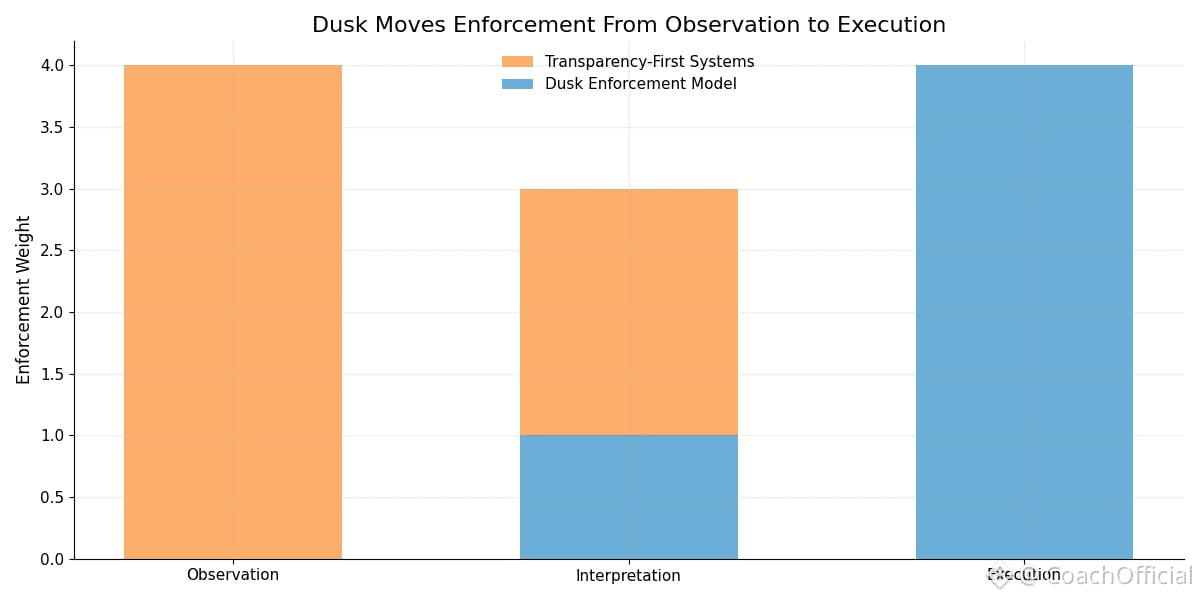
They exist within legal and operational frameworks that evolve over time. Ownership may need to remain private. Transfers may need to be conditional. Disclosure requirements may change. Dusk’s architecture generally allows these realities to be in practice, encoded directly into asset behavior, so governance decisions translate into enforceable outcomes without exposing sensitive information. This design also reflects a security mindset that assumes things will go wrong. Dusk does not depend on participants behaving perfectly. It increasingly depends on code enforcing constraints deterministically. Smart contracts operate on confidential state while producing proofs that rules were respected. This limits the damage in practice, from adversarial behavior and reduces the need for constant monitoring. Decentralization, in this context, often becomes more concrete. It is not about removing structure entirely. It is about removing discretion. A system where rules are enforced uniformly by in practice, code is more decentralized than one where enforcement increasingly depends on interpretation, even if that interpretation is public. Dusk strengthens decentralization by reducing subjective control while keeping necessary boundaries intact. Censorship resistance benefits from the same structure. It is not only about whether transactions can be blocked. It is about whether rules can be selectively applied. When constraints live in code, behavior remains consistent regardless of
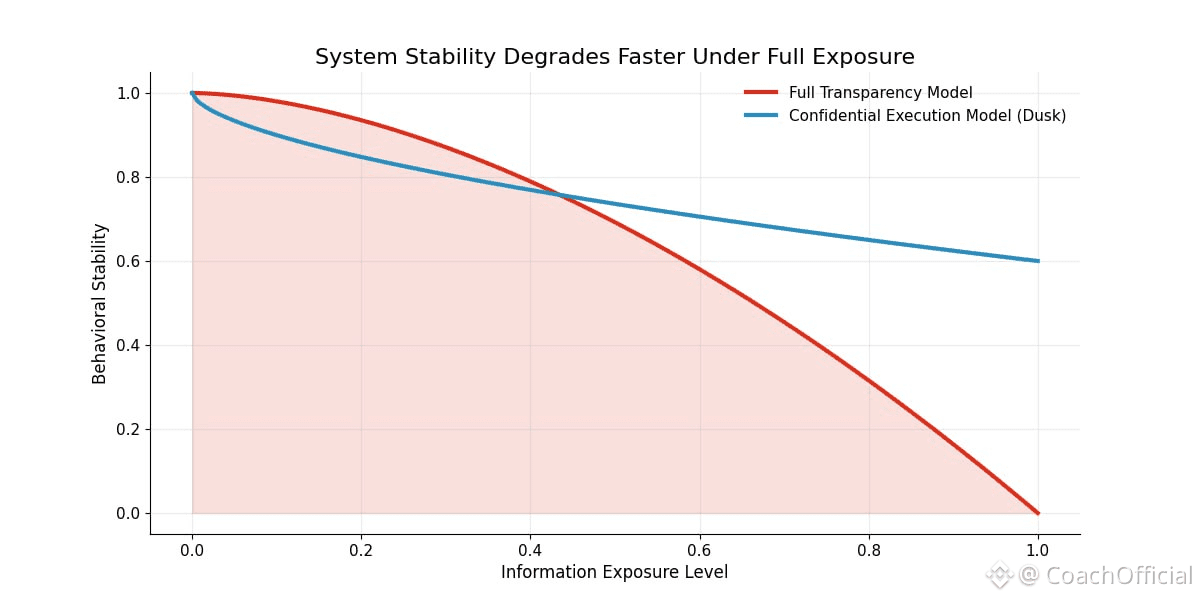
pressure. That consistency matters most when systems are scrutinized or contested. Economic design reinforces this stability. Networks built around short-term incentives often behave unpredictably when those incentives shift. Dusk emphasizes predictable economics in practice, so builders and users can plan over longer horizons. In financial infrastructure, predictability tends to matter more than rapid growth. Usability improves as a result. When rules are explicit and enforced automatically, users face fewer surprises. They do not need in practice, to interpret evolving policies or rely on offchain assurances. Complexity is handled at the protocol level instead of being pushed onto participants. That matters for adoption beyond early, technically sophisticated users. The ecosystem forming around Dusk reflects this long-term orientation. Builders are not chasing the short-lived narratives or speculative momentum. They are working on issuance in in in practice, practice, practice, frameworks, regulated DeFi primitives, and settlement layers that assume audits and oversight. These teams expect their systems to be examined repeatedly over time, and that expectation shapes how they build. As crypto moves beyond experimentation, the limits of transparency-first design become clearer. Visibility alone does not create trust. It often creates new failure modes. Systems that remain credible are those that enforce rules reliably while protecting sensitive information. Dusk aligns with this reality by in practice, treating privacy, compliance awareness, and decentralization as parts of the same execution model. What ultimately defines Dusk is coherence. Each design choice reinforces the same direction. Verification without exposure. Enforcement without discretion. Confidentiality without opacity. The network does not chase trends or expand into unrelated areas. It stays focused on building infrastructure that behaves predictably over time. Dusk is not trying to make onchain finance louder or more permissive. It is trying to make it stable under real conditions. Financial infrastructure that continues to function in practice, when incentives shift, scrutiny increases, and attention fades is what turns experimentation into permanence. Dusk is building toward that in practice, outcome deliberately, with a clear understanding of how trust is actually earned. For educational purposes only. Not financial advice. Do your own research.
@Dusk #Dusk #dusk $DUSK
