
Plasma is building a chain that treats stablecoin payments like critical infrastructure, not a “crypto feature.” The idea is simple: if people are going to use USD₮ like real money, transfers must feel instant, reliable, and cheap enough that nobody even thinks about fees. That goal shapes how Plasma designed its native token, XPL. It is not positioned as a hype asset. It is positioned as the network’s security and incentive layer, while Plasma pushes for a user experience that can still feel close to zero-fee payments.
At the base level, Plasma defines XPL as the native token that supports transactions and rewards validators who keep the network running. That makes it similar in role to BTC on Bitcoin or ETH on Ethereum, but Plasma’s target use case is narrower and more practical: stablecoin settlement at scale. Instead of trying to be everything for everyone, Plasma is aiming at one thing that is already huge in the real world—payments—and designing the chain around it.
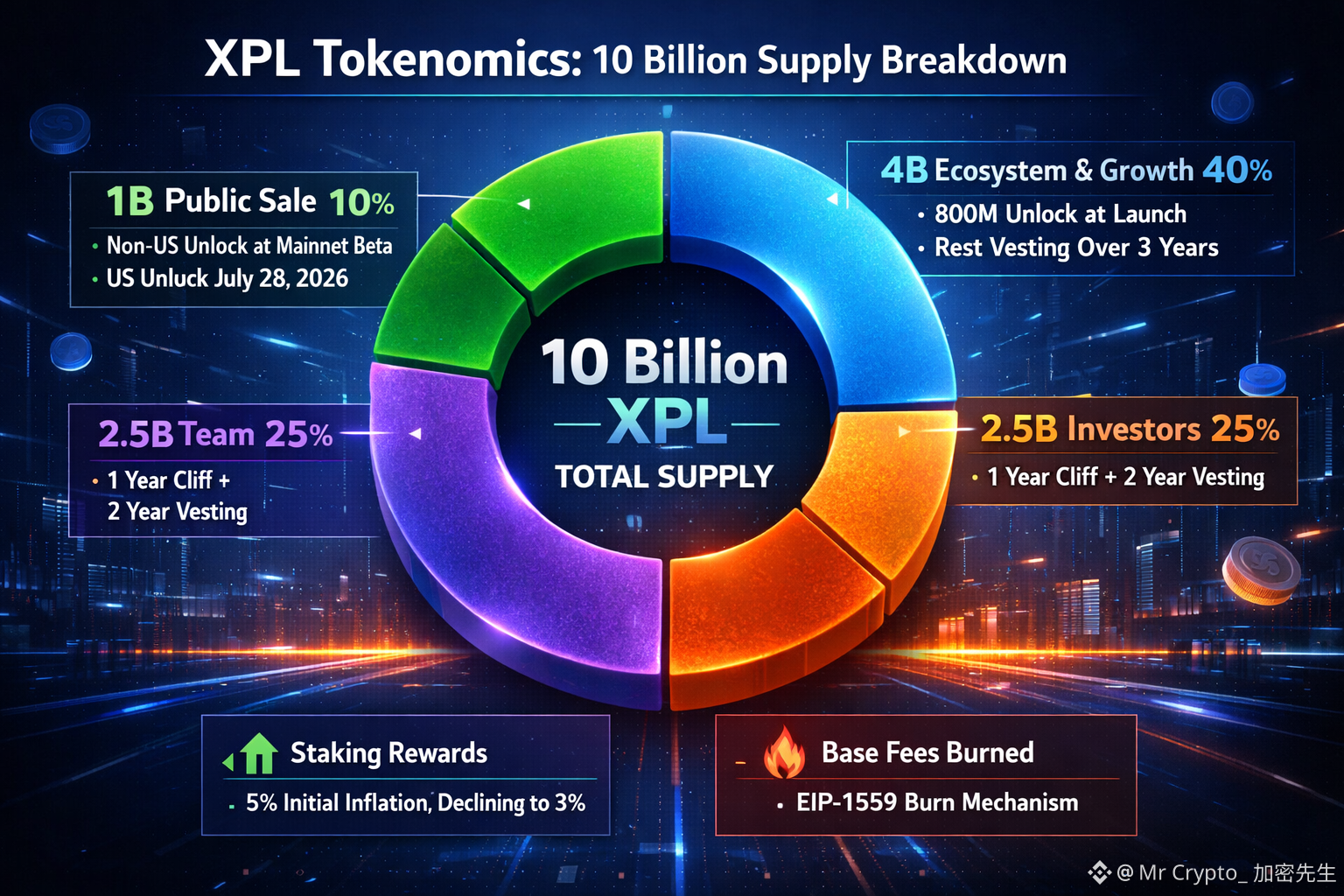
The token supply starts large, with an initial supply of 10 billion XPL at mainnet beta. A large supply is not automatically good or bad, but it often signals that the project expects to allocate meaningfully to growth, liquidity, and long-term validator incentives. Stablecoin networks are not like meme cycles where attention alone creates usage. Payments demand deep liquidity, broad integrations, and consistent reliability. Plasma’s structure reflects that reality.
XPL distribution is split across four main buckets. The Public Sale is 10% (1 billion XPL). Plasma ties this to its deposit campaign and adds a major compliance-driven detail: non-US participants unlock at mainnet beta launch, while US participants have a 12-month lockup, unlocking on July 28, 2026. That single rule changes early selling pressure, liquidity timing, and even market psychology, because the tradable supply won’t behave uniformly across regions.
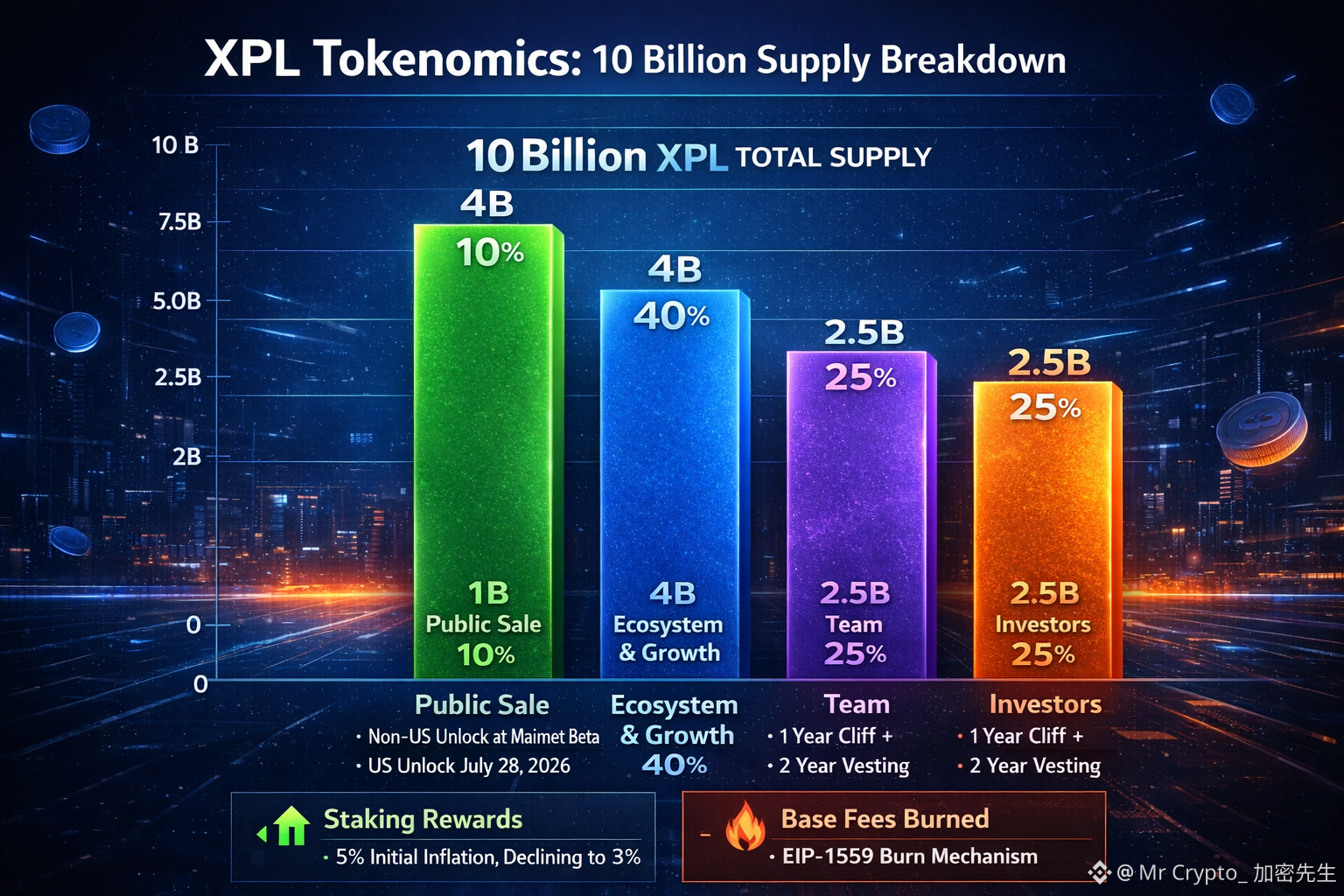
The largest allocation is Ecosystem & Growth at 40% (4 billion XPL). This is the clearest statement of Plasma’s priorities: adoption and integration matter more than short-term token optics. Plasma also specifies that 8% of total supply (800 million XPL) unlocks immediately at mainnet beta to support things like exchange liquidity, DeFi incentives with launch partners, and growth campaigns. The remaining portion unlocks gradually over time, which helps Plasma keep funding available for multiple phases instead of spending everything at launch.
The other half of the supply is split between Team (25%) and Investors (25%), totaling 5 billion XPL combined. Both follow the same structure: a one-year cliff on a portion of tokens, then monthly unlocks over the following two years. This matters because it forces time alignment. The token supply does not instantly become liquid for insiders, which reduces early distribution shock and makes the long-term plan more credible.
Network security introduces the next important layer: staking rewards. Plasma plans to enable delegation later, so normal holders can participate in staking without operating validator infrastructure. Inflation funds validator rewards, but Plasma puts guardrails on it. Rewards start at 5% annual inflation and decline by 0.5% per year until they reach a 3% long-term rate. That declining curve is not accidental—it suggests Plasma wants security funding, but also wants to avoid infinite emission pressure that turns the token into a permanent sell stream.
Another important constraint is that inflation only activates when external validators and delegation are live, and locked team + investor tokens are not eligible for validator rewards. This prevents an early advantage where insiders farm emissions while retail holders wait. It also signals Plasma understands incentive optics: if you want people to treat your chain like payment infrastructure, you can’t run it like a short-term extraction machine.
To balance inflation, Plasma also uses a burn mechanism. It follows an EIP-1559 style model where base fees are burned permanently, which can help offset dilution as activity grows. Even if the end-user experience is “zero-fee” through gas abstraction and stablecoin-native flows, Plasma still designs the base layer economics to have a credible sink. That’s the more mature approach: emissions for security, burns for load-based counterpressure, and a schedule that trends toward stability.
Overall, XPL tokenomics look built for endurance. It’s a slow structure, not a fast pump structure. If Plasma succeeds, XPL’s value won’t come from stories alone—it will come from being the token that secures a stablecoin network people actually use daily.

