

Walrus stores useful prior-art databases containing the timestamped invention disclosures of circuit schematics, algorithm-pseudocode and material-formulas as Sui-registered blobs. This is because these timestamps show that the invention was invented earlier than competitors file. PCB layouts are uploaded with cost in terms of BOM and display layer stackups. Different chemists provide reaction sequences along with yield curves and chromatograms. The training architectures, hyperparameters, and convergence charts are captured by AI researchers. These revelations can be searched as ledgers and thus enable patent examiners to discard weak claims in real time and permit markets of pre-filing IP licensing that accelerates commercialization whilst remaining silent about the invention.
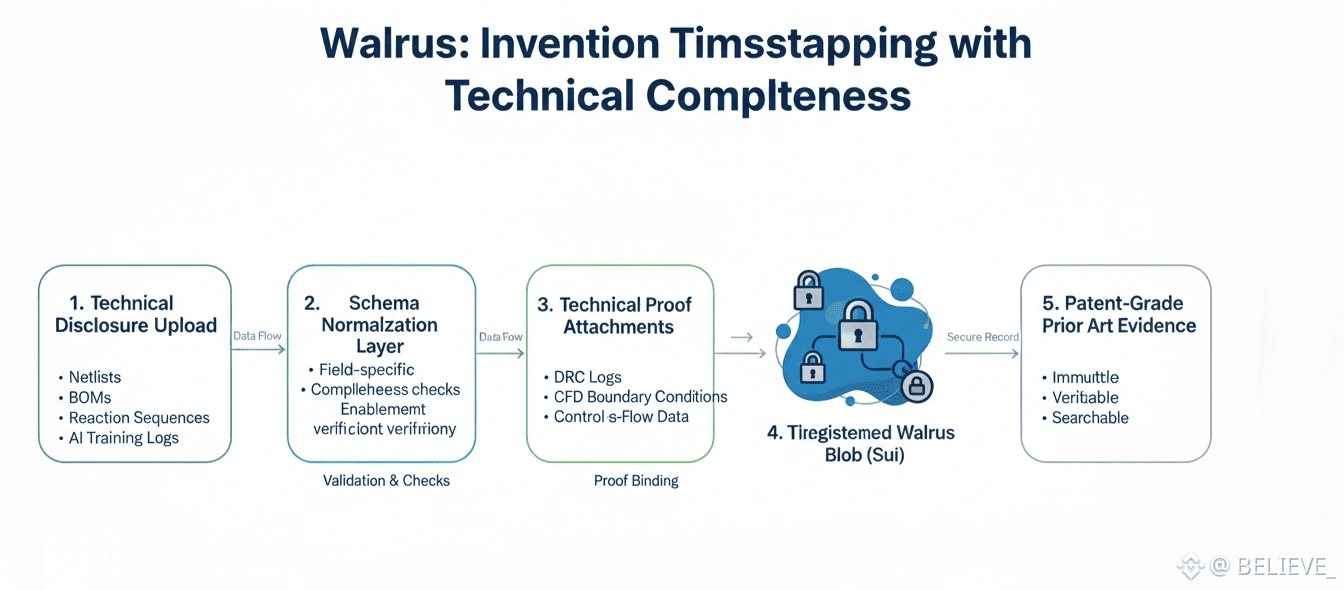
Invention Timestamping with Technical Completeness.
Walrus normalizes capture between fields that have extensible schema layers. Gate level netlists and DRC logs and power grid analysis are registered by circuit designers. Tolerance stackup studies are uploaded by mechanical engineers that are associated with GD&T callouts. State-machine diagrams and proofs of transition validity are time-stamped using proofs by software architects. Algorithms pass completeness, novelty wording, and enablement examples followed by demonstrating practice, before completing the blob as verifying that everything needed is there and prevents enablement failures later.
Technical illustrations have interactive drill-downs: part-to-part assemblies have access to fastener torque data. Boundary conditions assumptions are observed in the cross-sectional CFD simulations. Control-flow graphs indicate race-condition fixes. BOM versioning, which measures component replacement and its effects on performance, proves to be resilient to supply-chain variability. Chemical synthesis trees Plot stoichiometry and spectroscopic data of all intermediates, satisfying written description requirements of Markush support.
Harse Search Automation at Investigation Pace.
Walrus engines scour remotely all over patent offices in the world through APIs and unearths the same disclosures. EPO functional or claims are equivalent to USPTO apparatus equivalents, JPO utility model registrations indicate incremental Japanese innovations and CNIPA design patents display ornamental precedents. Semantic search is a type of NLP that integrates structural analysis, i.e. matching equations and formulations despite differences in notation.
Pre-Filing Marketplaces of Application in licensing.
Walrus markets are used to buy and sell invention rights in advance of publicity. An example is a lithium-metal dendrite drowning protection for which a price is 250k option, and perovskite solar-cell passivation is 1.2M exclusives. Filing activity increases prices- semiconductor node network where Samsung competes is priced three times higher; gene-editing vectors are surging in times of clinical trials. Technical merit is vetted by escrow agents considering independent reviews prior to the exercise of options to avoid baseless bids that can tie up capital of inventors.
The royalty waterfalls are used to pay on a development-to-development basis. The inventor-in-chief will receive 60 percent of the base plus 20 percent commercialization bonus. The material scientists receive royalty that is yield-based. Validation of milestone payments is done to test engineers. Migration of complementary portfolios through use of algorithms to match complementary portfolios, facilitates cross-licensing quantum error-correction components support superconducting qubits, wide-bandgap power electronics and SiC MOSFET-based drive circuits.
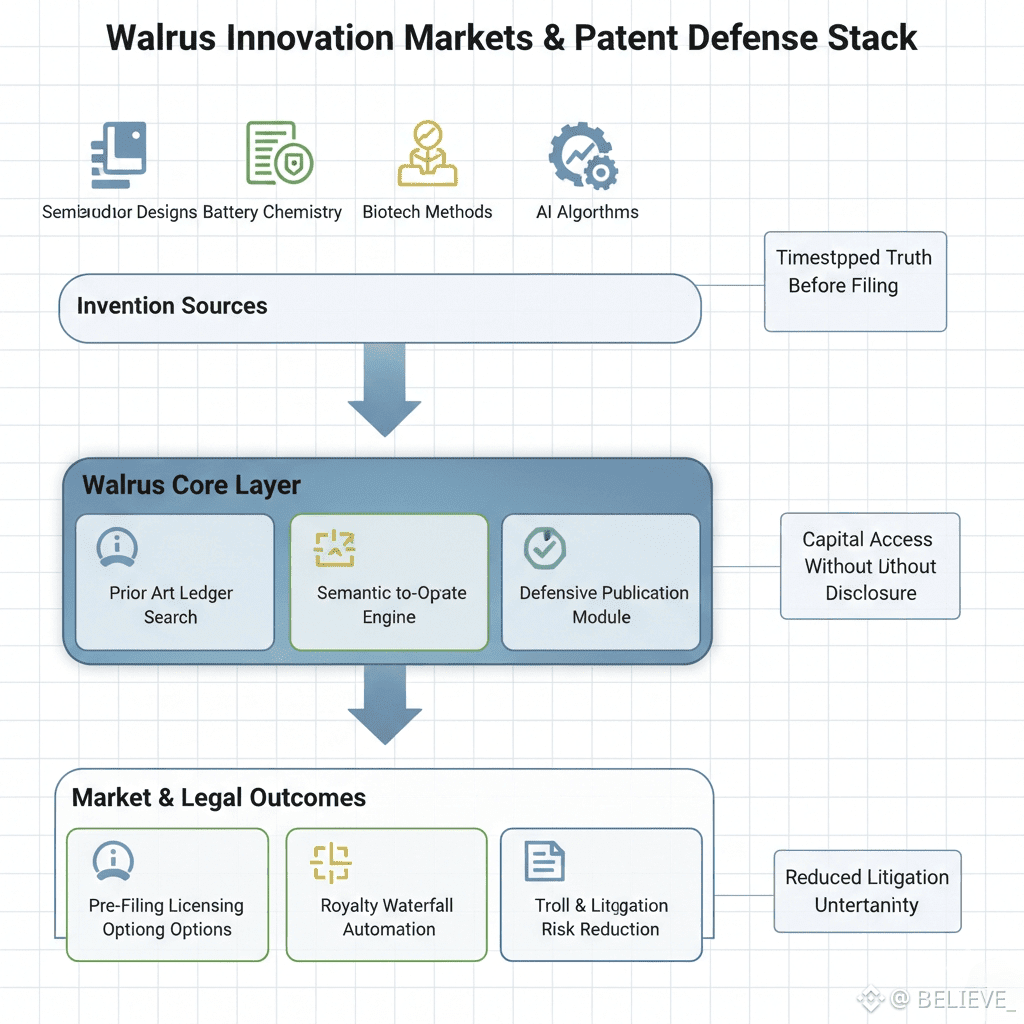
Analogy Acceleration of Freedom-to-Operate Analysis.
Walrus FTO platforms identify all assertions against global portfolios, detecting blocking patents via literal infringement mapping and identification design-around opportunities via element replacement. Risk scores are adjusted to weigh the claims based on the history of enforceability, venue of litigation and ownership of the NPEs. Suggestions of amendments by the automated processor are narrow and do not discriminate on commercial scope to prevent infringement.
The trends of landscape surveillance include clustering, 3D NAND companies are normalizing charge-trap designs; EV battery developers use silicon-graphene anodes. The white part of the egg is where identification of the white space is identified as unprotected routes, and dendrite blockers, but not SEI stabilizers, are patented with lithium-metal. Competitive intelligence takes continuation chains to identify stealth pivots ahead of public earnings.
Defensive Publication Strategies.
Walrus defensive publishing deluge the prior-art space with the finer details of disclosure--precise PLL jitter budgets nullifying the claims of oscillator, curves of memory-cell stability nullifying SRAM patents. Publication schedules are adjusted to overcome competition deadlines of 18 months. Constructive disclosure bounties: these prizes work on detailed submissions, such as USB-level predistortion linearizer and mmWave sequences of terms.
The community-managed claim blockers are used to suggest high-value papers that are to be expanded. A fusion geometries paper in academic plasma physics has branched out into a 50-page boundary condition engineering manual. Bulk filing makes use of trade associations to coordinate the disclosure of arsenals of patent trolls systematically, under coordinated disclosure waves.
Automation of Research in Technical Due Diligence.
Walrus diligence systems build out full histories of technology transfer- IP assignment chains in corporate records, inventorship in badge-swipe logs related to time of disclosure Walrus Diligence Systems. M&A closings do not necessitate costly reviews of the law facilitated by freedom- to- operate letters which are automatically generated based on claim charts. The valuation models utilise historical exit multiples of reports exited on blobs.
The Portfolio Optimization and Patent Quality Scoring.
Walrus quality engines evaluate given patents through analytics of prosecution-citation rates -claim fan-outs ratio, citation speed, attorney win-rates. It is proposed under portfolio optimization to forego low maintenance fees used on low worth maintenance, the filing of continuation on otherwise neglected claims, and the fixing of enablement gaps identified using blob cross-reference. The litigation risk emanates through the semantic similarity to litigated claims and venue trends.
Walrus infrastructure accelerates innovation processes and also shields against litigation. The absolute novelty is checked by means of timestamping. Searching saves time by automation. The pre-filing capital is liberated by licensing markets. Blockers of surprise are eliminated by FTO analysis. Trolls are foiled by defensive publishing. Due diligence fast tracks transactions. Portfolios are polished on quality scoring. Inventors have a safe-havens whereby technical truth goes through more quickly than legal formalities, enhancing the speed of innovation on all circuits, reactions and algorithms.

