

I first started thinking seriously confidential assets outside of crypto. It was during a routine discussion with a compliance officer at a traditional financial firm, where the frustration wasn’t about speed or innovation, but about data exposure. They weren’t asking for secrecy in the abstract. They wanted selective visibility: who can see what, when, and under which rules. That same tension shows up clearly when you look at how Dusk’s confidential asset model is designed, and why storage primitives like Walrus matter more than they first appear.
This is not about excitement or novelty. It’s about trade-offs.
Most blockchains were designed for transparency first. Every balance, every transfer, every interaction is visible by default. That works for open experimentation, but it breaks down quickly in regulated finance. Issuers don’t want their capitalization tables public. Investors don’t want their positions broadcast. Regulators, however, still need auditability.
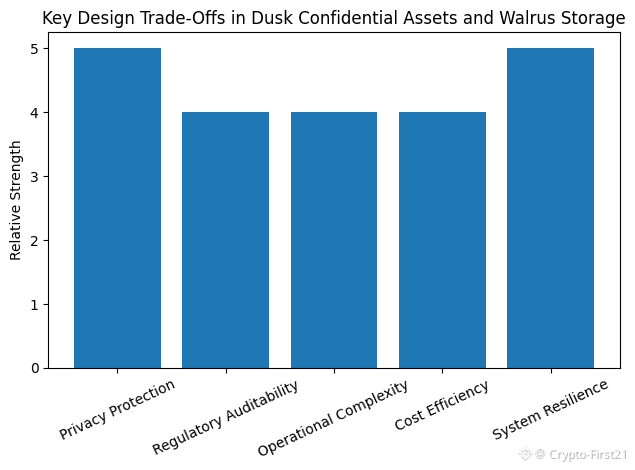
Dusk’s confidential asset model starts from this reality. It assumes that privacy and compliance are not enemies, but competing constraints that must be engineered together. Assets on Dusk are designed so that transaction details are hidden from the public, yet provable to authorized parties.
But assets are more than transactions. They rely on off-chain data: legal documents, issuer disclosures, identity attestations, and corporate actions. That data has to live somewhere. This is where Walrus enters the picture as a storage primitive. Walrus uses erasure coding instead of full replication. The cause-and-effect here is straightforward. Less duplication means lower storage cost and less data concentration.
Nothing here is free. Erasure coding adds complexity. Retrieval and repair require coordination. Metadata management becomes critical. From a systems perspective, Walrus trades operational simplicity for efficiency and privacy guarantees.
Dusk makes a similar trade-off at the asset layer. Confidential transactions require more computation and careful key management. Automation helps, but it increases the importance of reliable infrastructure. If storage or execution becomes unpredictable, the entire compliance model suffers.
For institutional users, predictability matters more than raw speed. A secondary market for tokenized securities does not need millisecond excitement. It needs consistent settlement, clear permissions, and auditable outcomes.
Both systems rely on incentives to function. Walrus nodes are rewarded for storing and serving data correctly over time. This discourages short-term behavior and supports long-lived records, which regulated assets require.
On Dusk, token mechanics support transaction execution, privacy proofs, and validator participation. The token is not about speculation in this context. It is a coordination tool that pays for compliance-aware infrastructure.
The risk, as always, is misalignment. If incentives reward volume without reliability, systems degrade. If they reward long-term service quality, confidence grows. This is where both designs show discipline. They assume adversarial behavior and plan for it.
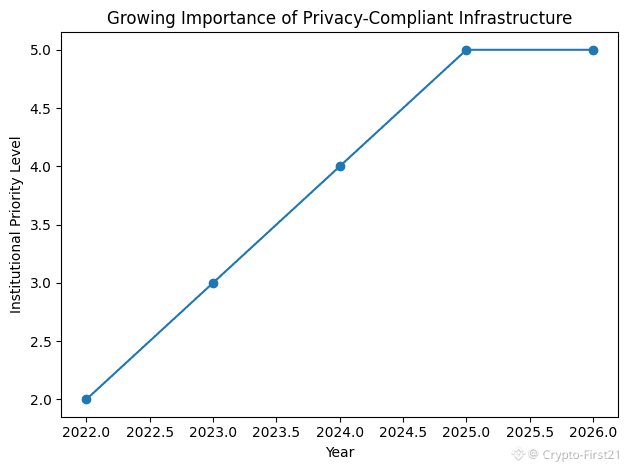
The broader market trend is clear. Tokenized assets are moving from pilots to early production. Secondary markets are the real test. Assets must trade repeatedly without leaking sensitive information or violating rules.
Dusk’s confidential model supports this by separating visibility from validity. Walrus supports it by making sure the supporting data layer does not become a bottleneck or a liability.
From an investor’s perspective, this matters because infrastructure risk is balance-sheet risk. From a regulator’s perspective, it matters because systems that cannot explain themselves under scrutiny eventually get shut down.
I tend to evaluate infrastructure by asking a simple question: does it still work when nobody is watching? Privacy systems fail quietly when incentives or assumptions are wrong. Storage systems fail loudly when data disappears.
The combination of Dusk’s confidential asset design and Walrus’s efficient storage model reflects a broader shift in crypto. Less emphasis on spectacle. More emphasis on durability, legality, and operational realism.
The takeaway is not that these systems are perfect. It’s that they are asking the right questions. Beyond speculation, projects like this matter because financial markets run on trust in infrastructure. And trust, once lost, is far harder to rebuild than it is to design carefully from the start.
