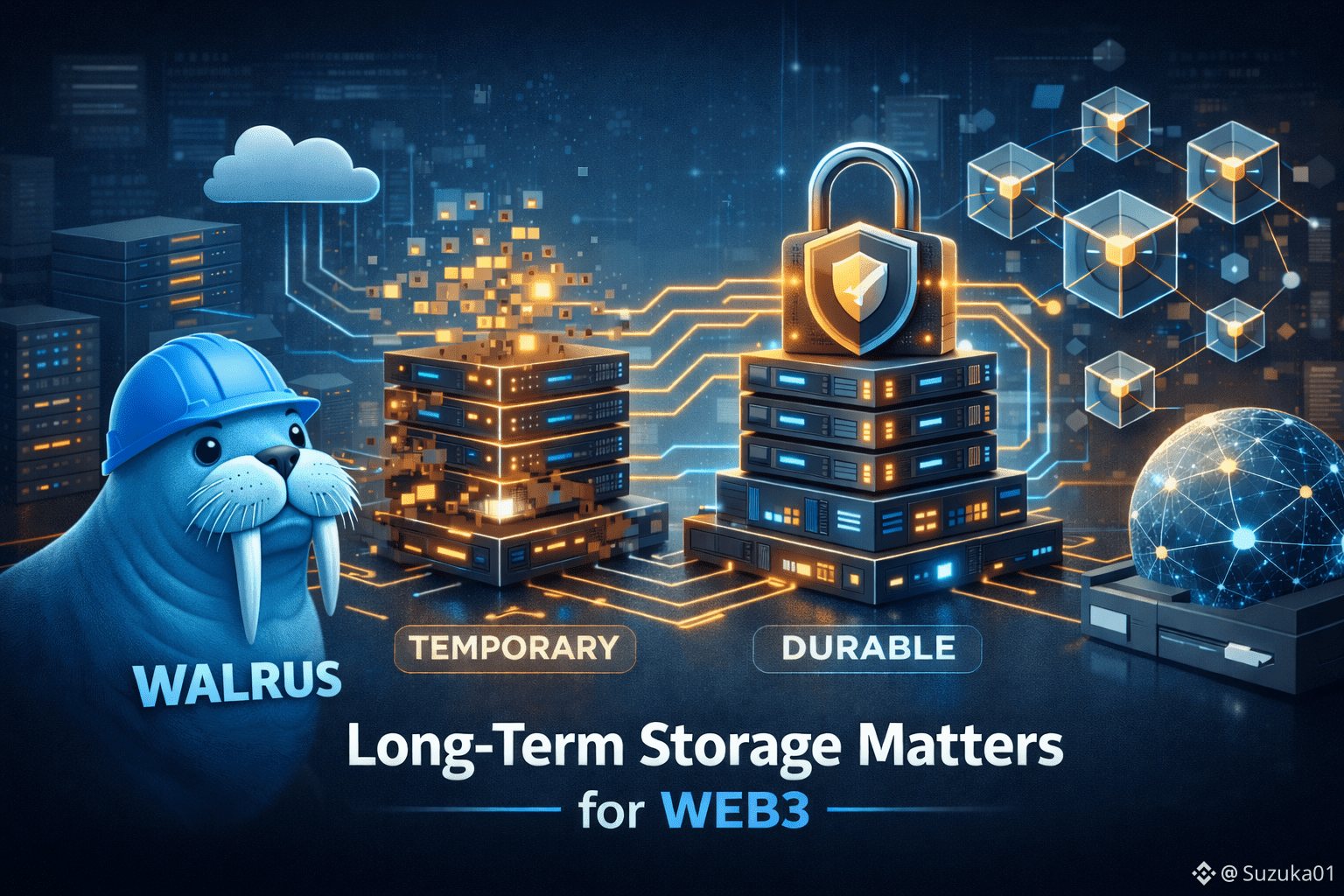
Many Web3 applications rely on storage systems designed for short-term availability rather than long-term durability. This approach may work during early development, but it creates serious risks once applications move into sustained, real-world usage. Data that disappears, degrades, or becomes inconsistent over time directly undermines application reliability.
@Walrus 🦭/acc is built around the idea that storage should be treated as permanent infrastructure, not temporary state. Real applications depend on historical data, user-generated content, and application state that cannot be easily replaced. When storage systems assume data is disposable, failures during upgrades, network changes, or scaling events can lead to irreversible loss.
Unlike temporary storage models, Walrus is designed for long-lived data retention. Storage remains reliable across extended periods, supporting applications that require continuous access rather than short testing cycles. This makes Walrus suitable for production environments where data persistence is a core requirement, not an optional feature.
As Web3 applications grow, storage usage becomes constant rather than intermittent. Walrus maintains durability even as access patterns change and usage scales, reducing operational risk and complexity for developers. Applications do not need to redesign storage logic as they move from early stages to full production.
Durable storage is a foundation for real Web3 adoption. By focusing on sustained reliability instead of temporary availability, Walrus provides infrastructure that applications can trust over time, supporting long-term growth and stable production deployment.