
Every blockchain claims to be scalable. Very few confront what scalability really breaks first: data availability. On Sui, where applications are fast, object-based, and increasingly data-heavy, storage is not a side concern — it is the limiting factor. This is where @Walrus 🦭/acc , $WAL, and #walrus become structurally important.
Walrus exists because Sui applications need more than execution speed. They need data that stays available under real network conditions.
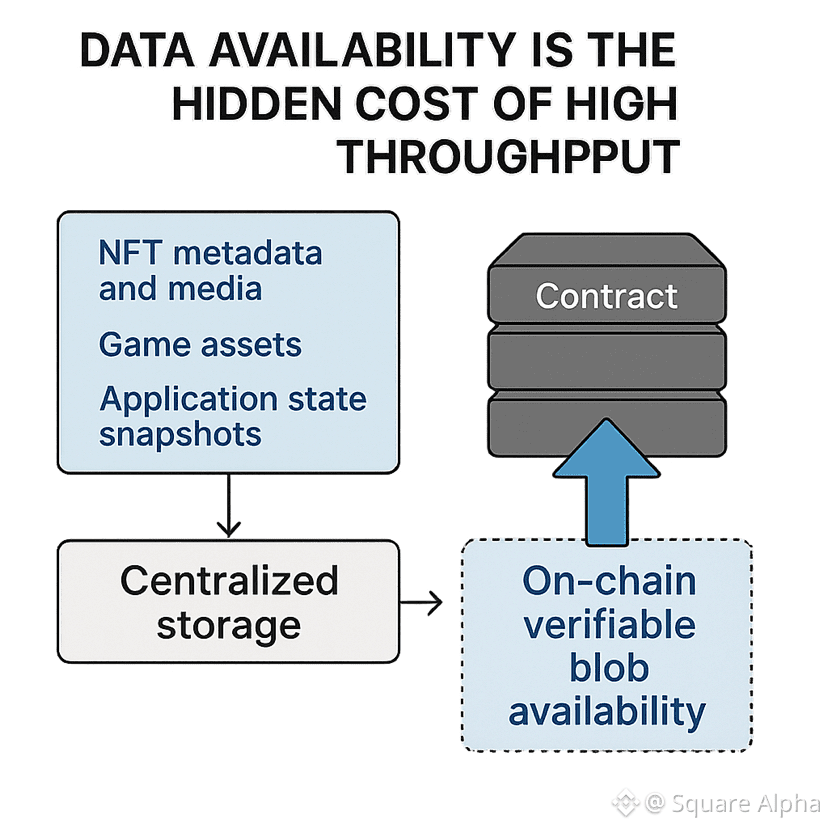
Data Availability Is the Hidden Cost of High Throughput
High-throughput chains like Sui generate large volumes of off-chain data:
NFT metadata and media
game assets
application state snapshots
AI and analytics datasets
If this data lives on centralized infrastructure, decentralization stops at the contract layer. Walrus directly addresses this by providing on-chain verifiable blob availability, purpose-built for Sui’s execution model.
This is not generic storage. It is availability with accountability.
How Walrus Operates on Mainnet Today
Walrus mainnet is already coordinating:
distributed blob storage across validators
erasure-coded data to survive node churn
continuous availability enforcement rather than static guarantees
When nodes leave, data does not vanish. When demand spikes, availability rules still apply. This is exactly the scenario storage networks fail in — and the scenario Walrus is designed for.
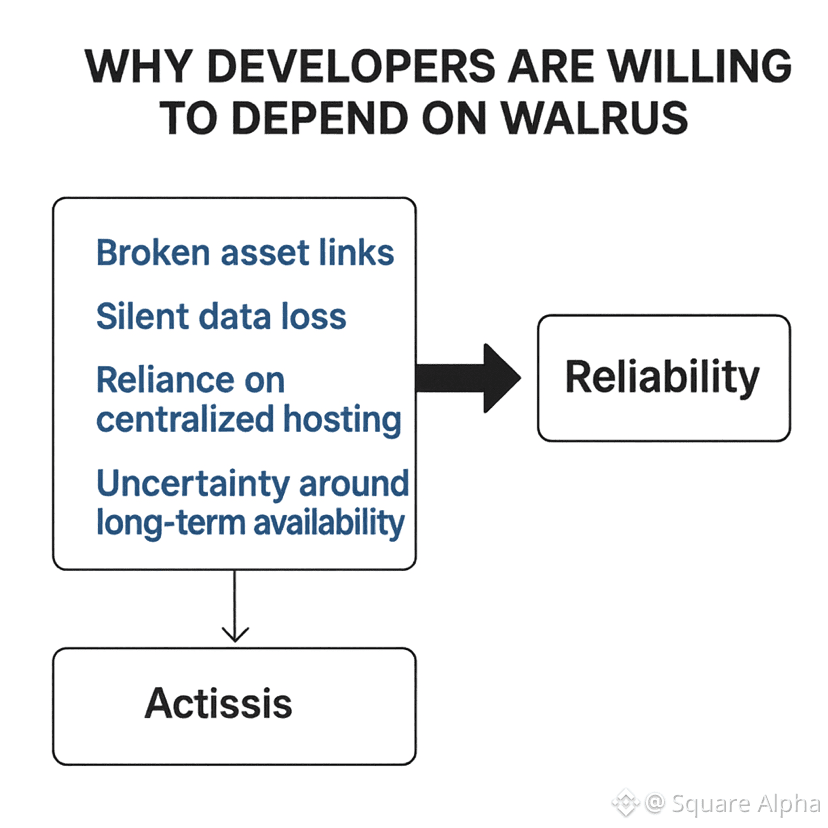
Why Developers Are Willing to Depend on Walrus
Developers adopt infrastructure when it removes failure modes, not when it sounds innovative.
Walrus removes:
broken asset links
silent data loss
reliance on centralized hosting
uncertainty around long-term availability
For Sui developers building live products, this reliability matters more than cost optimization. Once an application depends on Walrus, switching away introduces real risk.
That is how infrastructure locks in organically.
WAL Is Actively Maintaining Network Stability
The relevance of $WAL is operational, not speculative.
Today, WAL:
incentivizes storage providers to remain active
secures validator participation
aligns rewards with long-term availability
supports governance for protocol upgrades
This keeps Walrus functional as usage grows. Storage without persistent incentives decays. WAL exists to prevent that decay.
Walrus and Decentralization Done Correctly
Decentralization without accountability leads to fragility. Walrus avoids this by making custody explicit and enforceable. Responsibilities are not abstract — they are encoded.
If guarantees fail:
consequences trigger automatically
incentives rebalance
availability logic adapts
This makes Walrus predictable under stress, which is rare in decentralized storage.
Where Walrus Is Headed Next
As Sui adoption increases, the need for dependable data layers grows with it. Walrus is positioned to become:
a default storage backend for Sui apps
a critical dependency for data-heavy use cases
a foundation for future cross-ecosystem data availability
This is not a growth story driven by hype. It is driven by necessity.
Final Take
Walrus is not building optional infrastructure.
It is addressing a problem Sui applications cannot ignore.
With mainnet live, active usage, and $WAL enforcing real network behavior, Walrus is becoming part of the Sui stack itself — not an add-on.
That is relevance the market eventually catches up to.


