Most blockchains were not designed to support financial markets. They were built to move tokens, automate agreements, or enable open experimentation. Over time, financial use cases were added on top. But adding finance on top of infrastructure that was never meant for it creates structural limits.
Dusk Network starts from a different assumption: regulated financial markets are not an extension of crypto — they are a completely different design problem.
Instead of optimizing for maximum openness, speculative velocity, or application diversity, Dusk focuses on what real markets require: confidentiality, compliance, identity, predictable execution, and institutional-grade settlement.
This difference in starting point defines everything about its architecture.
The problem Dusk is addressing
Traditional financial markets operate on private infrastructures where identities are known, transactions are confidential, and rules are embedded directly into the system. Regulation is not external; it is structural.
Public blockchains invert this logic. They expose all activity, separate identity from execution, and rely on applications to enforce rules. This works for open networks, but breaks down when applied to capital markets, asset issuance, or regulated trading.
In these environments, transparency can become a vulnerability. Front-running, balance exposure, compliance conflicts, and data leakage are not side issues — they are system-level risks.
Dusk is built around the idea that financial markets require selective visibility, not radical transparency.
This is not about hiding information. It is about controlling who is allowed to see what, and under which conditions.
A blockchain designed as financial infrastructure
Dusk positions itself not as an application platform, but as a financial network.
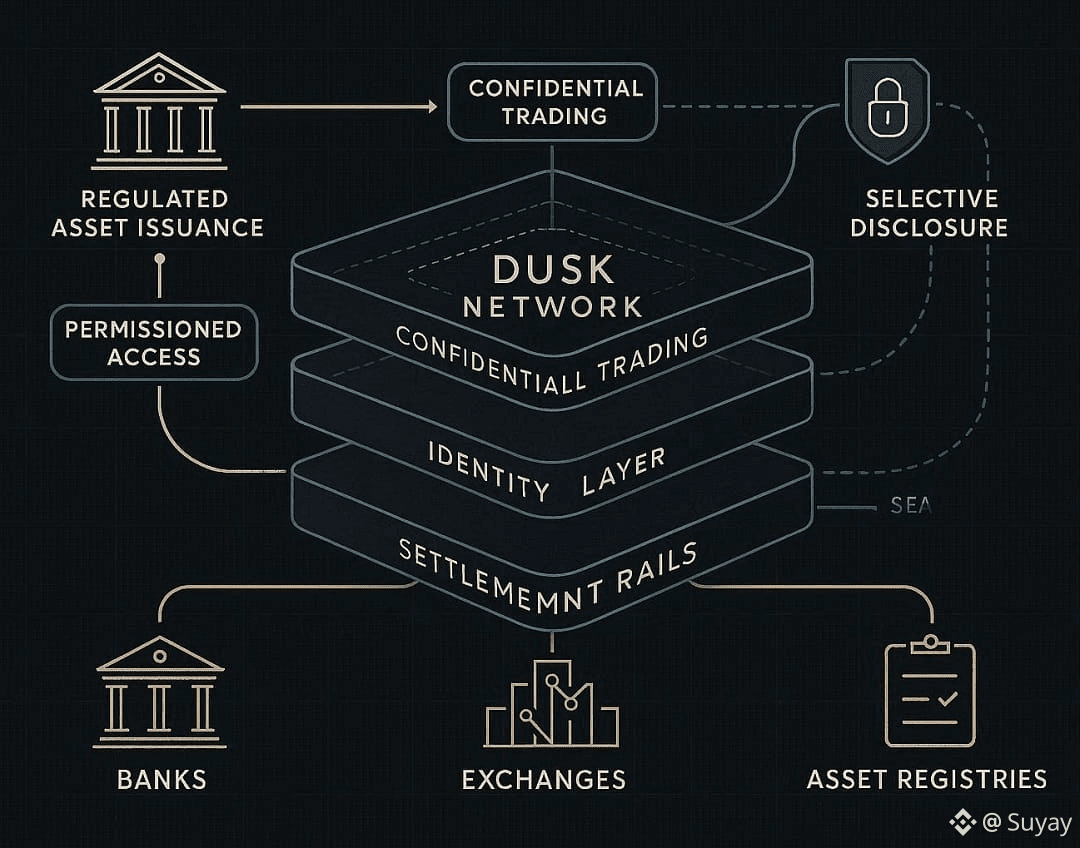
Its architecture is designed to support the full lifecycle of regulated assets: issuance, distribution, trading, corporate actions, and settlement. This means that the protocol itself must handle confidentiality, permissioning, and regulatory constraints — instead of outsourcing them to fragmented applications.
From the start, Dusk integrates programmable privacy, identity primitives, and compliance logic into its base layers. This allows financial workflows to be expressed directly at protocol level.
The result is a system where:
Assets can remain confidential.
Participants can prove eligibility without exposing identity.
Rules can be enforced without revealing internal market data.
Regulators can audit without breaking privacy.
This design mirrors how financial infrastructure works in the real world — but with cryptographic guarantees instead of centralized trust.
Why this approach is fundamentally different
Most blockchains treat regulation as an obstacle. Dusk treats it as a design constraint.
This shifts the development logic entirely. Instead of asking “how do we add compliance later?”, the question becomes “how do we embed compliance into the system without destroying market dynamics?”
By building around this principle, Dusk avoids the structural compromises that appear when financial systems are forced onto open-ledger architectures.
This is why Dusk is often closer to financial market infrastructure than to DeFi platforms. Its role is not to host experimental applications, but to provide the rails on which regulated digital finance can operate.
In this sense, Dusk is less comparable to an app ecosystem, and more comparable to the backend layers that power exchanges, settlement systems, and asset registries.
Why this matters
Tokenization, digital securities, and on-chain capital markets will not scale on infrastructures that leak information, ignore legal constraints, or lack identity frameworks.
The next phase of blockchain adoption is not driven by retail speculation. It is driven by institutions, issuers, and financial operators seeking programmable infrastructure that can coexist with existing regulatory systems.
Dusk is designed precisely for that transition.
By building confidentiality, compliance, and financial logic into the protocol itself, Dusk positions blockchain not as a parallel financial universe — but as a direct extension of real-world markets.
That distinction will define which networks are able to move from crypto experimentation into actual financial adoption.
🎯 Why this matters (core takeaway)
Dusk is not trying to adapt crypto to finance.
It is rebuilding financial infrastructure using cryptography.