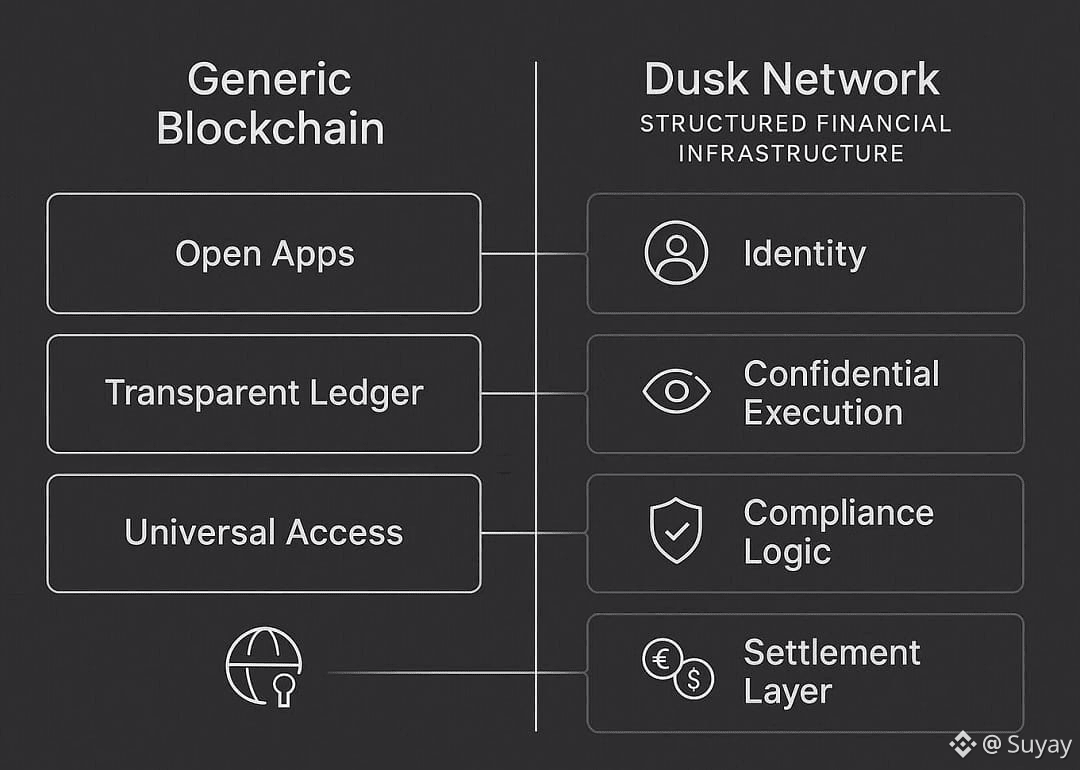
In crypto, the term “Layer 1” usually refers to a general-purpose blockchain: a base network designed to host applications, move tokens, and support a wide range of use cases. Over time, this concept has become associated with scalability battles, DeFi ecosystems, and developer adoption metrics.
Dusk does not fit cleanly into this category.
While it is technically a Layer 1, its design logic, priorities, and architecture are fundamentally different. Dusk was not created to maximize application diversity or user throughput. It was created to serve as financial infrastructure.
This distinction reshapes everything: what the protocol optimizes for, how its components are structured, and what kind of economic and technical behavior it supports.
Different starting assumptions
Typical Layer 1 blockchains start from an open-world assumption: anyone can participate, everything is transparent, and rules are mostly enforced at the application layer.
Dusk starts from a financial-world assumption: markets operate with identities, confidentiality, and embedded rules. Access is contextual, not absolute. Information is selectively disclosed. Compliance is structural, not optional.
Instead of asking how finance can be adapted to crypto primitives, Dusk asks how cryptography can be adapted to financial realities.
This leads to a very different design path. Rather than focusing on generic execution and universal composability, Dusk focuses on primitives such as programmable privacy, identity integration, transaction confidentiality, and protocol-level compliance tooling.
These are not extensions. They are foundations.
A purpose-built architecture
Most Layer 1s are built as single execution environments with standardized transaction models. Financial functionality is later recreated through smart contracts and external tooling.
Dusk takes the opposite approach. Its architecture is modular and financial-first.
Core components are designed around specific roles: secure execution, confidential state handling, identity support, and regulated asset flows. Instead of one monolithic stack, Dusk evolves as a multilayer system, where responsibilities are separated to protect market integrity.
This multilayer approach is not about scalability theater. It is about isolating critical financial functions so they can be controlled, audited, and evolved without destabilizing the entire network.
In financial systems, architecture is risk management. Dusk reflects this reality at protocol level.
Why financial blockchains cannot behave like app platforms
In open application platforms, transparency is a feature. In financial markets, uncontrolled transparency is often a failure.
Order exposure, balance visibility, transaction traceability, and unrestricted composability can create front-running, liquidity extraction, regulatory violations, and systemic instability.
A financial blockchain must therefore support:
Confidential transaction logic.
Restricted interaction models.
Verifiable identity frameworks.
Selective auditability.
Enforceable asset rules.
These requirements conflict directly with the assumptions behind most Layer 1 ecosystems.
Dusk does not attempt to resolve this tension at the application layer. It resolves it at the protocol layer.
This is why it does not compete in the same category as chains designed for consumer dApps, NFTs, or speculative DeFi. Its target environment is closer to exchanges, registries, issuance platforms, and settlement systems.
Values that shape the protocol
Dusk’s core values revolve around real-world viability: regulatory alignment, market integrity, long-term sustainability, and technical rigor.
This leads to design choices that are often invisible in hype-driven ecosystems, but decisive in financial infrastructure:
Preference for controlled complexity over maximal openness.
Emphasis on auditability and determinism.
Focus on economic stability instead of yield mechanics.
Long-term protocol evolution over short-term growth metrics.
These values explain why Dusk evolves as a system, not as a product. And why its progress is measured in capabilities rather than narratives.
Why this matters
The next wave of blockchain adoption will not be driven by who hosts the most apps. It will be driven by which networks can support real financial operations under real legal, economic, and institutional constraints.
A typical Layer 1 optimizes for participation.
A financial Layer 1 must optimize for trust.
Dusk is not trying to be everything to everyone. It is trying to be correct, reliable, and compatible with the systems that already move global capital.
That focus makes it fundamentally different from the Layer 1 category it is often placed into.
🎯 Why this matters (core takeaway)
Dusk is not a general-purpose Layer 1 with financial features.
It is a financial network that happens to be a Layer 1.