When people talk about decentralization, they often focus on tokens, trading, or smart contracts, but almost no one talks about where the actual data lives, even though data is what gives most applications their real value.
Images behind NFTs, videos inside platforms, datasets used by AI, game assets, and application state usually sit on traditional cloud servers, quietly reintroducing central points of failure.
Walrus Protocol exists because this contradiction cannot last if Web3 is meant to grow into something real.
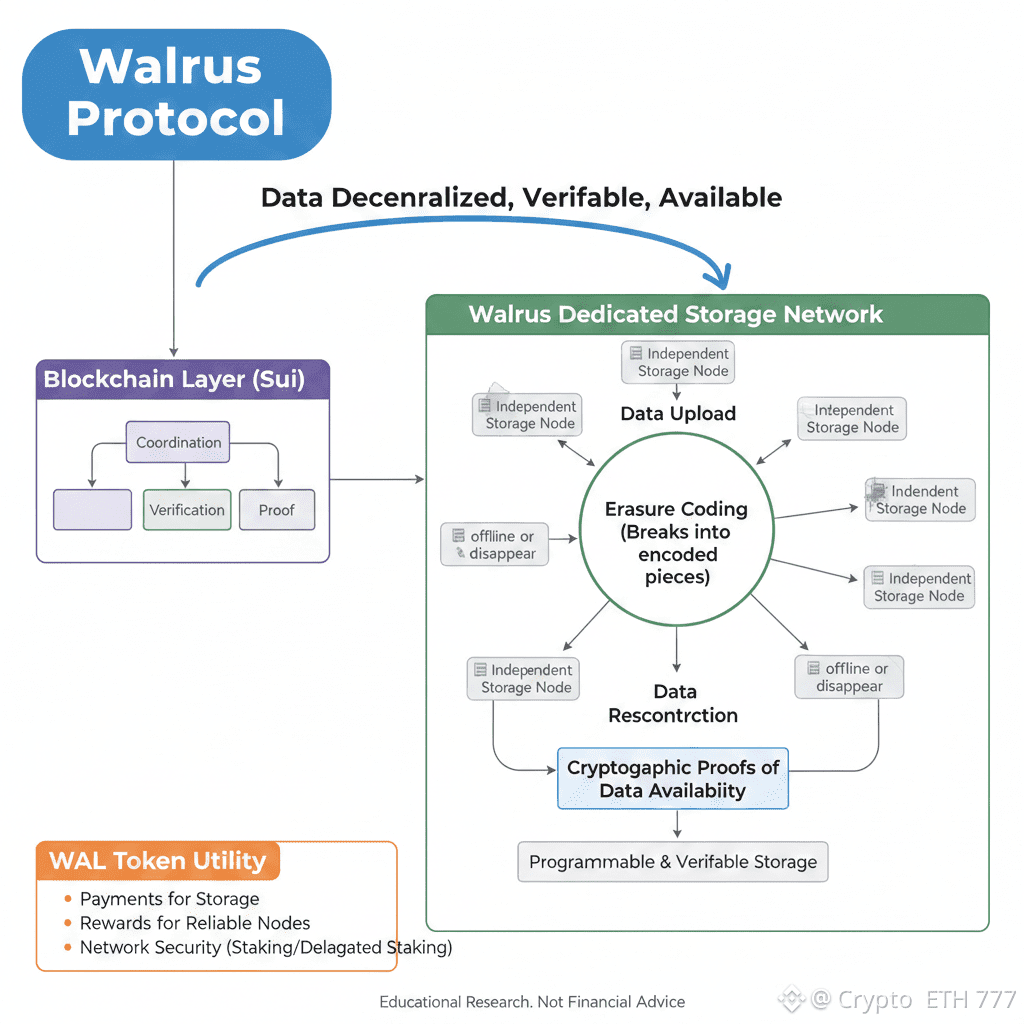
Walrus is built around a simple but difficult idea: data should be decentralized, verifiable, and available over time without relying on a single company or server.
Instead of forcing large files onto a blockchain that was never designed to store them, Walrus separates responsibilities in a practical way.
The blockchain layer, Sui, is used for coordination, verification, and proof, while Walrus itself handles the heavy data through a dedicated storage network.
This separation allows each layer to do what it is best at, resulting in a system that is more scalable and more honest about real-world constraints.
When data is uploaded to Walrus, it is not simply copied and stored in full across many machines.
That approach would be expensive and inefficient.
Instead, the data is broken into encoded pieces using erasure coding and distributed across independent storage nodes.
Even if some nodes go offline or disappear, the original data can still be reconstructed.
This design accepts the reality that decentralized networks are dynamic and imperfect, and it is built to remain reliable despite that.
A key feature of Walrus is that it does not just store data, it produces cryptographic proof that the data is actually available.
These proofs can be referenced on Sui, allowing applications and systems to verify storage instead of trusting a promise.
This changes how developers can think about storage, turning it into something programmable and verifiable rather than assumed.
The native token, WAL, plays a natural role in this design by powering payments for storage, rewarding nodes that behave reliably, and securing the network through staking.
Through delegated staking, users can support storage providers without running hardware themselves, aligning incentives toward long-term availability instead of short-term behavior.
This matters because storage is invisible when it works and catastrophic when it fails.
When files disappear, metadata breaks, or assets become unreachable, narratives stop mattering.
Walrus is designed for that unglamorous reality, aiming to be infrastructure that simply works in the background.
As Web3 applications evolve, they are becoming heavier rather than lighter.
AI systems require large datasets and models, games require persistent worlds, and media platforms require reliable access to content.
These needs already exist, and they will only grow.
Walrus positions itself as infrastructure for this phase of growth, where decentralization must function under real load rather than theoretical conditions.
Its epoch-based design allows storage responsibilities to adapt over time as nodes join or leave, ensuring that data remains accessible even as the network changes. Walrus is not built as a quick trend or a speculative experiment. It is infrastructure, and infrastructure grows quietly.
The underlying bet is straightforward: if decentralized applications are going to matter in the real world, their data must be as decentralized as their logic. Relying on centralized storage while claiming decentralization is only a temporary compromise.
Walrus is an attempt to close that gap with a design that respects how systems behave in reality.
Whether it succeeds will depend on execution and adoption, but the problem it addresses is fundamental and not going away.
Not financial advice.
This is educational research, not a recommendation to buy, sell, or hold any asset.