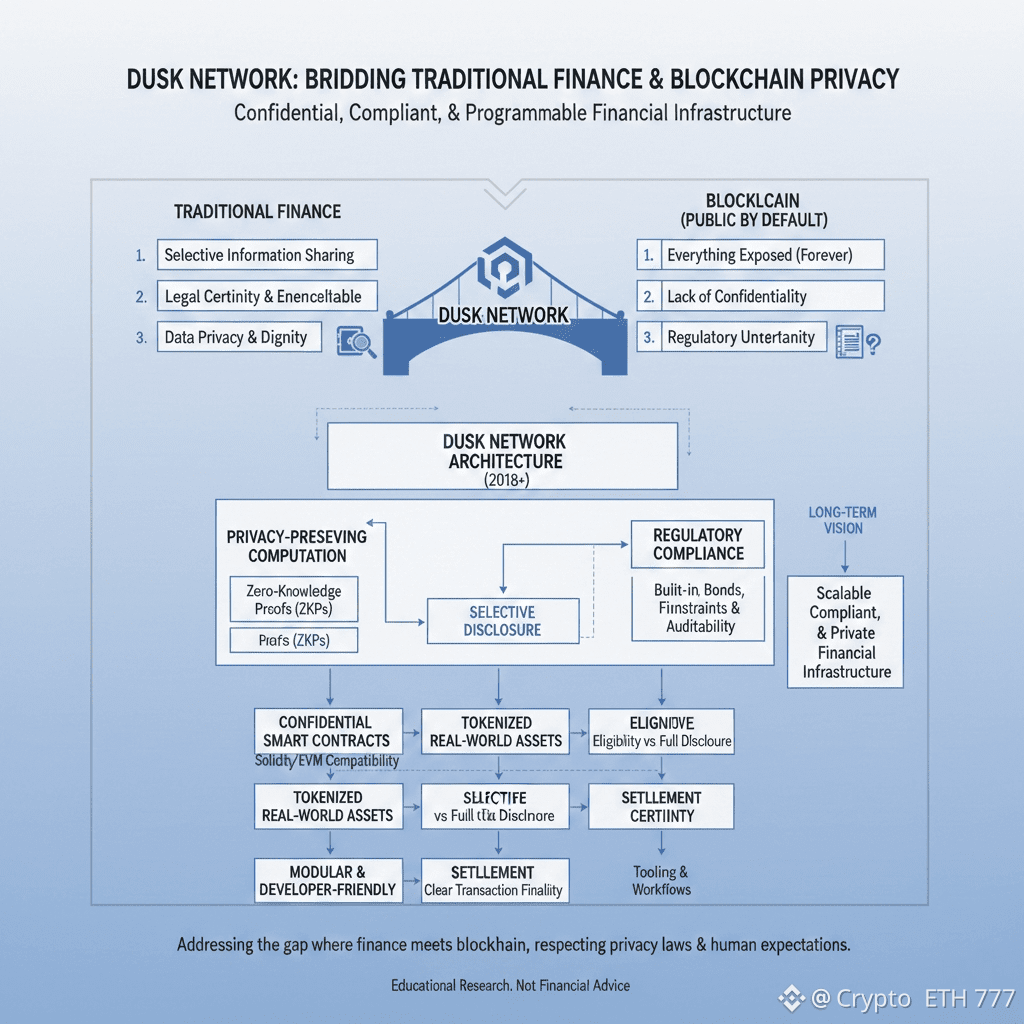
When people talk about blockchain and finance, there is usually a big gap between how things sound in theory and how they work in real life.
Public ledgers feel elegant and fair on paper, but finance does not function well when every transaction, position, and relationship is exposed forever.
Businesses need confidentiality, institutions need legal certainty, and users need dignity and protection of their data.
This is the space where Dusk Network entered in 2018, not to chase trends, but to solve a problem most blockchains avoid because it is difficult.
From the very beginning, Dusk was not designed as a general-purpose chain trying to appeal to everyone.
It focused on a narrow but important question: how can real financial value move on-chain in a way that respects privacy laws, regulatory requirements, and human expectations at the same time.
Instead of treating regulation as an obstacle, Dusk treated it as a constraint that must be built into the system itself.
That single design choice shaped the entire architecture and long-term vision of the network.
In traditional finance, information is shared selectively.
Not everyone sees everything, but the system still remains verifiable and enforceable.
Blockchain usually does the opposite by making everything public by default.
Dusk tries to bring these two worlds closer together. Its idea of privacy is not about hiding activity from everyone, but about showing only what is necessary, only to the parties who are authorized to see it.
In this model, privacy becomes a tool for relevance rather than secrecy.
This approach becomes critical once you move beyond simple tokens and start dealing with real assets.
Tokenizing something like a regulated share, bond, or financial instrument is not just a technical task.
These assets come with rules about who can hold them, how they can be transferred, what disclosures are required, and how compliance is enforced.
Dusk was designed with these realities in mind, aiming to support assets that behave like real financial products instead of simplified crypto abstractions.
A common misconception is that privacy and auditability cannot coexist. In reality, they can, if the system is designed correctly. Regulators do not need to see everything all the time.
They need the ability to verify that rules were followed when it matters.
Dusk’s philosophy is that compliance should be provable without forcing users or institutions to expose unnecessary data.
This balance is difficult, but it is essential if blockchain is ever going to support real financial infrastructure at scale.
Identity is another area where most systems struggle. Many compliant platforms either collect excessive personal data or block access entirely.
Dusk leans toward selective proof, where a user can demonstrate that they meet certain requirements without revealing their full identity or financial history.
This mirrors how compliance works in the real world, where you prove eligibility rather than surrender your entire private life.
From a network design perspective, Dusk places strong emphasis on settlement certainty.
Financial markets depend on clear finality.
A transaction must be definitively settled, not just likely settled.
This focus influences how the network approaches consensus and execution, prioritizing clarity and reliability over speculative performance metrics that matter less in regulated environments.
Developer experience is treated as a practical necessity rather than an afterthought.
Privacy technology has little value if developers cannot realistically build and deploy applications on top of it.
Over time, Dusk has focused on execution environments, tooling, and workflows that make confidential smart contracts feasible to develop, test, and maintain.
This kind of infrastructure work is slow and often invisible, but it is what determines whether a platform can grow beyond its core team.
As the network progressed toward mainnet, the conversation shifted from ideas to execution.
Opening the platform to third-party smart contracts marked an important transition.
For a chain targeting financial infrastructure, openness matters, but it must exist alongside guardrails.
Too much restriction creates a closed system, while too little structure makes regulated use impossible.
Dusk aims to operate in the narrow space between those extremes.
In more recent development, the focus on modularity and EVM accessibility has made the strategy clearer.
Most developers already understand EVM tools and workflows.
By moving toward compatibility without abandoning its privacy-first design, Dusk lowers the barrier for builders while preserving what makes the network different.
The goal is not familiarity for its own sake, but practicality, allowing developers to build with tools they know while gaining capabilities they normally do not have.
This path is not designed for quick hype or easy narratives.
It is slower, more complex, and more demanding than launching a typical blockchain.
But it addresses a real gap in the ecosystem.
Many chains optimize for speculation.
Very few are built to handle regulated value transfer while respecting user privacy.
Dusk is betting that long-term relevance will come from solving real constraints instead of avoiding them.
There are no guarantees.
Privacy-preserving computation is hard to scale, regulatory integration is slow, and adoption always takes time.
But what sets Dusk apart is consistency.
The project has stayed focused on its original problem through multiple market cycles, choosing depth over noise.
If blockchain is going to matter beyond trading tokens, it will need infrastructure that understands how finance actually works. Dusk is an attempt to build that infrastructure in a way that is realistic, respectful, and durable.
Not financial advice.
This is educational research and explanation, not a recommendation to buy, sell, or hold any asset.